
Proud India lands spacecraft on the moon, becoming the fourth country to do so
By Tata
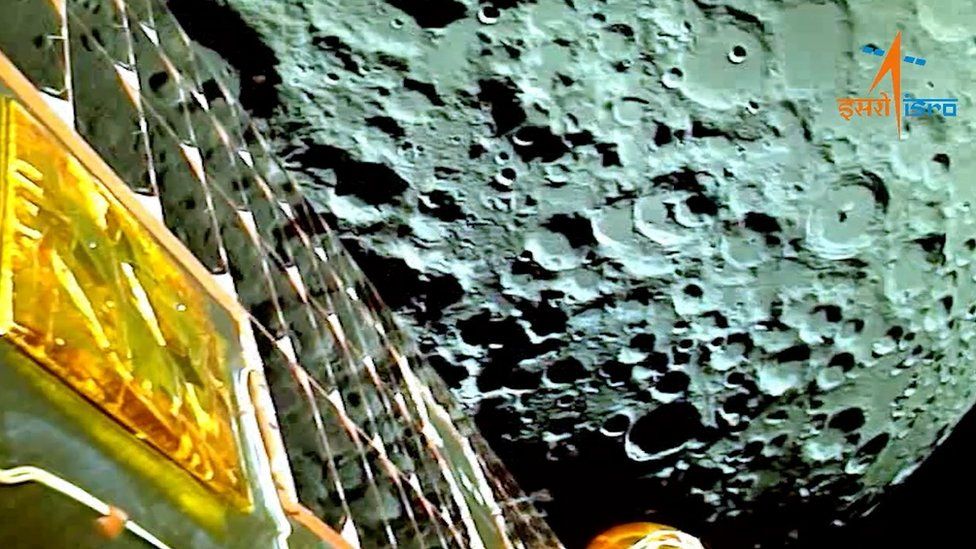
India’s Chandrayaan-3 spacecraft, Wednesday, landed on the moon, making it the fourth country to achieve the feat in history and the second in the 21st century.
More than 500 people gathered inside an auditorium at the country’s Council of Scientific and Industrial Research in New Delhi to watch the live-streaming of the historic landing.
“We have achieved a soft landing on the moon,” ISRO’s chairman S. Somanath, said while announcing the mission’s success. “India is on the moon.”
The room erupted in applause that lasted for over a minute following the announcement. Throughout the country, about 70 million people watched the live streaming of the historic moment. The cameras attached to Chandrayaan-3 captured beautiful pictures of the moon, showing its dusty grey terrain.
Prime Minister Narendra Modi, who is far away in South Africa for the BRICS summit, was full of excitement after virtually watching the historical moment.
“India’s successful moon mission is not just India’s alone,” Mr Modi said after the livestream. “This success belongs to all of humanity, and it will help moon missions by other countries in the future.”
A step closer to the waters of the moon
Chandrayaan-3 land was the first spacecraft in history to land on the moon’s south pole. This region is said to house water ice deposits, making it an area of interest to the US and other spacefaring nations.
In 2008, India launched the Chandrayaan-1, equipped to find the presence of solid ice on the moon. Although the mission failed, the spacecraft collected information showing solid ice on the moon’s surface.
“Learning more about this ice, how it got there, and how it interacts with the larger lunar environment will be a key mission focus for NASA and commercial partners as we endeavour to return to and explore our closest neighbour, the Moon,” NASA stated in 2018.
The success of Chandrayaan-3 could significantly help in learning more about the water ice on the moon’s surface.
The success was a result of two failed missions.
The mission is called Chandrayaan-3 for a reason. It was India’s third attempt to land a spacecraft on the moon. The first attempt, Chandrayaan-1, was launched in 2008, but radio contact was lost with the spacecraft, causing the mission to fail.
In 2019, the Asian country tried again. This time contact was lost just before the landing of Chandrayaan-2. With two failed missions, enough lessons were learned to make the third mission successful.
The four successful countries
Before now, the United States, the former Soviet Union, and China were the only countries that had successfully landed spacecraft on the moon. China was the only country to achieve the feat in the 21st century until India joined the list on Wednesday.
Several countries, including Russia, Israel, and Japan recently attempted to join the list, but their missions were unsuccessful. But China seems to have mastered the game after recently sending three spacecraft to the moon. The United States is seeing how it could send astronauts to the moon as early as 2025 while other nations, while other nations, including Israel, Japan, and Russia, attempt to join the list of countries to catch a glimpse of the moon.

This story was first published by Antigua News on : antigua.news/2023/08/25/proud-india-lands-spacecraft-on-the-moon-becoming-the-fourth-country-to-do-so. © 2023 Antigua News. Republication without permission is not allowed.
Read our editorial standards and corrections policy. Spotted an error? Contact the newsroom.
More from Culture, Science and Tech
View section
VIDEO: As School Reopens, Simon Bolivar Pre-School’s Garden serves as a Model for teaching Agriculture in Early Childhood
By Editorial Staff

CUB Hells Gate Crowned 2026 Panorama Champions After Electrifying Carnival Showdown
By Cory Wayland

Five Female Chefs Wow Diners With Multi-Course Dinner at Hodges Bay Resort
By Shermain Bique-Charles

North Europe and the Arctic 2026: The Race for Power, Resources and New Trade Routes
By Dario Item
Comments
Be the first to comment.