



















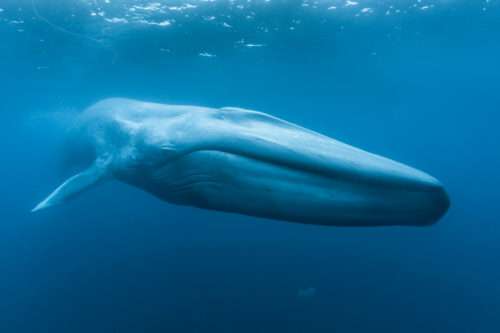
Blue whales return to Seychelles 50 years after being wiped out
Over half a century after being wiped out of existence in a particular area of the Indian Ocean, a population of blue whales have seemingly returned.
Back in the sixties Soviet whalers decimated the species near the island nation of the Seychelles, and nothing had been seen of them in the seas around that location until recently.
Approximately 154,000 square miles of water surrounding the country’s islands are now protected thanks to deal known as a “debt for climate” swap, where a national debt – in this case £16.8m ($22m) – is paid off in return for protection being put in place to take greater care of its ocean.
Scientists are now reporting that the largest animals on earth have found their way back, at least for part of the year, after taking underwater audio recordings which have captured the creatures distinct songs.
They are now trying to understand the importance of the findings and are excited at the possibility that the sounds are being made my male blue whales, indicating that the area could be being used for breeding.
Soviets whalers responsible
Similar to many of the whale species around the oceans, the blue whale populations were severely depleted throughout the 20th century. In was during the 1960’s that a fleet of whalers from the Soviet Union killed an estimated 500 blue whales, very near to the Seychelles, which in essence had the effect of removing the existence of the animal from that particular location.
Sound trap uncovers exciting find
Now, 50 years on, global conservation efforts, coupled with whaling bans, have allowed the numbers of blue whales to steadily climb, worldwide.
Nevertheless, the sightings in the Indian Ocean around the area in question were initially treated with some scepticism, but a team of researchers and film makers did capture some footage which then led to the setting up of a “sound trap” on the ocean floor, complete with recording devices, microphones and batteries.
The equipment recorded sounds for 15 minutes of every hour, every day, for an entire year.

Breeding possibilities
Upon reviewing their findings they discovered the blue whales’ signature song, which are of such a low frequency they simply cannot be heard by the human ear.
These songs were observed from December to April, and were believed to have come primarily from males, prompting the belief that they could be using the area for breeding purposes.
Lead author excited by discovery
Kate Stafford, a professor at Oregon State University’s Marine Mammal Institute and a lead author on the study, remarked: “It turns out if you stop killing animals on mass scales and you give them a chance to rebound, they can recover.”
She observed that the endangered species is only very slowly recovering from the commercial and illegal whaling carried out decades ago and added: “This is the largest animal to ever exist on the planet, so knowing there is a population around the Seychelles is incredibly exciting.”
Diversity growing
Dr Jeremy Kiszka from Florida International University, a lead scientist and key member of the study, told how the diversity and abundance of marine mammals in the region was “exceptional”. He explained: “We recorded 23 species during our surveys and some of these are among the least known species of whales and dolphins around the world.”
Species remains endangered
Despite making population gains, blue whales are still listed as endangered by the International Union for the Conservation of Nature and under the Endangered Species Act in the US. Ship strikes, pollution and climate change continue to put it at risk.
On average they live for around 85-90 years and have been known to reach a length of 29.9 meters (98 ft) and weigh up to 199 tonnes.



0 Comments