
Japanese passenger jet collided with smaller plane that had NOT been cleared for take-off

By Mick the Ram
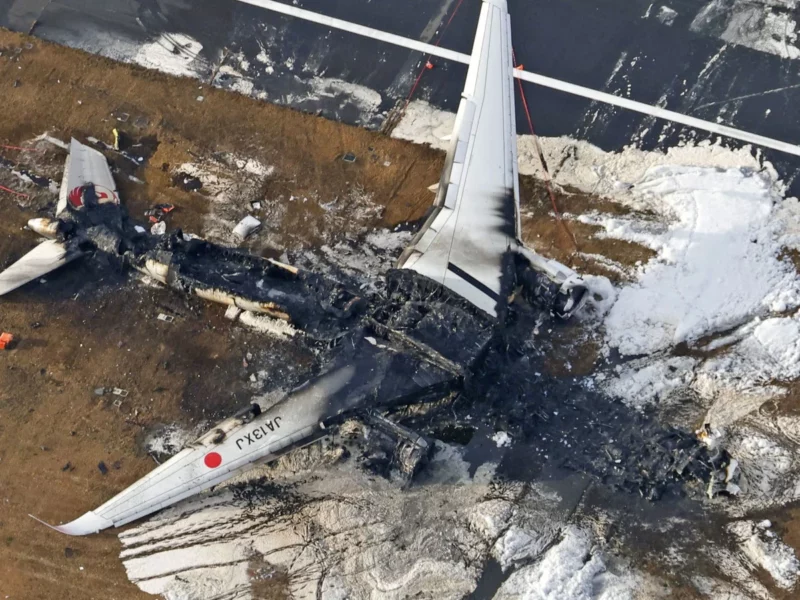
It has emerged that the horrifying collision on a Tokyo runway, which saw a passenger jet burst into flames, occurred because of a strong probability of human error.
The Japan Airlines (JAL) Flight 516, that slammed into a small coastguard plane shortly after touching down at Haneda Airport, on 2 January, HAD been given permission to land, but authorities confirmed that the second aircraft had been directed to wait for clearance – based on control tower transcripts – but seemingly ignored the instruction.
This information contradicts the version of events from the captain of the coastguard plane, who was the only one of six on board that aircraft who survived the impact. He told investigators that he HAD been given permission to enter the runway, which fatally was the same as that which the JAL airliner was approaching.
It has been suggested that a strip of stop lights embedded in the tarmac as an extra safety measure to prevent wrong turns, was out of service at the time of the accident, and could have been a contributing factor.
Incredibly, all 379 passengers and crew were evacuated from the JAL aircraft, despite it being engulfed by flames and remarkably, it was also reported that the pilots were unaware that the jet was on fire and it needed a flight attendant to alert the cabin to desperate situation unfolding.
What followed has been described as a “miraculous 18 minutes” with the evacuation carried out with what was literally, life-saving precision.
The plane broke up and burned for more than six hours.
Air traffic control give clear instructions
In a statement released by JAL, they confirmed that their aircraft recognised and repeated the landing permission from air traffic control, before approaching and touching down on runway 34R.
Meanwhile, it appears that the coastguard plane, which tragically was on an aid mission to the earthquake hit region of the country, was directed to “taxi to holding point C5”- a place on the airfield’s taxiway system, where aircraft then have to wait for permission from the controllers to enter the active runway for take-off.
Acknowledgement then denial
This instruction was clear in the transcripts, that also show that the pilot of the stricken smaller plane, 39-year-old Genki Miyamoto, acknowledged the call, which would be its last transmission before the fatal collision.
He would later insist that he DID receive permission to take-off, but he naturally was in shock and unfortunately for him, it seems he either misunderstood, or simply made a dreadful miscalculation.

Chances of survival unlikely
Once he committed his small craft into the path of the rapidly approaching jet, their fate was as good as sealed.
It probably should also have been a move that brought about a massive loss of life on the passenger plane too, as the impact ignited a fire in the jet and the chances of anybody getting out alive from a plane hurtling down the runway with a fireball underneath it, would seemingly be slim to non-existent.
Unaware that plane is engulfed in flames
Even more so when staggeringly, it transpired that the pilots had not realised what had happened and were oblivious to the horrors developing behind them.
The chief flight attendant, one of nine on board, managed to raise the alarm as the cabin was filling with smoke and getting hotter by the second.
Remarkable actions from heroic crew
It was here that the crew’s safety training kicked in and they proceeded to direct a remarkable evacuation, carried out with unbelievable calm given the situation, even passing instructions through megaphones, due to the PA system being damaged.
There were eight emergency exits, but because of the fire raging outside, only the two slides at the front were initially released. Then when it became apparent that it was urgent for the passengers to disembark from the back of the plane too, they took the decision to open the rear left exit, which was safe from fire for a short time.
Incredible outcome
It took 18 minutes from initial impact to fully evacuate the plane, with the pilot being the last person to set foot on the tarmac. Implausibly, nobody was seriously injured, although sadly a cat and dog that had to be left in the plane, died. Mercifully, it is thought they would have perished very quickly.
Investigation already under way
The accident forced the cancellation of 137 domestic, and four international flights and prompted investigators to be flown in from Japan, France, the UK and Canada.
They will examine the flight and voice recorders from the coastguard plane, which were recovered almost straight away; but those from Flight 516 were still to be found two days after the incident.
The charred remains of the two planes have still to be removed from one of the airport’s four runways.

About the author
Mick Burrows is an independent freelance author based in the UK, boasting over 20 years of experience in the online writing landscape. His extensive background has enabled him to develop a diverse range of material, marked by a unique and distinct style. Recognized as a platinum-level expert author by leading e-zine publications, Mick excels in optimizing content for Search Engine Optimization (SEO) through effective keyword density and distribution. He has served as the lead reviewer for a travel enterprise and the senior previewer at a sports prediction company, melding his passions for sport—particularly football and cricket—with his love for travel, having explored more than 50 countries worldwide.
Read our editorial standards and corrections policy. Spotted an error? Contact the newsroom.
More from Antigua and Barbuda
View section
More Than 2,500 Students Screened as School Vision Programme Identifies Children Needing Follow-Up
School Vision Screenings Flag Eye Concerns in More Than 280 Students
By Cory Wayland

Antigua and Barbuda Signs Visa Waiver Agreement with Azerbaijan at UN General Assembly
Antigua and Barbuda, Azerbaijan Sign Visa Waiver Agreement During UN Meetings
By Cory Wayland

St. Kitts DPP Seeks Antigua’s Help in Outstanding Case Involving Former Resort Clerk
By Shermain Bique-Charles
UPDATE: Nothing Spared as Fire Reduces XPZ Supermarket to Ruins Again
By Shermain Bique-Charles
Comments
Be the first to comment.