



















Archaeologists uncover lost city hidden in the Amazon rainforest
In a major archaeological discovery, an enormous ancient city has been identified in the Amazon, having been hidden for thousands of years by lush vegetation.
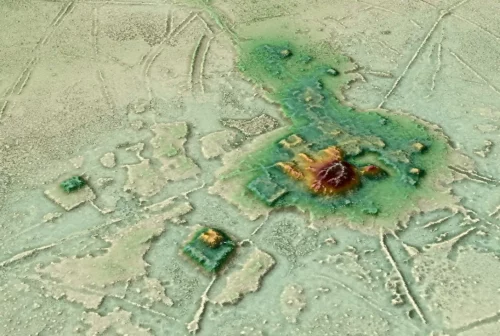
By combining ground excavations with laser sensors directed towards the forestry from an aircraft above, it was possible to determine the vast previously unseen area, underneath the density of plants and trees, tucked into the foothills of the Andes, in the Upano area of eastern Ecuador.
Skilled professionals from the scientific and archaeological world have been able to conclude that the city was built around 2,500 years ago, with houses and plazas connected by an incredible network of roads and canals.
Although an accurate estimate is not possible, it is thought that up to as many as 100,000 people may have lived there at its peek, in a period stretched over one thousand years.
Ditches around the entrances to the settlements have led experts to believe the inhabitants may have encountered threats from rival tribes, but it also lies under the shadow of a volcano which they conclude may have been the root of its demise.
Archaeologists from several countries, including France, Germany and Puerto Rico, as well as Ecuador, have been researching the area for more than two decades and see this as evidence of the earliest and largest network found in the Amazon.
Laser scanning leads to “incredible” findings
Using LiDAR mapping technology, or to give it its proper name – Light Detection and Ranging, the researchers were able to find more than 6,000 rectangular platforms, with dimensions of some 20m by 10m, and a height of around 3m.
This remote sensing method takes light in the form of a pulsed laser to measure variable distances. The technique allows a detailed 3D map to be created showing the surface beneath most vegetation, revealing features that would otherwise be invisible.
Lead study author Stéphen Rostain, an archeologist and director of Research at France’s National Center for Scientific Research (CNRS), described the findings – which were first captured back in 2015, but are only now being published – as “incredible”.
Oldest in the Amazon
The settlements were far more extensive than anyone had previously realised. They covered an area of over 300 square kilometres. Subsequent excavations have revealed post holes and fireplaces where the structures would once have stood.
There appeared to be central plazas possibly with some purpose of performing a ceremonial function. Professor Rostain said: “This is older than any other site we know in the Amazon. We have a Eurocentric view of civilisation, but this shows we have to change our idea about what is culture and civilisation.”

Signs of advanced engineering
The most isolated complexes were found to be linked by pathways and an extensive network of larger, straight roads, one which extended some 25km.
This suggested the existence of “advanced engineering” according to Prof Rostain, who described the road network as being “very sophisticated”, before explaining how it is much harder to build a straight road than one that fits in with its surrounding landscape.
Glad to ignore warnings
In the rest of the Amazon, many settlements were abandoned after the arrival of Europeans, but artefacts dated by Rostain’s team and layers of volcanic ash, suggest the possibility that a series of violent eruptions may well have been the cause for people to leave the valley in this instance.
The professor told how he was actually warned against continuing the research because scientists were convinced that there had not been any ancient groups living in the Amazon. “I am very stubborn so I did it anyway and now I must admit I am quite happy to have made such a big discovery” he joyfully confessed.





0 Comments