
Critically endangered species of white rhino could be saved from extinction after IVF breakthrough

By Mick the Ram
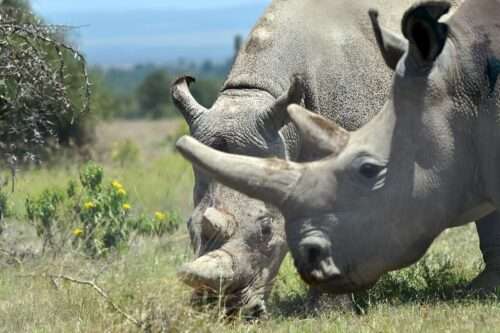
A remarkable fertility breakthrough has offered up hope of saving the northern white rhino, a species which at this present moment in time is… technically extinct.
There are actually two of the animals still in existence, but as these are both female they are obviously unable to reproduce.
Now though, an international team of German government-backed researchers has performed the first successful in-vitro fertilization (IVF) treatment, albeit on the southern white rhino.
The team, who are a consortium from Bio-Rescue – a body looking to halt animal extinctions around the world – were able to transfer a lab-created rhino embryo into a surrogate mother.
The progressive aim now is to match the technique on their closely related, but critically endangered northern sub-species. These were once found right across central Africa, but illegal poaching, driven by the incessant demand for the rhino horn, completely obliterated the wild population.
The two surviving females are named: Najin, and her daughter Fatu, both former zoo animals. Now however, they are now kept under 24-hour armed protection, at a conservation reservation in Kenya.
To actually undertake the process will represent a huge challenge, due to the fact that neither of these two rhinos will be able to carry a pregnancy, due to a combination of age and complicated health problems.
To overcome this pretty significant obstacle, an embryo will instead be implanted into the womb of a surrogate southern white rhino, thus making that also a scientific first.
Hope after despair
Just over half a century ago there were more than 2,000 northern white rhinos left in Africa, but the greed of man led to the slaughter of the species and when the last male northern white rhino, Sudan, died in 2018, their total disappearance appeared imminent.
This latest development is like bringing them back to life – or so everyone hopes. The scientific team began using their cousin the southern white rhino, which is considered a conservation success story and has a population well into the thousands, although they still remain threatened by illegal hunting.
Many vital decisions
This ambitious project has taken many years and has had to overcome numerous challenges, which included establishing how to collect eggs from two-tonne animals, and also then how precisely to create the first-ever rhino embryos in a lab.
Then there was the key decision to be made of how and just as importantly, when, to implant them.

13th time lucky
There were in actual fact, 12 unsuccessful attempts before at the 13th time of asking a pregnancy was achieved.
It was in September 2023 when the sperm from a male southern white rhino at the Zoo Salzburg in Hellbrunn, Austria, fertilized an egg taken from a female southern white rhino living at the Pairi Daiza Zoo in Belgium, after being transferred into a southern white surrogate female in Kenya, who became pregnant.
Tragedy strikes
Sadly, although this was a resounding success, there was a tragic end to the story. A violent storm swept through the area where the pregnant mother was being monitored and this released a bacteria called Clostridia into the air, which can be fatal to these animals and so it proved in this case, just 70 days into the pregnancy.
The death dealt a blow to the team, but a post-mortem revealed that the 6.5cm male foetus was developing very well and would have had a 95% chance of being born alive. This gives the team immense confidence moving forward.
Challenges overcome
“It’s very challenging in such a big animal, in terms of placing an embryo inside the reproductive tract, which is almost 2m inside the animal,” said Susanne Holtze, a scientist at Leibniz Institute for Zoo and Wildlife Research in Germany.
Continuing she observed: “We are very confident that we will be able to create northern white rhinos in the same manner and that we will be able to save the species and bring these wonderful animals back from the brink.”
Precious embryos in storage
Now the northern white rhino embryos are the next step. There are only 30 of these precious embryos in existence, stored in liquid nitrogen at -196C in Berlin, Germany and Cremona, Italy. They were created using eggs harvested from Fatu, the younger female in Kenya, and sperm collected from two male northern white rhinos, before they died.
A surrogate rhino will be injected with the embryo through its anus and the research team say they will look to perform more embryo transfers, if the initial pregnancy seems to be progressing well.
This could mean that as many as six northern white rhino calves might be born all within a very short space of time.
Confidence from the professor
Prof. Thomas Hildebrandt, the director of Liebniz IZW and project head for the Bio-Rescue Consortium, said: “I think the situation for the northern white rhino is quite privileged for the embryo transfer, because we have a closely related recipient – so their internal map is nearly the same.”
He went on to point out the importance of the calf or calves being able to meet Fatu and Najin whilst that pair are still alive. “We want to preserve the northern white rhinos social communication and heritage, so by putting the first calf on the ground it will be able to learn the language from the last two rhinos, and learn how to behave from them”, explained Prof. Hildebrandt.
Huge milestone
Justin Heath, CEO of the Ol Pejeta Conservancy reservation added: “This is a huge milestone for all those that dedicate their lives to protecting endangered species.”
If the 16-month pregnancy is successful, it would be the first northern white rhino born since 2000.

About the author
Mick Burrows is an independent freelance author based in the UK, boasting over 20 years of experience in the online writing landscape. His extensive background has enabled him to develop a diverse range of material, marked by a unique and distinct style. Recognized as a platinum-level expert author by leading e-zine publications, Mick excels in optimizing content for Search Engine Optimization (SEO) through effective keyword density and distribution. He has served as the lead reviewer for a travel enterprise and the senior previewer at a sports prediction company, melding his passions for sport—particularly football and cricket—with his love for travel, having explored more than 50 countries worldwide.
Read our editorial standards and corrections policy. Spotted an error? Contact the newsroom.
More from World
View section
Antigua and Barbuda, Octopus Energy to Explore Cheaper, Cleaner Power
By Shermain Bique-Charles
Afreximbank issues a $29 million guarantee to scale EAC Customs Bond, easing movement of goods across East Africa
By Editorial Staff

Browne Pushes Small-State Priorities at UN General Assembly
By Shermain Bique-Charles
Afreximbank and ATDC sign US$500 million facility to expand African trade and distribution
By Editorial Staff
Comments
Be the first to comment.