
Mount Everest climbers to be made to carry own poop back down the mountain in contentious new initiative

By Mick the Ram
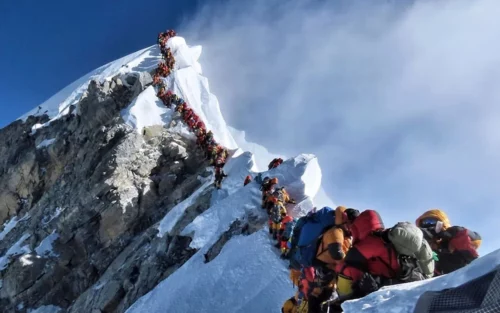
Climbing Mount Everest has always been a challenge, but it has now taken on a further complication after a new ruling was introduced that requires them to clear up their own… poop.
Not only that, but they are also being compelled to bring it back to base camp to be disposed of in specially made bags, which they will be ordered to buy at base camp.
Most climbers and support staff tend to dig a hole when nature calls, but higher up the mountain certain locations have less snow so it becomes necessary to go to the toilet out in the open.
Due to extreme temperatures, excrement left on the world’s highest peak does not fully degrade and this has had the effect of creating quite a stink. It is estimated that there are around three tonnes of human waste between camp one at the bottom of Everest and camp four, towards the summit.
Authorities have felt the need to act and implement a series of measures, with the bags a major initiative. They contain chemicals and powders that solidify human excrement and make it largely odourless. Climbers will have to show the contents on their return to camp.
All good at base camp
Throughout the climbing season mountaineers spend the majority of their time down at base camp allowing their bodies to adjust to the altitude and acclimatise as best they can. Tents can be erected to be used as toilets, with waste collected and disposed of properly, but as they begin their treacherous ascent things are not quite so straightforward.
Three tonnes of waste
Mingma Sherpa, chairman of Pasang Lhamu rural municipality, which covers most of the Everest region said: “Our mountains have begun to stink,” before estimating that as much as three tonnes of human excrement lies between camp one at the bottom of the mountain and camp four, also known as South Col, just short of the summit.
At 25,938 feet (7,906 metres) high, South Col serves as the last base before climbers attempt to reach the their holy grail at the very top of the mountain. It is here that the terrain is incredibly hostile, wildly windswept, with very little ice or snow.

Eroding Everest’s image
The average climber is believed to produce around 250 grams of excrement per day and considering that they will spend upwards of two weeks in the upper camps, that is a lot of waste.
“We are getting complaints that human stools are visible on rocks and some climbers are falling sick. This is not acceptable and erodes our image,” Mr Mingma added.
Thousands of bags on the way
Approximately 8,000 poop bags have been procured for an estimated 400 foreign climbers and 800 support staff, in readiness for the upcoming climbing season, which begins in March.
The plan is to give everyone two bags each, which can apparently be used five or six times.
Initiative could be replicated
Dambar Parajuli, president of the Expedition Operators Association of Nepal, welcomed the initiative, calling it a positive move and one his organisation will be happy to support, using Everest as a pilot project that if successful can be replicated on other mountains.
Stricter observation gives hope of success
There has been an increasing number of clean-up campaigns, including an annual one led by the Nepali Army, but for one reason or another they have not been wholly productive.
This new drive will receive proper liaison, with contact officers ensuring all measures are completely adhered to.

About the author
Mick Burrows is an independent freelance author based in the UK, boasting over 20 years of experience in the online writing landscape. His extensive background has enabled him to develop a diverse range of material, marked by a unique and distinct style. Recognized as a platinum-level expert author by leading e-zine publications, Mick excels in optimizing content for Search Engine Optimization (SEO) through effective keyword density and distribution. He has served as the lead reviewer for a travel enterprise and the senior previewer at a sports prediction company, melding his passions for sport—particularly football and cricket—with his love for travel, having explored more than 50 countries worldwide.
Read our editorial standards and corrections policy. Spotted an error? Contact the newsroom.
More from World
View section
Antigua and Barbuda, Octopus Energy to Explore Cheaper, Cleaner Power
By Shermain Bique-Charles
Afreximbank issues a $29 million guarantee to scale EAC Customs Bond, easing movement of goods across East Africa
By Editorial Staff
Browne Pushes Small-State Priorities at UN General Assembly
By Shermain Bique-Charles

Afreximbank and ATDC sign US$500 million facility to expand African trade and distribution
By Editorial Staff
Comments
Be the first to comment.