
















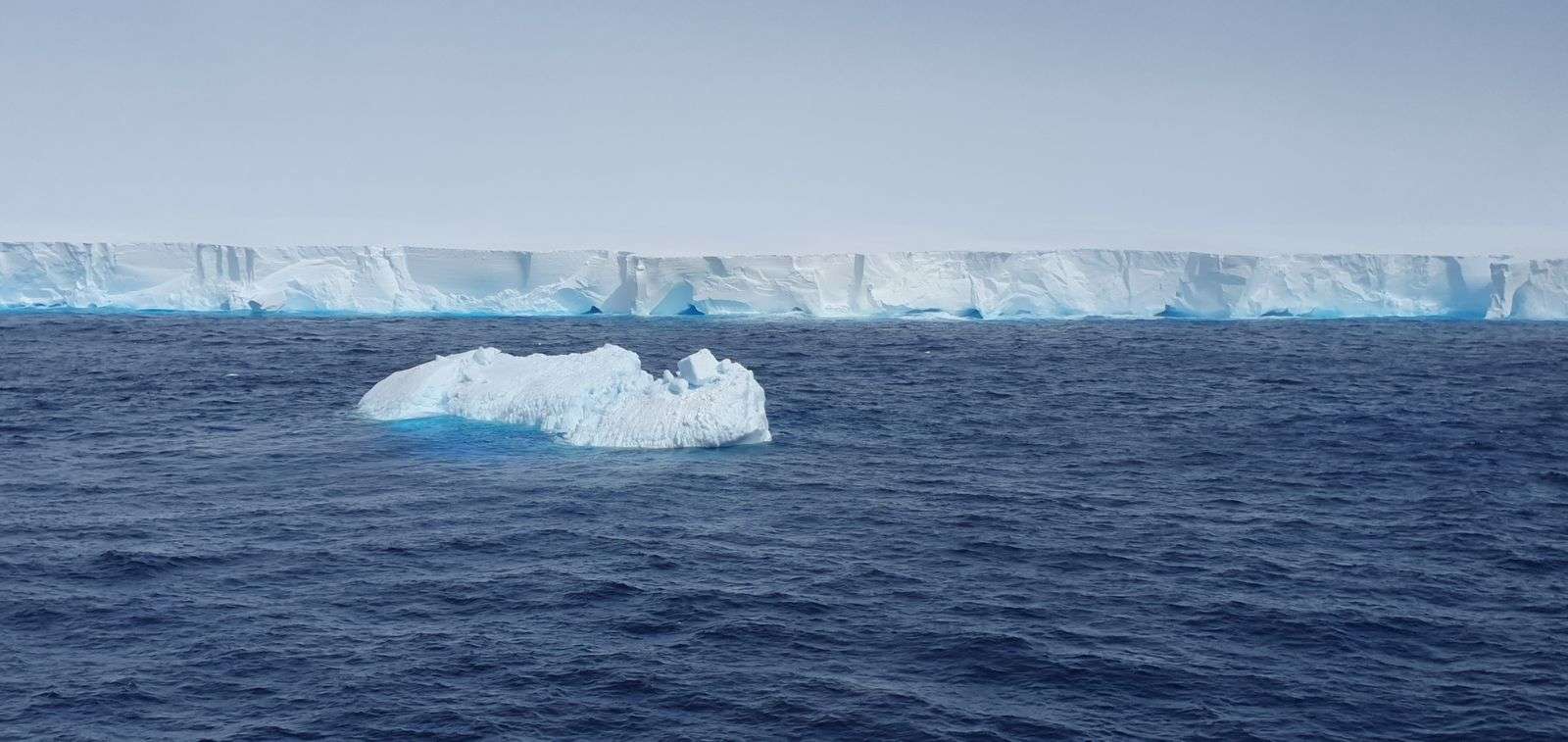
An iceberg, given the name A23a among science circles, has become trapped in a phenomenon that oceanographers call a Taylor Column, which is a type of vortex.
The world’s largest iceberg is lying idle, simply floating on the spot just north of South Orkney Island and randomly turning anti-clockwise, at about 15 degrees a day.
Earlier this year the iceberg entered the Antarctic Circumpolar Current (ACC), a powerful force that pumps the ocean waters and whatever is in them – regardless of size – north to what ultimately be its eventual demise.
However, on this occasion when A23a entered the ACC, it suddenly ground to a halt. Incredibly it is not wedged in any way; indeed there is at least 1000 metres of water between its base and the ocean floor.
It is thought that the iceberg could remain in its current state of limbo for quite a number of years, giving the giant broken glacier a stay of execution well beyond the time it should have naturally met its natural ending.
Academic discovers the Taylor Column phenomenon
A Taylor Column was first described around a hundred years ago by physicist, Sir Geoffrey Ingram Taylor, who was a Cambridge academic and a pioneer in the field of fluid dynamics.
He was able to demonstrate how a current that meets an obstruction on the seafloor can in certain situations, separate into two distinct flows, which in turn would have the effect of generating a full-depth mass of rotating water between them.

Could be stuck for years
A23a has been slowly spinning on the spot since April just north of Antarctica, when realistically it ought to be in the grips of the Earth’s most powerful ocean current.
How long it stays trapped is subject to conjecture, but previous experiments that involved the use of a scientific buoy, saw that particular object remain in place and continue to rotate in one spot for over four years.
Triple the size of NYC
The iceberg is a staggering 4,000 sq km (1,500 sq miles) in area, making it more than twice the size of the Australian Capital Territory, Greater London and three times the size of New York City.
It is believed to weigh almost one trillion tonnes, with a thickness of around 400m, which to give it some perspective, is greater than the height of Europe’s tallest skyscraper – the Shard building in London, which is 310m tall.
Static ice island
It first broke free from the Antarctic coastline back in 1986, but almost immediately after making its escape, A23a got itself bogged down in the Weddell Sea and actually stayed there for 34 years, forming what was essentially a static “ice island”.
It eventually re-floated in 2020 and resumed its journey northwards, heading to warmer air and waters in the South Atlantic, the place where many smaller icebergs break down to eventually lose their structure.
The powers of the ACC
The ACC where the iceberg has taken up temporary residence, moves a hundred times as much water around the globe as all Earth’s rivers combined.





0 Comments