

















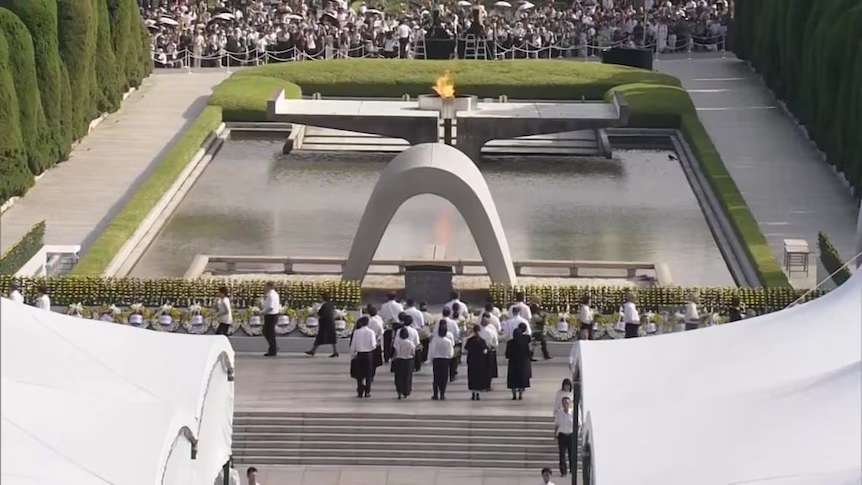
Ceremony has been held to mark the 80th anniversary of the dropping of the first atomic bomb in Hiroshima which killed well over 100,000 and flattened the city (ABC News)
At 08.15 this morning (6 August) a bell rang out to signal the start of a minute of silence, which was observed by around 55,000 people at the Japanese city of Hiroshima’s Peace Memorial Park.
They had gathered there to mark the exact time 80 years ago that a US B-29 Aircraft called Enola Gay dropped the most devastating bomb ever released, causing unimaginable death and destruction.
Japanese prime minister Shigeru Ishiba attended the ceremony, along with representatives from a record 120 countries and regions to remember the 140,000 people who lost their lives in such a horrifying way.
A flash of blinding light, followed by a giant mushroom cloud eventually cleared to reveal its deadly aftermath, as the blast had flattened almost everything within a 2.5 km radius and of the 90,000 buildings in the city prior to the explosion, only 28,000 remained afterwards.
Hiroshima Mayor Kazumi Matsui warned against a growing acceptance of using nuclear weapons for national security, pointing in particular at the wars in Ukraine and the Middle East.
Survivors speak of their losses
The release of dozens of white doves cemented the deep desire amongst the vast crowd at the cenotaph for peace in the world and the end of nuclear arms.
The terrible suffering was recalled by many visiting the site, including 96-year-old wheelchair user Yoshie Yokoyama, who told how she had lost her parents and grandparents as a result of the nuclear attack.
“My grandfather died soon after the bombing, while my father and mother both died after developing cancer,” she said. Continuing, she added: “My parents-in-law also died, so my husband couldn’t see them again when he came back from battlefields after the war.”
Seventy-four-year-old Kazuo Miyoshi was at the ceremony to honour his grandfather and two cousins who died in the bombing and prayed that the “mistake” will never be repeated.
More names added to death registry
The numbers of those still alive who survived the horror are rapidly declining, with less than 100,000 remaining and this specific milestone is considered to very likely be the last for most of them.
“There will be nobody left to pass on this sad and painful experience in 10 years or 20 years,” said Minoru Suzuto, who is now 94-years-old.
“That’s why I want to share (my story) as much as I can,” he stated with a heavy heart.
At the ceremony the names and other personal details of more than 4,940 registered survivors who have died in the past year were added to a registry that is kept inside the cenotaph. It brought the number of deaths attributed to the Hiroshima bombing to almost 350,000.

Protestors appeal to next generation
Close to the iconic Atomic Bomb Dome – one of the few buildings that survived the attack eighty years ago – over 200 protesters chanted slogans, whilst holding aloft flags and posters displaying messages which read among others: “Free Gaza! No more genocide” and “No Nuke, Stop War”.
A spokesperson said lessons which the international community should have learned from the tragedies of history are flagrantly being disregarded.
The peace-building frameworks that so many have worked so hard to construct, were under threat of being toppled they said, and appealed to the younger generation to “recognise that acceptance of the nuclear option could cause utterly inhumane consequences for their future.”
Fear of heavy losses prompted deadly decision
In 1945 the then US President Harry S. Truman was desperate to avoid a land invasion of Japan. He was aware that the Japanese would fight to the end and he was advised that to defeat them would probably cost over a quarter of a million American soldiers their lives.
That was the crucial deciding factor that prompted him to give the go ahead for the atomic bomb to be dropped.
Second devastation finally ended war
Nevertheless, despite the absolute devastation, still Japan did not surrender. Consequently, three days later on 9 August, he sanctioned the dropping of a second deadly nuclear bomb, this time over the city of Nagasaki.
There, at least 74,000 people died in the blast, or from subsequent injuries with almost everything in the industrial district flattened.
Those who survived suffered terrible injuries, or radiation sickness and finally just under a week later on 15 August 1945, Japan accepted defeat and the terrible Second World War was thankfully over.



0 Comments