
New York AT1 Lawsuit: Credit Suisse and FINMA Claim Privilege, again

By Dario Item
Another Wall of Secrecy: the Collapsed Bank and the Swiss Financial Regulator Stretch “Legal Privilege” to Keep AT1 Files in the Dark
The secrecy fight over Credit Suisse’s AT1 wipeout is not theoretical; it is unfolding inside a live class action pending in the U.S. District Court for the Southern District of New York. In July 2025, the court allowed the AT1 bondholder case to move into discovery—opening the door to internal emails, risk reports, and board communications about the March 2023 decision that zeroed out roughly CHF 16 billion of bonds.
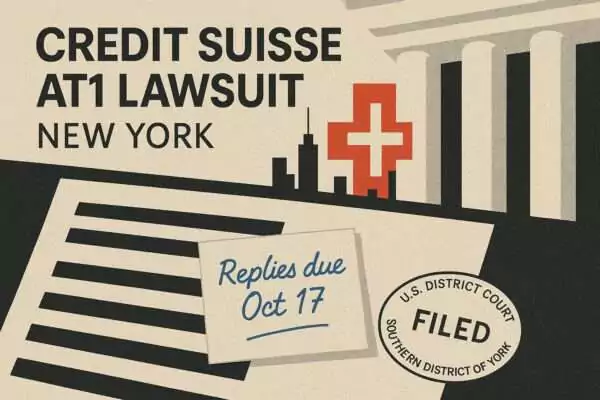
Within that same litigation, a fresh filing shows how the discovery phase is already running into a familiar roadblock: Credit Suisse has been withholding or heavily redacting documents by invoking Swiss privacy laws, “blocking statutes,” and an asserted supervisory privilege. The judge’s handwritten instruction—scrawled in blue ink on the first page of the filing—now sets a briefing schedule with all replies due by October 17, 2025.
New York: secrecy repackaged as “privilege”
In a September 2025 letter to Judge Colleen McMahon, counsel for investor Ali Diabat warns that key evidence is being withheld under the banner of Swiss secrecy rules and a Swiss supervisory privilege. Plaintiffs argue those claims are overbroad—especially because the Swiss Parliamentary Investigative Commission has already put the substance of several FINMA communications into the public record, weakening any blanket confidentiality rationale. The letter asks the court to prioritize U.S. discovery principles over foreign blocking statutes in this U.S. securities case.
Plaintiffs also press the judge to decide the dispute directly, rather than send it to a magistrate, noting that a referral could simply invite another round of objections and delay. It’s a tactical plea for speed in a case where time favors the better‑resourced party.
Switzerland: FINMA’s earlier push to keep the files closed
The New York frictions mirror a stance FINMA has taken at home. In April 2024, the regulator urged Switzerland’s Federal Administrative Court not to show bondholders the case files, arguing that disclosure risked “uncontrolled” dissemination to the media and could feed lawsuits in countries where respect for the rule of law is “questionable.” It even floated concerns about ex aequo et bono decisions in arbitration. However, FINMA initially did not oppose file access in early appeals (while Credit Suisse did), but then pivoted to oppose disclosure—a shift that looks tactical and defensive rather than principled for a taxpayer‑funded authority.
Taken together, the moves on both sides of the Atlantic amount to a strategy of secrecy: In Switzerland, FINMA claims that openness would erode supervisee trust and spawn litigation abroad—language that, intentionally or not, casts doubt on allied jurisdictions while keeping investors in the dark about how and why the AT1 wipeout happened. In New York, Credit Suisse leverages those same Swiss doctrines to sanitize discovery, despite allegations that much of what’s being hidden has already been ventilated in Switzerland’s parliamentary process. For investors, the stakes are straightforward: transparency vs. trial by ambush. The SDNY case exists precisely because the AT1 write‑down—an extraordinary intervention—demands daylight on whether executive assurances matched internal risk reality.
In another securities fraud class action (Christine Asia Co. v. Alibaba Grp. Holding Ltd.), the same Judge (Colleen McMahon) has previously stated that “My position is very clear. If you want to raise money in the United States of America, the only laws that matter to me are the laws of the United States of America.”. This statement suggests what will happen to the objections raised by Credit Suisse (and FINMA), objections that we have already criticized in a previous article as being largely specious.
FINMA’s 2024 filing reads less like a neutral public authority and more like an adversary worried about reputational risk—citing media leaks, overseas lawsuits, and hypothetical arbitration dynamics as reasons to keep the record closed. That’s self‑protection over public accountability.
This story was first published by Antigua News on : antigua.news/2025/09/09/credit-suisse-at1-lawsuit-finma-legal-privilege-new-york. © 2025 Antigua News. Republication without permission is not allowed.

About the author
Dr. Dario Item is the Head of Mission of the Embassy of Antigua and Barbuda in Madrid. He is an experienced financial crimes lawyer with nearly 30 years of practice. He holds degrees in law and political science, a Ph.D. in criminal law and an LL.M. in transnational financial crime.
Read our editorial standards and corrections policy. Spotted an error? Contact the newsroom.
More from Credit Suisse AT1 Case
View section
Credit Suisse AT1 wipeout: the price of UBS’s ‘yes’
UBS demanded protection. Bern resisted an unlimited guarantee. The cancellation of SFr16.5bn in bonds was part of the agreement that followed — despite Credit Suisse’s warning that the contractual conditions had not been met.
By Dario Item

Credit Suisse fraud case: US judge moves towards private review of FINMA files
The Swiss watchdog declined to join a New York hearing while defending secrecy over an inquiry into the bank’s final months. The court is weighing investors’ demand for the records.
By Dario Item
Arbitrator finds Credit Suisse write-down trigger never fired
By Dario Item

Credit Suisse AT1 Arbitration moves behind closed doors as Switzerland’s paper trail stays hidden
By Dario Item
Comments (4)
Apex Jones September 9, 2025, 8:26 AM
Naomi September 9, 2025, 11:08 AM
Informed citizen September 9, 2025, 11:58 PM
+1268 September 10, 2025, 6:17 AM