


















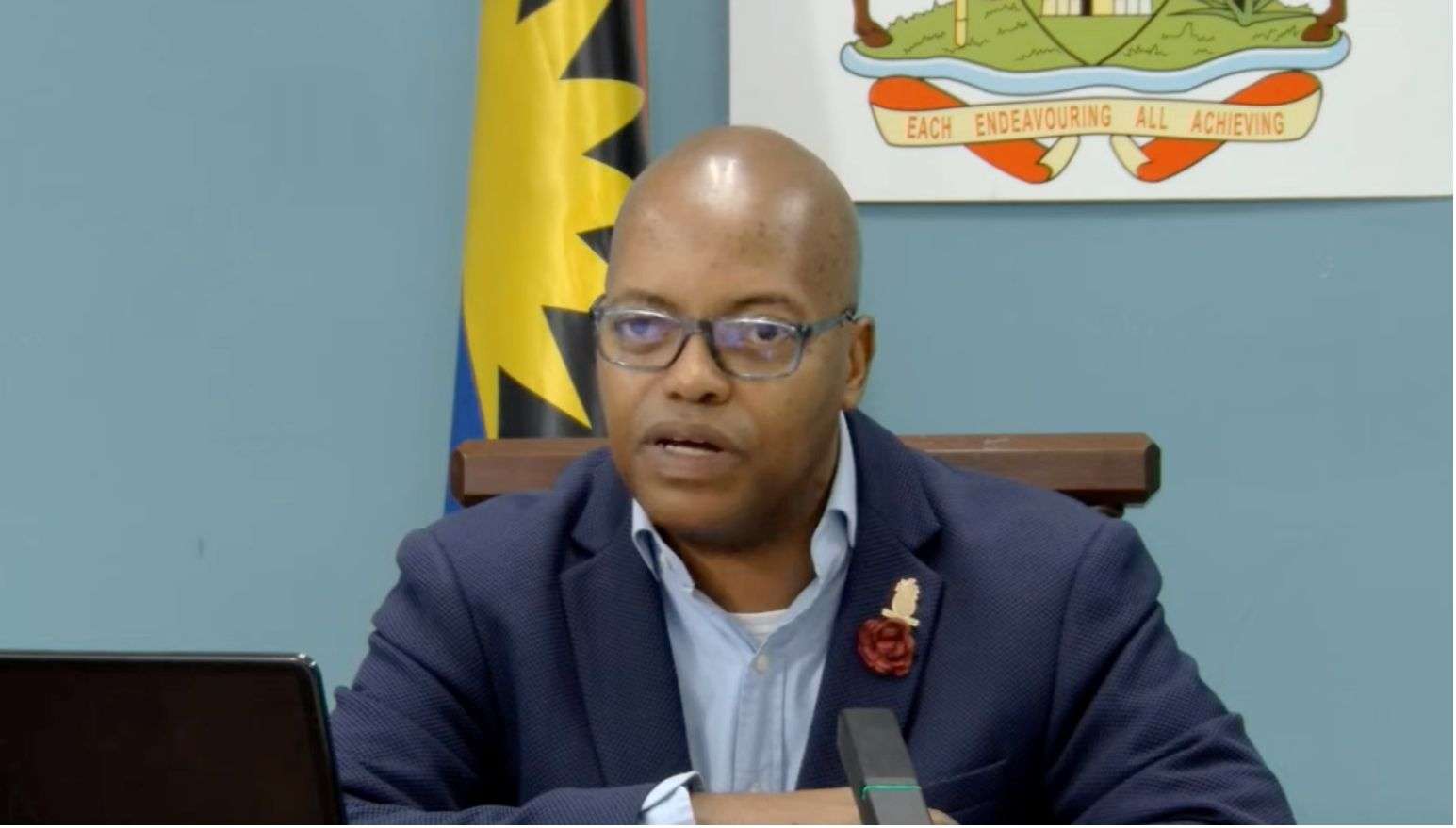
Director General of Communications Maurice Merchant
Director of Communications within in Prime Minister’s Office Maurice Merchant says the fight for climate justice is moving “slowly but surely,” as Prime Minister Gaston Browne continues to press world leaders and financial institutions for urgent and enforceable action.
For more than a decade, Prime Minister Browne has been at the forefront of global climate negotiations, championing the cause of Small Island Developing States (SIDS) and demanding that major polluting economies take responsibility for their role in the climate crisis.
Merchant acknowledged the frustrations of slow progress but said the Prime Minister’s persistence is ensuring that climate justice remains on the global agenda: “Slowly but surely, this is why the Prime Minister continues to push for it, so that it doesn’t die a natural death.”

Delivering a powerful keynote address to international leaders, Prime Minister Browne called for an enforceable and equitable transition from fossil fuels. He insisted that countries which have profited most from fossil-fuel-driven economies must now bear the costs of enabling climate justice.
On climate finance, the Prime Minister was blunt: existing funding for adaptation, resilience, and loss and damage remains “woefully inadequate.” He urged the restructuring of the global financial architecture to make polluters pay not through charity but through a binding “polluter-pays” principle. He cited projections that adaptation costs could soar to US$387 billion annually by 2030, while current funding mechanisms lag dangerously behind.
Nationally, Browne reaffirmed Antigua and Barbuda’s National Adaptation Plan (NAP), which provides a roadmap for resilience through data-driven risk mapping and institutional strengthening. He also pledged that the country’s updated Nationally Determined Contribution (NDC) will accelerate its green and resilient transformation.


Is it really moving? Cause I’m not seeing any progress from my vantage point
Slow progress is still progress. It takes time to negotiate with large countries, sort out legal, financial, and technical hurdles.Antigua & Barbuda shouldn’t have to wait, but it’s good to see that the fight isn’t being abandoned. We’ll get there
This is a strong and timely intervention by Prime Minister Browne, and Maurice Merchant is right to emphasize the slowly but surely approach.
The truth is, Small Island Developing States like Antigua and Barbuda are fighting for survival. Rising seas, stronger hurricanes, and collapsing coastal ecosystems are not abstract threats they are lived realities. Browne’s insistence that polluters must pay through a binding “polluter-pays” principle is not only morally justified but economically necessary. The numbers he cited adaptation costs projected to hit nearly US$400 billion annually by 2030 show just how far behind global funding is.
Well said, Ambassador Merchant. Change might be slow, but Antigua and Barbuda continues to lead the way for small island states.
Slow progress is better than no progress, but the big economies dragging their feet is costing small islands like ours dearly. We don’t have time for empty promises.
People may criticize Browne for being persistent, but persistence is exactly what’s needed. If he didn’t keep pushing, Antigua and Barbuda would be ignored in the global debate.
What stands out is that Antigua and Barbuda, despite its size, continues to shape the global climate agenda. This persistence ensures that SIDS are not sidelined but remain central in negotiations. While progress may be slow, Browne’s consistency is forcing the conversation forward and that persistence may ultimately be what keeps climate justice from “dying a natural death
Prime Minister Browne has been saying the same thing for years and he’s right SIDS can’t keep footing the bill for damages they didn’t cause. The “polluter-pays” principle is long overdue.