
Switzerland’s AT1 Shock: Court Says Credit Suisse Bond Wipeout Was Unlawful

By Dario Item
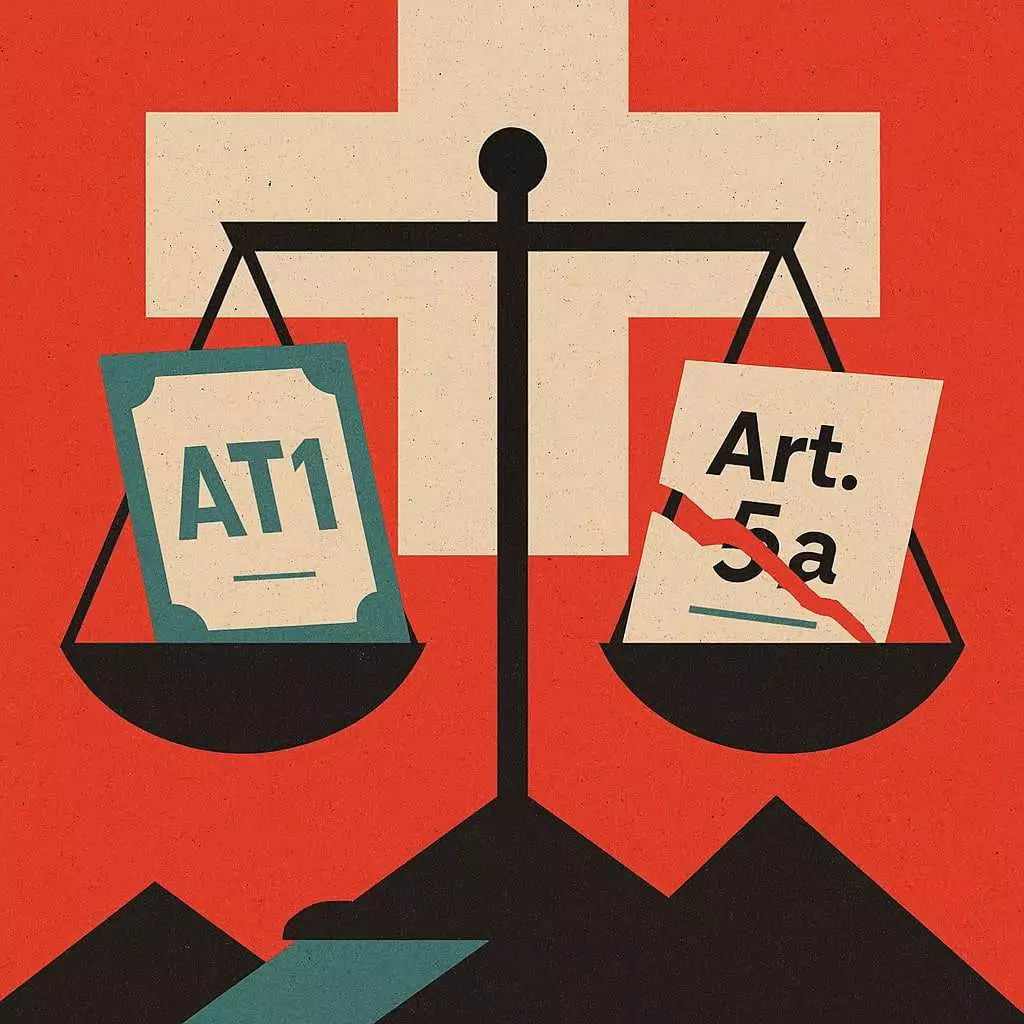
The Swiss Federal Administrative Court has ruled that the forced write‑off of Credit Suisse’s Additional Tier 1 (AT1) bonds during the bank’s 2023 rescue lacked a legal basis and must be annulled—a decision that upends the official narrative of a crisis weekend and reopens fundamental questions about Switzerland’s emergency powers and investor protections.
On 1 October 2025, the court issued a partial decision in case B‑2334/2023, revoking FINMA’s 19 March 2023 decree that zeroed out roughly CHF 16.5 billion of Credit Suisse AT1s as part of the UBS takeover. The ruling stems from around 360 appeals filed by roughly 3,000 investors; the court confirmed their standing to sue.
The trigger that never was
AT1 “write‑off bonds” can only be wiped when a contractually defined “viability event”occurs. The court found that, at the time of the wipeout, Credit Suisse was sufficiently capitalized and met regulatory capital requirements; the government and central bank measures were aimed at shoring up liquidity, not replenishing capital—and therefore did not trigger the contractual write‑off mechanism.
An emergency decree on unconstitutional ground
The judges also dismantled the state’s legal scaffolding. They concluded that FINMA’s order constituted a serious intrusion on bondholders’ property rights and lacked a “clear and formal” statutory basis. Article 26 of the Banking Act and Article 31 of the FINMA Act did not suffice, and Article 5a of the Federal Council’s emergency ordinance—added on the very day of the rescue—was unconstitutional on multiple counts, including separation‑of‑powers limits on emergency law and the constitutional guarantee of property.
The paper trail: Credit Suisse warned FINMA
A contemporaneous email entered into the court record shows Credit Suisse pleaded with the supervisor hours before the wipeout, arguing the contractual requirements for a write‑down were not met and that the measures on the table addressed liquidity, “not capital.” The bank also cautioned that equity created by declaring a viability event was “not priced in the valuation of the deal” and would amount to “a gift of ca CHF 16bn to the shareholders of the acquiring party.”
What the ruling does—and doesn’t—do (yet)
The judgment annuls FINMA’s 19 March 2023 decree, but the court has not yet decidedwhether to reinstate bondholder claims or order other remedies. The remaining cases are stayed until this partial decision becomes final, and Switzerland’s Federal Supreme Court may still be asked to weigh in.
What’s really at stake
Legitimacy of the crisis playbook
Switzerland’s authorities stitched together an unprecedented rescue over a single weekend. The court’s finding that the key emergency tool—a same‑day ordinance add‑on—was unconstitutional cuts to the heart of how far the executive can go in a banking panic. Even more striking, the ordinance paragraph that enabled the wipeout (Article 5a) was later repealed; the court’s view suggests it should never have been used to erase private claims in the first place.
Contract versus command
AT1s were sold on the premise that losses would be imposed according to contract triggers. The court’s message is blunt: contract terms matter—and in this case, liquidity backstops, however necessary, did not equal a capital failure. If this reasoning stands on appeal, it reshapes the hierarchy of creditor expectations in Swiss crisis management.
A potential liability time bomb
By voiding the legal basis for the write‑off, the court has opened the door to restitution or compensation debates. If the “reversal” question ultimately goes the investors’ way, who bears the cost? UBS, which benefited from the deletion of debt? The state, which crafted the emergency architecture? Or some combination? The partial decision leaves those questions live—precisely the uncertainty bond markets hate most.
FINMA under the microscope
Supervisors are paid to act decisively in a panic; courts are paid to demand legality after the smoke clears. The record shows Credit Suisse itself told FINMA that declaring a viability event in a mere liquidity crisis would contradict the “plain wording” of bond clauses and damage the market’s trust in AT1 as a funding tool. Whether FINMA’s judgment call was defensible in the fog of crisis will now be scrutinized line by line in appellate briefs.
What to watch next
Appeal posture
The decision is appealable to the Federal Supreme Court. Expect arguments to zero in on the boundary between liquidity support and capital impairment; the court’s reading of AT1 prospectus language; and constitutional constraints on emergency ordinances.
Remedies and valuation
If reinstatement is considered, how are coupons, accrued claims, trading suspensions, and post‑wipeout transactions handled? If compensation is considered instead, who pays and under what theory?
Policy overhaul
The ruling effectively invites Parliament to codify a clearer, formal framework for imposing losses in resolution scenarios—one that won’t need improvised emergency clauses on the night of a rescue.

About the author
Dr. Dario Item is the Head of Mission of the Embassy of Antigua and Barbuda in Madrid. He is an experienced financial crimes lawyer with nearly 30 years of practice. He holds degrees in law and political science, a Ph.D. in criminal law and an LL.M. in transnational financial crime.
Read our editorial standards and corrections policy. Spotted an error? Contact the newsroom.
More from Credit Suisse AT1 Case
View section
Credit Suisse AT1 wipeout: the price of UBS’s ‘yes’
UBS demanded protection. Bern resisted an unlimited guarantee. The cancellation of SFr16.5bn in bonds was part of the agreement that followed — despite Credit Suisse’s warning that the contractual conditions had not been met.
By Dario Item

Credit Suisse fraud case: US judge moves towards private review of FINMA files
The Swiss watchdog declined to join a New York hearing while defending secrecy over an inquiry into the bank’s final months. The court is weighing investors’ demand for the records.
By Dario Item

Arbitrator finds Credit Suisse write-down trigger never fired
By Dario Item

Credit Suisse AT1 Arbitration moves behind closed doors as Switzerland’s paper trail stays hidden
By Dario Item
Comments
Be the first to comment.