
Thieves break into the Louvre in Paris and escape with a selection of “priceless” crown jewels

By Mick the Ram
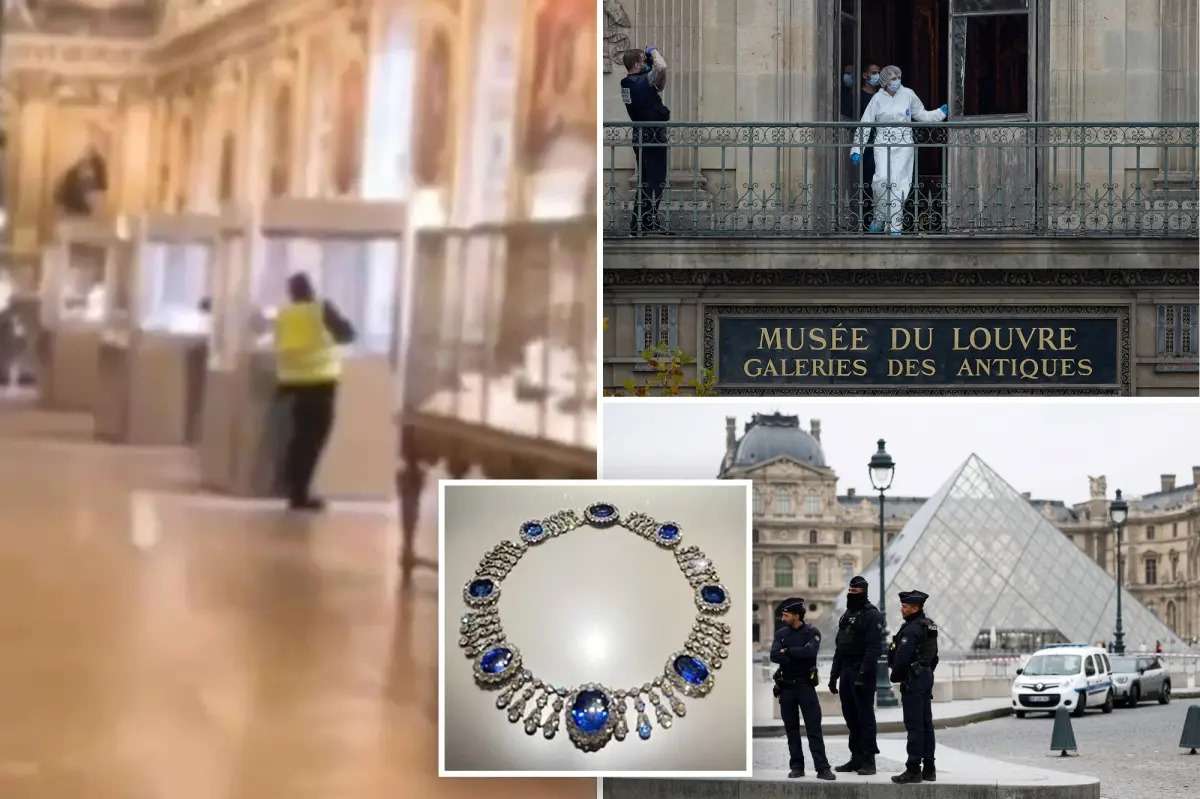
It could have been a scene from a Hollywood blockbuster movie, with thieves carrying out a brazen raid on the world’s most-visited museum in broad daylight and escaping with eight pieces of a country’s crown jewels, but unfortunately for France this was very real.
Four masked men used a vehicle-mounted ladder which they positioned to lead up to a first-floor balcony to gain access to the Louvre in Paris at around 9.30am and just 30 minutes after the famous tourist attraction opened to the general public.
In what is being described as a “professional” heist, the entire robbery was undertaken and the perpetrators made their get-away in just seven minutes, racing away on motor scooters and causing huge embarrassment to the French authorities at the ease of the crime and highlighting an obvious vulnerability at the museum.
There is a strong belief amongst experts that unless they are apprehended within the next 48-72 hours, the priceless items – which included a diamond and emerald necklace that Emperor Napoleon presented to his wife, Empress Marie Louise – will be broken up, recut, or melted down and smuggled out of the country.
An investigation is under way, seeking to determine how criminals were able to breach supposedly one of the most secure cultural sites in Europe. It is the most spectacular theft at the Louvre since the Mona Lisa disappeared way back in 1911.
No interest in the famous paintings
The Louvre is the most visited museum in the world and attracts up to 30,000 visitors on a daily basis to view its thousands of world-famous art pieces, including the Mona Lisa and the Venus de Milo.
However, those are not of any real interest to criminal groups as they are almost impossible to move on. Instead they prefer items that can be converted into hard cash, hence the targetting of the jewels.
Carefully planned
It is understood that four men pulled up on scooters at the side of the Apollo Gallery where the crown jewels are housed, facing across the River Seine. They wore yellow and orange vests to disguise themselves as workmen to buy some valuable minutes and climbed onto a truck equipped with an elevating platform of the type used by removal companies.
Two of them proceeded to cut through glass panes with a battery-powered angle grinder and gain entry. They knew exactly what they were after, targetting specifically two display-cases which contain what remained of the French crown jewels.
Immeasurable value
France’s ministry of culture said the stolen items were: a tiara and brooch belonging to Empress Eugénie, wife of Napoleon III; an emerald necklace and a pair of emerald earrings from Empress Marie Louise; a tiara, necklace and single earring from the sapphire set that belonged to Queen Marie-Amelie and Queen Hortense and a brooch known as the “reliquary brooch”.
Between them, they are adorned with thousands of diamonds and other precious gemstones. Two more items, including Empress Eugénie’s crown, were found near the scene, apparently having been dropped during the escape. Authorities described the stolen jewels as “priceless” and of “immeasurable heritage value”.
President’s comment
France’s president Emmanuel Macron described the robbery as an “attack on a heritage that we cherish because it is our history”, but embarrassingly, French media is reporting that a preliminary assessment by the Court of Auditors (due to be published next month) found that a third of the rooms in the wing where the robbery took place have no working surveillance cameras.
This despite the Louvre’s collection being estimated to be worth tens of billions of euros.
Most daring since Mona Lisa
Before this remarkable robbery, the most well-known theft at the museum was when Leonardo da Vinci’s La Joconde – better known now as the Mona Lisa – was taken in 1911. Back then the culprit had hidden himself in a closet overnight, after which he was able to simply remove the painting from its frame, wrap it up in his smock, tuck it under his arm and audaciously walk out of the building.
It transpired that the man was an Italian national who believed the artwork should be brought back to where he felt it belonged. It was eventually found in Italy in 1914 and returned to the Louvre.
This story was first published by Antigua News on : antigua.news/2025/10/21/thieves-break-into-the-louvre-in-paris-and-escape-with-a-selection-of-priceless-crown-jewels. © 2025 Antigua News. Republication without permission is not allowed.

About the author
Mick Burrows is an independent freelance author based in the UK, boasting over 20 years of experience in the online writing landscape. His extensive background has enabled him to develop a diverse range of material, marked by a unique and distinct style. Recognized as a platinum-level expert author by leading e-zine publications, Mick excels in optimizing content for Search Engine Optimization (SEO) through effective keyword density and distribution. He has served as the lead reviewer for a travel enterprise and the senior previewer at a sports prediction company, melding his passions for sport—particularly football and cricket—with his love for travel, having explored more than 50 countries worldwide.
Read our editorial standards and corrections policy. Spotted an error? Contact the newsroom.
More from World
View section
France and Italy Count the Cost as Protests Turn Violent Across Europe
Burned public buildings and looted shops have overshadowed demands for better schools and relief from living costs, as unrest takes different forms across Europe.
By Editorial Staff

Trump Fires White House Press Secretary Katie Zacharia After Just Five Days in Office
A turbulent first week marked by questions over her legal credentials and a controversial debut briefing ends in one of the shortest tenures in White House history.
By Cory Wayland

From Coaster Buses to Driverless Technology: China Offers a Glimpse Into the Future of Public Transportation
A striking contrast between the familiar coaster bus and a modern self-driving vehicle highlights how rapidly technology is transforming public transportation in China.
By Cory Wayland

Pope Leo XIV to Undergo Surgery to Remove Lung Nodule
The 71-year-old pontiff announced the operation after Sunday’s Angelus. The nodule was found during recent medical checks and, he said, detected at an early stage.
By Dario Item
Comments
Be the first to comment.