
Fortescue engineer says Caribbean positioned to play key role in global green ammonia supply chain

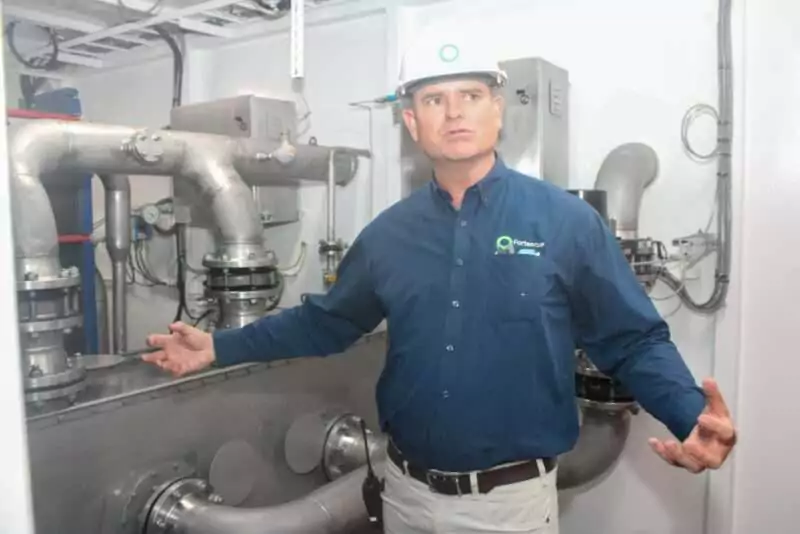
Anthony Smith, Engineering Manager at Fortescue Green Shipping, says the Caribbean’s existing energy infrastructure and its standing at the International Maritime Organization (IMO) make it a natural partner in the global transition to green ammonia as a marine fuel, as the company’s pioneering vessel, the Green Pioneer, docked in Antigua this week.
Speaking on the sidelines of the welcome ceremony for the world’s first ammonia powered vessel to the twin island state, Smith said the vessel’s Caribbean tour was not accidental.
The region’s history in energy and its heightened awareness of climate responsibility, he explained, align closely with Fortescue’s own decarbonisation mission.
“When you combine the energy history of the Caribbean with the forward-looking attitude towards decarbonisation and also the pivotal role that Caribbean states play in the IMO, it’s obviously a fantastic opportunity for us to visit and achieve as much influence and as much partnership as we can in taking green fuels forward,” Smith said.
The Green Pioneer itself began as a design project in late 2021 where working alongside Det Norske Veritas (DNV), the world’s leading classification society, and the Maritime and Port Authority of Singapore as the vessel’s flag state, Fortescue ran its design and regulatory approval processes in parallel.
The effort produced the world’s first ammonia fuel certification and approval in principle from DNV, achieved in 2023, and the vessel completed commissioning following its conversion at a Singapore shipyard in the first quarter of 2024.
“All up from early phase design, mature design and approval of the design philosophy with the regulator, it was about two years from design through conversion and commissioning,” Smith said.
A notable outcome of the build process was its contribution to international regulation, he explained, as no codes or standards existed for ammonia as a marine fuel.
To this end, the Green Pioneer’s design process was used to draft the first set of guidance notes for ammonia fuel submitted to the IMO in 2024.
On the question of performance, Smith said while ammonia requires roughly twice the fuel volume compared to conventional hydrocarbon fuels, this poses no practical obstacle for large vessels.
“For the very large-scale application of marine vessels that we’re looking to use ammonia, certainly for our iron ore carriers, there’s plenty of space, there’s plenty of real estate on a vessel of that size. Ammonia is the perfect choice as the future green fuel for our iron ore fleet,” he said.
Smith was equally direct on the company’s emissions target, noting that Fortescue, which operates iron ore mining operations with a significant carbon footprint, is not pursuing incremental reductions.
“Our goal is to obviously achieve not just net zero but real zero. Part of our mission on the Green Pioneer is not to accept percentage decarbonisation but to aim high and aim for 100% decarbonisation,” he said.
Ammonia is widely used as a fertiliser and refrigerant, with established trading networks across multiple regions.
The work, Smith said, lies in converting that existing supply chain to green ammonia produced from renewable energy.
Prime Minister Gaston Browne earlier in the evening raised the prospect of land-based ammonia energy generation, a direction Smith said is consistent with where the technology is heading.
“The reason why we’ve chosen ammonia as our fuel of the future is exactly that. The scalability of ammonia is one of the key features that presents itself as the fuel of the future for very big heavy industry and power generation,” Smith said.
He added that the Caribbean’s existing energy expertise positions the region well for that role.
“That history and that capability together with a vision of green fuels is a perfect combination to see a good positioning for the Caribbean in the future in the global supply chain,” he said.

About the author
The Editorial Staff refers to all reporters employed by Antigua.news. When an article is not an original creation of Antigua.news—such as when it is based on a press release, other media articles, letters to the editor, or court decisions—one of our staff members is responsible for overseeing its publication.
Read our editorial standards and corrections policy. Spotted an error? Contact the newsroom.
More from Antigua and Barbuda
View section
LETTER | Enough Is Enough: Zero Tolerance, Zero Excuses - It Is Time to Take Back Our Nation”
By Editorial Staff

Tevin Willock Jailed for Nearly 11 Months Over Ammunition Possession
Tevin Willock Receives 10-Month, 20-Day Prison Sentence for 9mm Ammunition Possession
By Cory Wayland

More Than 2,500 Students Screened as School Vision Programme Identifies Children Needing Follow-Up
School Vision Screenings Flag Eye Concerns in More Than 280 Students
By Cory Wayland

Antigua and Barbuda Signs Visa Waiver Agreement with Azerbaijan at UN General Assembly
Antigua and Barbuda, Azerbaijan Sign Visa Waiver Agreement During UN Meetings
By Cory Wayland
Comments (3)
Informed citizen February 25, 2026, 3:01 PM
Janillia February 25, 2026, 9:22 AM
Juju Bee February 24, 2026, 7:36 PM