




















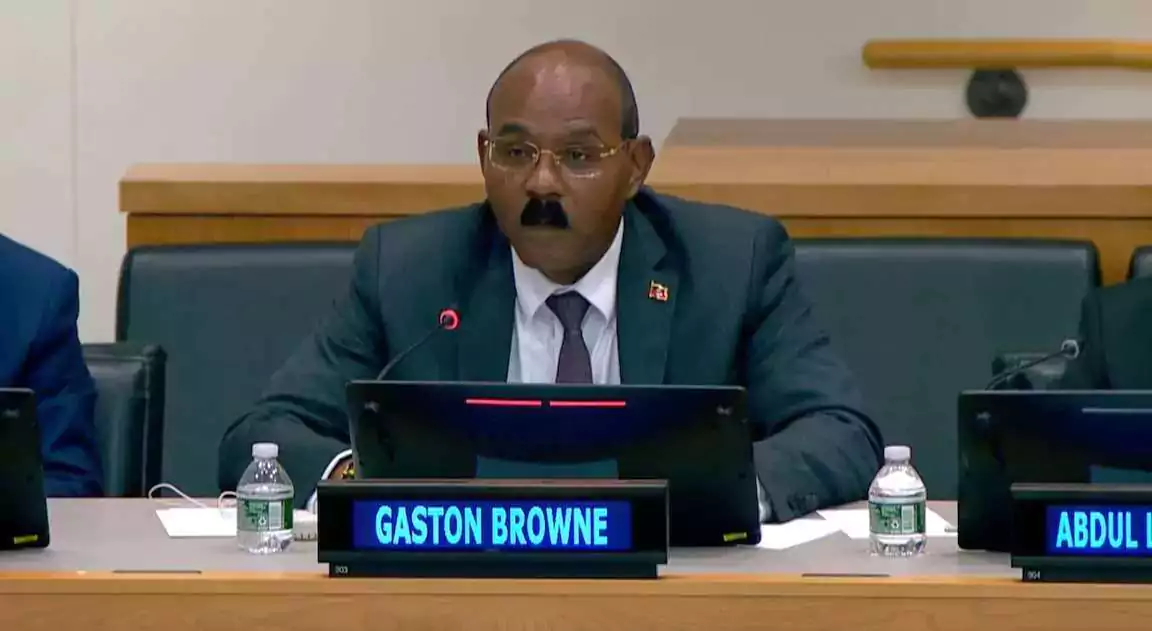
Prime Minister Gaston Browne
Prime Minister Gaston Browne has issued an urgent appeal for the immediate implementation of the Multidimensional Vulnerability Index (MVI), warning that Small Island Developing States (SIDS) can no longer afford delays in accessing fair development financing.
Speaking at the High-Level Retreat on Operationalizing the Multidimensional Vulnerability Index at United Nations Headquarters, Browne argued that while global challenges facing island nations have intensified, international financing systems continue to rely on outdated measures that fail to reflect their true vulnerabilities.
The Prime Minister, who served as co-chair of the United Nations Secretary-General’s High-Level Panel on the MVI, said the tool was developed to correct longstanding inequities created by using Gross Domestic Product (GDP) alone to determine access to concessional financing.
“The world has changed dramatically, but the rules governing access to development finance have not,” Browne told delegates.
Although the United Nations formally adopted the MVI in 2024, it has yet to be integrated into the global financial system. Browne said this delay continues to disadvantage countries like Antigua and Barbuda, which remain highly vulnerable to external shocks despite being classified as middle-income economies.
The retreat, co-hosted by Antigua and Barbuda, Portugal, the United Nations Office of the High Representative for the Least Developed Countries, Landlocked Developing Countries and Small Island Developing States, and the United Nations Department of Economic and Social Affairs, brought together governments, international financial institutions, UN agencies and development partners to discuss practical steps toward implementation.
Browne highlighted the region’s ongoing energy challenges as a clear example of why the MVI is urgently needed. He noted that nine Caribbean countries generate more than 80 percent of their electricity from imported fossil fuels, while five depend on imports for more than 90 percent of their energy needs.
“Electricity consumers across our sub-region pay some of the highest tariffs in the world, frequently approaching twice the average of developed countries. This is not because we are inefficient, but because we are trapped,” he said.
The Prime Minister explained that Caribbean nations remain vulnerable to fluctuations in global oil prices, citing the impacts of the COVID-19 pandemic, the war in Ukraine and ongoing tensions involving Iran.
“When global oil prices spike, our vulnerable countries absorb the full shock. We simply have no buffers,” he said.


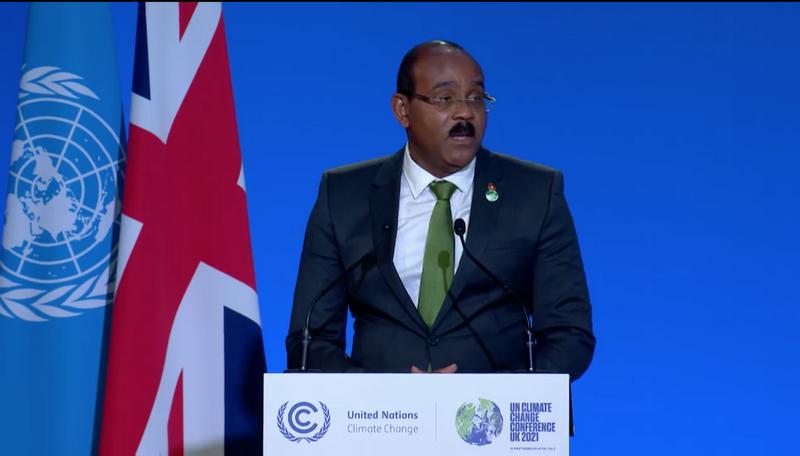


We cannot deny that Gaston has been the strongest advocate for climate chance in recent years
He deserves a medal for the way he keeps pushing for that
Time is a major factor when dealing with climate and development challenges.
Continue your advocacy sir we need leaders like you