
















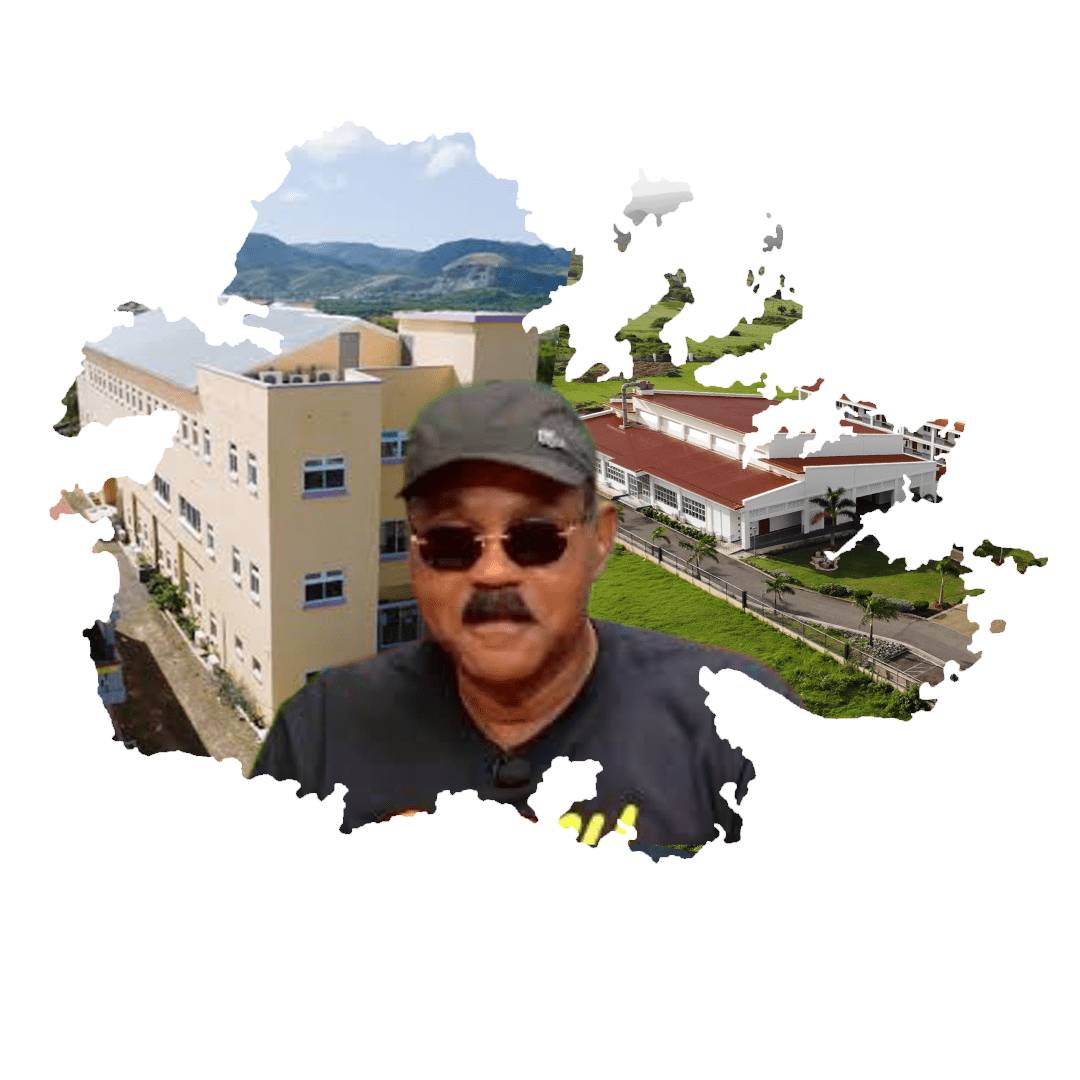
Prime Minister Gaston Browne
Fund the whole pipeline, not just the peak, and keep the receipts
By Professor C. Justin Robinson
Pro Vice-Chancellor and Principal, The UWI Five Islands Campus
Extend the windfall tax, broaden its base and dedicate every new dollar to education. That is the idea Prime Minister Gaston Browne floated last Saturday. It deserves serious national consideration. I want to suggest that the version worth building must be wider, fairer, and more demanding than simply funding any one institution.
Let me be candid about where I sit. I lead an institution that already benefits from this tax , The University of the West Indies (UWI) Five Islands Campus. The easy argument would be to ring-fence every new dollar for my campus. I will make the opposite argument. If we are serious about education as nation-building, we must fund the whole pipeline, not just the peak.
Start not with the tax, but with what it buys. Education is the only investment that returns to a society in every direction at once. The child who learns to read becomes the nurse who steadies a frightened patient, the teacher who lifts another generation, the technician who keeps an economy moving, the entrepreneur who builds her own business. A nation’s schools are not a cost reluctantly borne. They are the workshop where the country builds its future.
That is why education can never be the business of the Ministry alone. Every household, employer, and community has a stake. The family with a striving child needs the school down the road. The enterprise that wants reliable workers and stable communities needs the classrooms that produce them. Asking those who have prospered most to help strengthen that foundation is not punishment. It is shared responsibility.
So far, public discussion has centred on tertiary education, understandably, given that The UWI Five Islands has grown from fewer than 200 students in 2019 to nearly 1,500 today. That growth is real but a university is the peak of a pyramid. A peak can rise only as high as the base beneath it can hold.
If a child cannot read fluently in primary school, no tertiary levy will rescue that child at nineteen. If secondary schools cannot hold, challenge, and stretch their students, the university simply inherits the deficit. If the Antigua & Barbuda College of Advanced Studies (ABCAS) is not properly equipped, we lose one of the most important bridges in the system, gathering technical, vocational, hospitality, continuing education, and second chances under one roof.
Fund the peak alone, and we keep manufacturing the gaps we later spend a fortune trying to close. Fund the entire pipeline, the infant school, the primary school fighting for literacy, the secondary school straining at the seams, the college giving a second chance, and the campus carrying our brightest to the doctorate and we build a society, not a showpiece.
The design of such a fund matters. It should be education-wide, transparent, and disciplined. One share for early childhood and primary literacy. Another for secondary quality, retention, and teacher development. A third to build ABCAS as the national bridge between school, work, and higher learning. And a continuing share for The UWI Five Islands, so more Antiguans and Barbudans can study, research, and lead from home.
But none of this will work, or deserve public confidence, without accountability. If the public creates a common fund for a common good, the public is owed a paper trail it can follow. I propose two disciplines.

First, a public education dashboard. Not a glossy annual report that vanishes into a drawer. A plain-language, regularly updated account of what was raised, where it went, and what changed because of it. Reading levels, attendance, CSEC and other exam outcomes, Technical and vocational completions, ABCAS progression, university enrolment, retention, and graduation. Let the numbers be public and let them be uncomfortable where they must be.
Second, reciprocity. Across the region, community service has long been part of student life, the understanding that a publicly supported education carries an obligation back to the public. Write that into our own system, from secondary school through ABCAS and The UWI Five Islands.
Documented community-service hours should become a normal part of the education journey. Tutor a younger child, clean a beach or restore a community space. Sit with an elder, serve in a library, clinic, sports programme, or youth organization. The student then stops being merely a recipient and becomes a contributor to public life.
That is the deeper promise of this proposal. Not simply more money but a national bargain. Those who can contribute more will do so; those who benefit will give back; and the institutions that receive will show, clearly and publicly, what difference it made.
None of this is beyond us. A society that educates broadly lifts itself broadly. Fewer children left behind, more families secure, more enterprises finding the skills they need and more young people seeing a future at home. Lloyd Best taught us that a people must build and own the institutions that shape them and not wait to be rescued from outside.
No one is coming to educate the Antiguan and Barbudan child for us. No foreign donor, no departing empire, no benevolent hand will do for our children what we are unwilling to do ourselves.
The Prime Minister has opened an important door. Let us walk through it with ambition and discipline.
Let us carry not just a campus, but the whole pipeline from the first reader to the first degree, from the trades certificate to the doctorate. And let us keep the receipts to prove the investment paid.




Another long intellectual piece that has gone way over my head. Sighhhh
Well written and I agree 100%!!!
How much they paying you to pen these long articles ?
There is some truth in this