












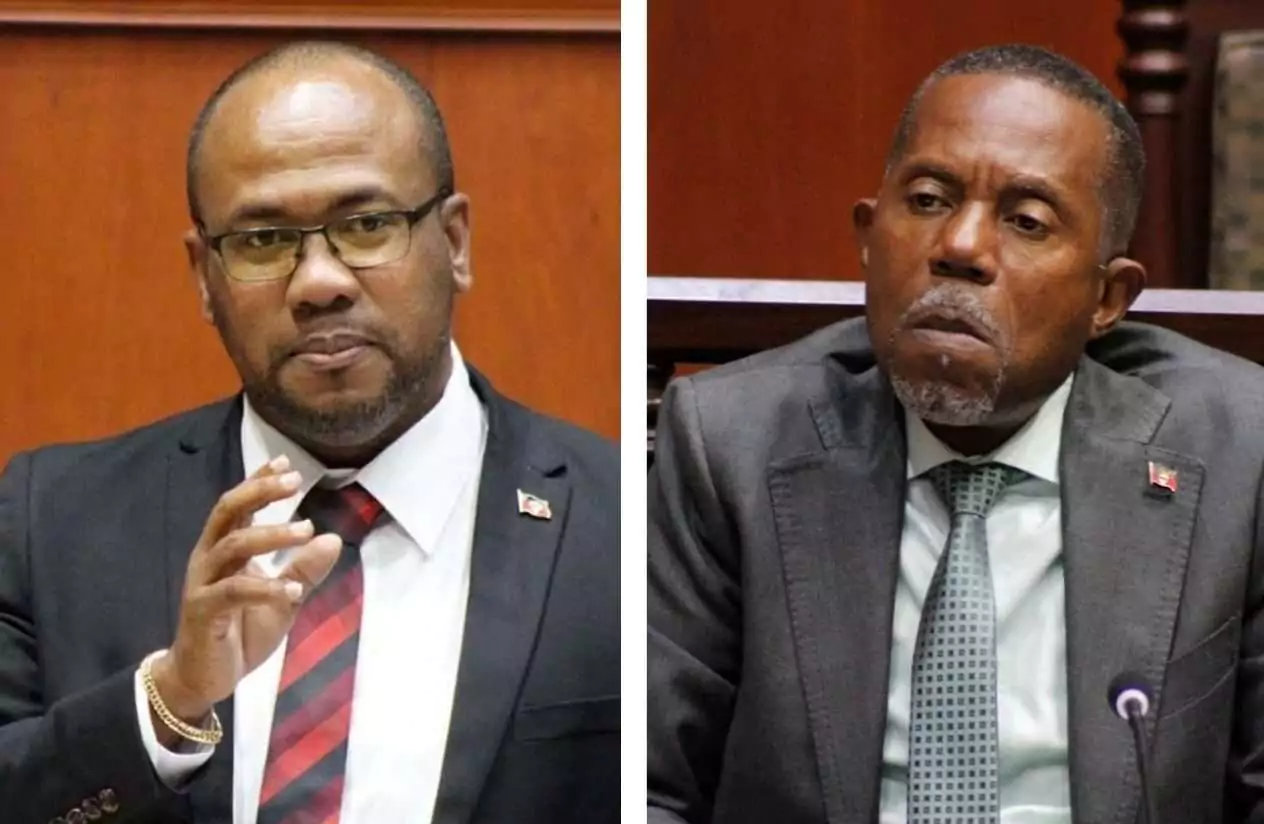
Minister Rawdon Turner (left) and MP Trevor Walker (right)
Minister of Social and Urban Transformation Rawdon Turner used his contribution to Tuesday’s House of Representatives debate to accuse Barbuda MP Trevor Walker of misleading the public by tying the government’s resolution on third-country nationals to Antigua and Barbuda’s Citizenship by Investment Programme, telling the House that the two issues are entirely separate.
Turner said Walker had failed to support what he described as “a sensible framework to negotiate on behalf of the people of Antigua and Barbuda” during his own contribution to the debate.
“You offered no support as a Member of Parliament, something that’s in the best interest of the people. You offer zero support for it. Zero support,” Turner said.
The minister accused Walker and his opposition colleagues of using soundbites on radio and social media to convince the public that the government is being forced to accept deportees because of pressure over the CIP.
“You spin every issue to deceive the people into believing that the sole reason for us being asked to accept third party nationals is because of our CIU units,” Turner said.
To make his case that the issue of the third country nationals arrangement extends well beyond the CIP programme, Turner read a list of 33 countries he said have been approached by Washington to accept third-country nationals, including Belize, Costa Rica, the Dominican Republic, Ecuador, Guyana, Jamaica, Mexico, Panama, Rwanda, Uganda and Poland.
“How many of those countries are engaged in the CIU? Y’all must stop deceiving the people,” he said.
Turner’s remarks came as the House considered a resolution setting out the principles that would govern any eventual agreement with the United States on the transfer of third-country nationals removed from that country, following the government’s publication of a white paper on the matter earlier this month.

The resolution states that Antigua and Barbuda will not accept a standing or open-ended programme and that no individual would be transferred without prior government approval on a case-by-case basis.
The minister said that the safety of the country was “paramount” and said that “if we accept any criminal element in this country from the United States, it will be the same United States that will turn around and say Antigua is an unsafe place so [US] tourists should not go there.”
Turner, who represents the St Peter constituency, said he would not have supported the arrangement if it risked bringing people with criminal records into his own community.
“I can’t go back to the people of St Peter and tell them that I’m going to accept criminal elements to be deported to this country,” he said.
Closing his contribution, Turner said the matter should not be treated as a partisan dispute given the obligations of elected officials to the wider public.
“Beat us on any other thing you want but we must show a united front on this matter because it is a national issue,” he said, calling on both sides of the House to set aside political differences in handling the negotiations with Washington.




“This is an important issue. Transparency and facts should guide the discussion, not politics.”