












The case for a strategic transition from Citizenship by Investment to sustainable economic resilience

Former Comptroller of Customs Raju Bodd
By Raju Boddu
“Citizenship is more than a passport. It is the legal expression of sovereignty, national identity and the bond between a state and its people. When citizenship becomes a commercial commodity, governments acquire immediate fiscal benefits—but they also assume long-term strategic risks.”
Introduction: A Defining Moment for the Caribbean
For more than four decades, Citizenship by Investment (CBI) programmes have provided several Caribbean Small Island Developing States (SIDS) with an innovative means of attracting foreign capital. Countries including Antigua and Barbuda, Dominica, Grenada, Saint Kitts and Nevis, and Saint Lucia have collectively generated billions of dollars through programmes granting citizenship to qualifying investors in return for contributions to national development funds, real estate investments or approved business ventures. These revenues have financed hospitals, airports, roads, schools, hurricane recovery and debt reduction, often without imposing additional taxation on citizens.[1]
For governments constrained by small domestic markets, limited natural resources and repeated exposure to hurricanes, pandemics and external economic shocks, CBI has appeared to offer an attractive solution to persistent fiscal challenges.
Yet the international environment is changing.
The European Union has progressively intensified its scrutiny of investor citizenship programmes, arguing that they may create risks relating to security, money laundering, tax evasion and organized crime. The European Commission has advocated stronger powers under the EU Visa Suspension Mechanism to suspend visa-free access where third-country citizenship schemes are considered to present risks to the Union’s security or public policy.[2]
Simultaneously, the United States, the Organisation for Economic Co-operation and Development (OECD), the Financial Action Task Force (FATF) and other international organisations have increased their focus on transparency, beneficial ownership, sanctions screening and due diligence relating to investment migration programmes.[3]
In response, Caribbean governments have introduced substantial reforms, including mandatory applicant interviews, enhanced background investigations, common due-diligence standards.
These reforms demonstrate a willingness to strengthen programme integrity. Whether they will be sufficient to preserve long-term international confidence remains uncertain.
This raises an important policy question.
Should Caribbean governments continue defending CBI as an indispensable pillar of economic development, or should they begin planning a gradual transition towards more sustainable and diversified revenue sources?
While CBI has delivered significant economic benefits, increasing geopolitical pressure and evolving international security expectations suggest that Caribbean governments should begin preparing for a future in which reliance on investor citizenship becomes progressively less viable.
The question is not whether CBI has served the region well. It undoubtedly has.
The question is whether it remains the most sustainable strategy for the decades ahead.
Why Citizenship by Investment Became so important
Understanding the future of CBI requires understanding the economic realities of the Caribbean.
Small island economies operate under structural constraints that differ fundamentally from those of larger states.
Most Caribbean countries possess:
- limited domestic markets;
- narrow export bases;
- high import dependence;
- elevated public debt;
- vulnerability to hurricanes and climate change;
- limited economies of scale;
- significant infrastructure costs.
These characteristics constrain traditional revenue generation.
Unlike larger economies, Caribbean governments cannot easily broaden their tax base or attract large-scale manufacturing investment. Tourism remains the dominant economic sector for many islands, leaving public finances vulnerable to global recessions, pandemics and natural disasters.
The COVID-19 pandemic provided a stark illustration. As international travel collapsed, tourism revenues declined dramatically across the region, exposing the fiscal fragility of tourism-dependent economies. Several governments relied heavily upon CBI receipts to stabilise public finances, finance healthcare expenditure and maintain essential public services.[4]
In this context, CBI evolved from a niche immigration programme into a central instrument of fiscal policy. For some countries, annual CBI receipts have represented a substantial proportion of government revenue. This dependence, however, has created a new vulnerability.
Fig1. The evolution of CBI Programme in the Caribbean
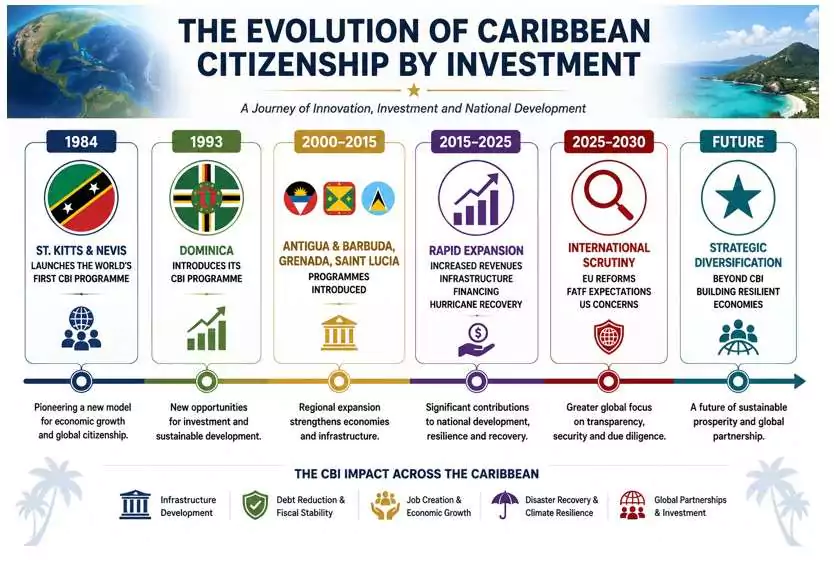
The Economic Success Story
There is little doubt that CBI has generated tangible economic benefits.
In Saint Kitts and Nevis, the world’s oldest CBI programme has financed debt reduction, infrastructure development and post-hurricane reconstruction. Antigua and Barbuda has used CBI revenues to expand public infrastructure and strengthen fiscal resilience. Dominica channelled significant receipts into rebuilding after Hurricane Maria, while Grenada and Saint Lucia have similarly supported public investment through their respective programmes.[5]
Beyond direct government revenue, CBI has stimulated investment in:
- hotels and resorts;
- residential developments;
- marinas;
- tourism infrastructure;
- professional services;
- construction;
- legal and financial sectors.
The multiplier effects have supported employment, expanded economic activity and strengthened foreign exchange earnings.
From a purely fiscal perspective, CBI has often outperformed many traditional taxation measures. It has enabled governments to raise significant capital without increasing income tax, corporate taxation or consumption taxes on domestic populations.
For policymakers facing limited alternatives, the attraction is obvious. However, economic success should not obscure strategic risk.
Fig 2. Estimated economic importance of CBI programmes
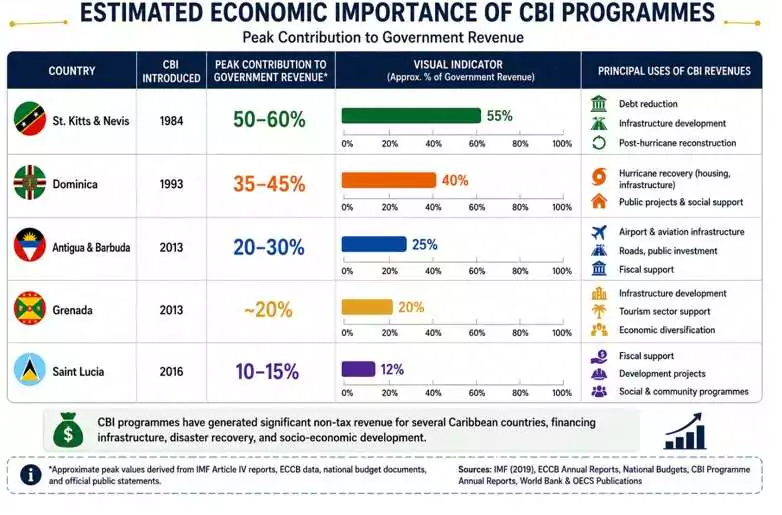
The Changing International Landscape
The international perception of CBI has evolved significantly.
Initially regarded as a legitimate exercise of national sovereignty, investor citizenship programmes are increasingly evaluated through the lenses of national security, financial integrity and geopolitical trust.
The European Commission has consistently argued that visa-free access to the Schengen Area depends upon confidence in the integrity of partner countries’ citizenship policies. Where citizenship may be acquired primarily through financial investment without what the Commission considers a sufficient “genuine link” to the country, concerns arise regarding identity verification, sanctions circumvention and organised crime.[6]
These concerns have become more pronounced following Russia’s invasion of Ukraine, increased global sanctions enforcement, heightened anti-money laundering expectations and growing international emphasis on beneficial ownership transparency.
Fig 3. Effects of hypothetical suspension of visa free access by EU
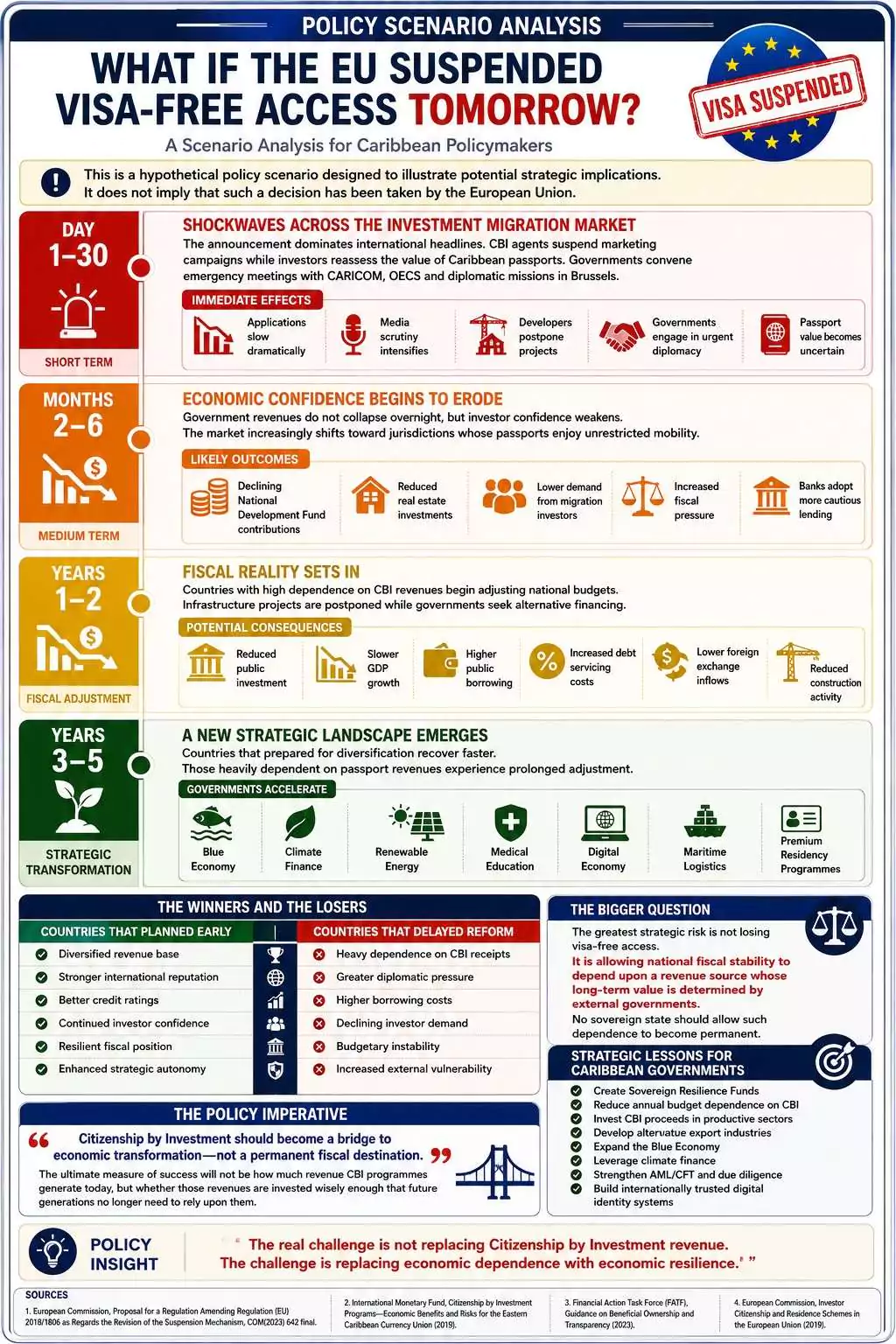
The following insert explains what will happen if EU suspends visa access to the CBI countries:
Thus, for Caribbean governments, the implications are significant. The value of their passports derives not only from citizenship itself but also from the international mobility those passports provide. If visa-free access to major destinations were significantly curtailed, the commercial attractiveness of Caribbean CBI programmes could diminish substantially.
This creates a strategic paradox. The very success of CBI depends upon maintaining the confidence of countries that are becoming increasingly sceptical of the model.
The Case for Transition: Why Caribbean Governments should begin Planning beyond Citizenship by Investment
The CBI programmes have financed infrastructure, strengthened fiscal resilience, supported disaster recovery and reduced dependence on conventional taxation. Any objective assessment must acknowledge these achievements.
However, sound public policy requires governments to evaluate not only present benefits but also future risks. The question confronting Caribbean leaders is therefore not whether CBI has been successful. It is whether long-term national prosperity should continue to depend upon a revenue source whose international acceptance appears to be steadily declining.
History offers an important lesson. Countries that successfully navigate structural economic change are usually those that diversify before external pressures force them to do so. Those that delay reform frequently find themselves responding to crises rather than shaping their own future. For the Caribbean, CBI has reached precisely such a crossroads.
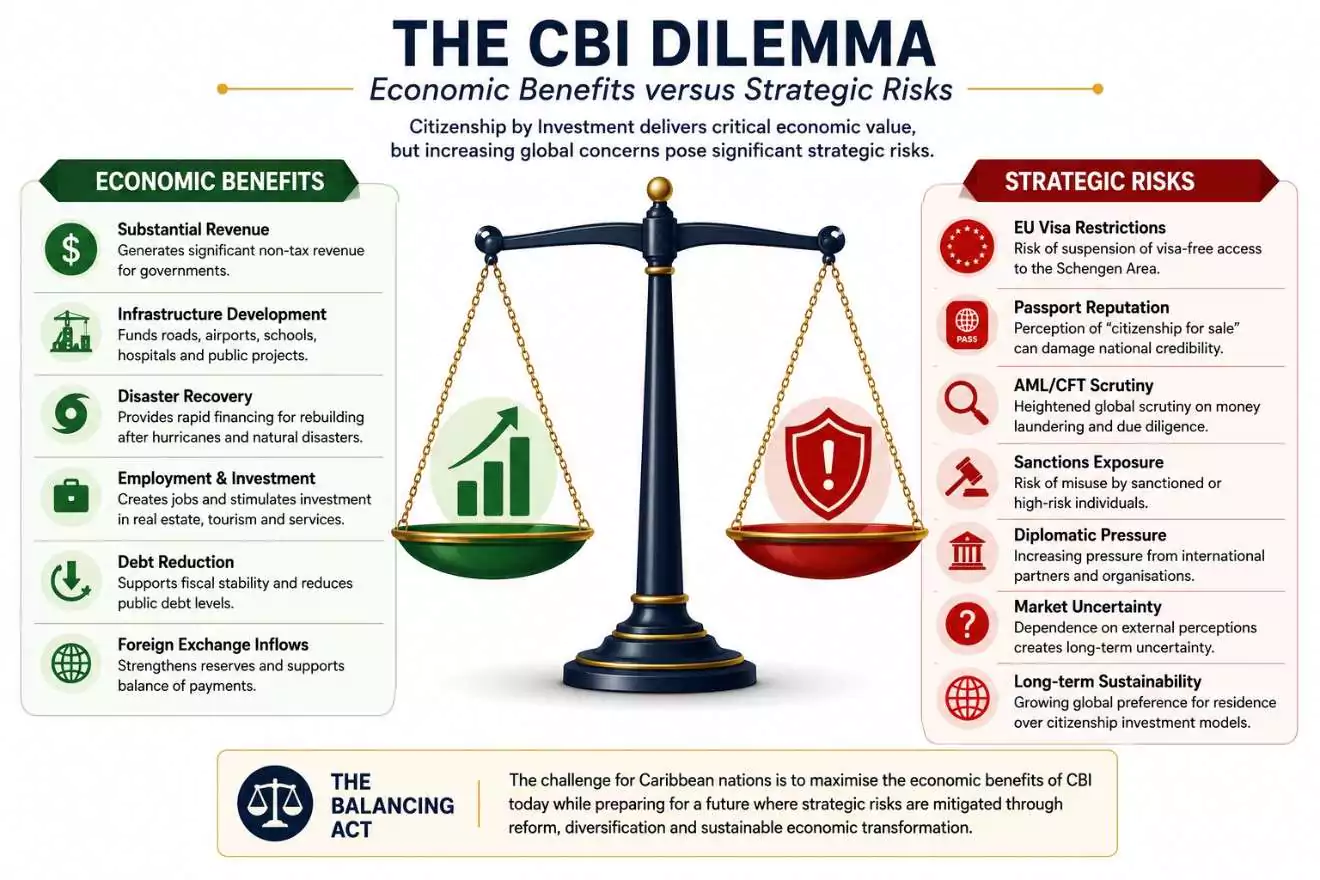

The Security Dimension
If economics explains why Caribbean governments adopted Citizenship by Investment, security explains why the international community has become increasingly concerned about it. The most significant challenge confronting CBI programmes is no longer economic. It is security. Modern border management increasingly depends upon trust.
When one country grants visa-free access to another country’s passport holders, it effectively places confidence in that country’s ability to verify identity, conduct due diligence and prevent abuse of its citizenship system. This principle underpins international mobility.
The European Union has repeatedly argued that CBI programmes may create vulnerabilities where nationality can be acquired without what it considers a sufficient “genuine connection” to the issuing state. The concern is not that every investor poses a security risk.
Rather, the concern is that the programme itself may create opportunities for abuse by a very small number of individuals seeking to conceal their identity, evade sanctions or exploit differences between national due diligence standards.[1]
Recent geopolitical developments have amplified these concerns. Following Russia’s invasion of Ukraine, governments across Europe intensified sanctions screening, beneficial ownership investigations and financial transparency measures. Citizenship programmes became subject to increased scrutiny because they potentially allow sanctioned individuals or politically exposed persons to acquire alternative travel documents.
Fig 5. International Stakeholders
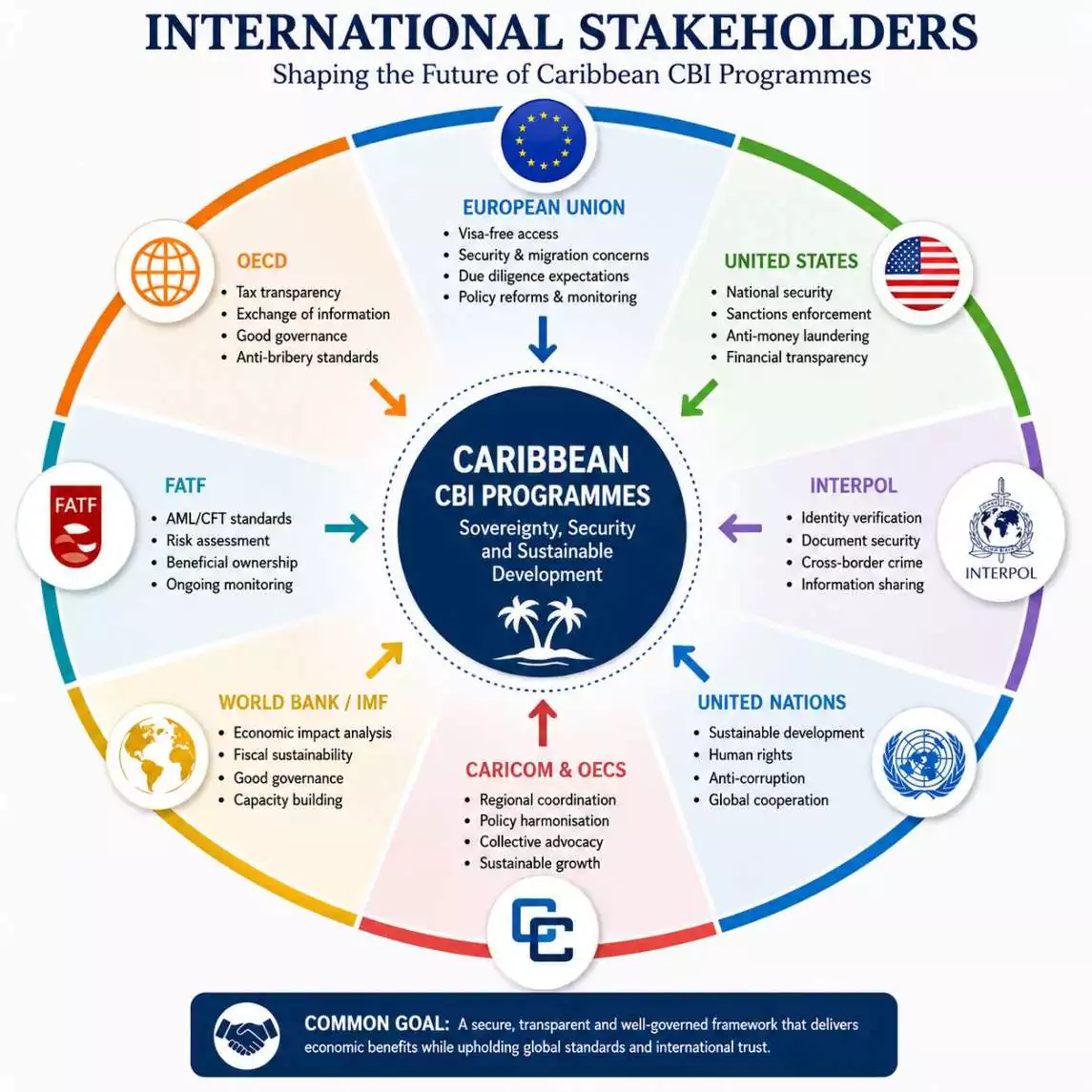
While Caribbean governments have significantly strengthened due diligence—including mandatory interviews, enhanced background investigations, biometric verification and sanctions screening—the challenge remains fundamentally one of perception.
International confidence depends not only upon actual programme integrity but also upon the confidence of partner governments. In diplomacy, perception frequently becomes policy.
International Confidence: The Caribbean’s Most Valuable Strategic Asset
Perhaps the greatest strategic risk lies not in the programmes themselves but in the consequences of losing visa-free access to major international markets.
For applicants, the principal attraction of Caribbean citizenship has never been the passport alone. It has been the mobility associated with that passport. Visa-free access to the Schengen Area, the United Kingdom and numerous other destinations substantially enhances the value of investor citizenship. Should that mobility diminish, market demand would almost certainly decline.
Governments therefore face a paradox. The more they depend upon CBI revenue, the more vulnerable they become to external policy decisions over which they exercise little control. Economic dependence on a product whose value is determined by foreign governments creates a structural strategic risk. No responsible government would willingly place such a significant proportion of national revenue beyond its own control.
National reputation has become an increasingly important economic asset. Countries compete not only for tourists and investors but also for international confidence. Financial institutions assess governance standards. Credit rating agencies evaluate policy stability. International organisations examine transparency, anti-money laundering compliance and institutional effectiveness. A country’s reputation influences investment decisions every bit as much as taxation policy.
Although Caribbean CBI programmes have undergone extensive reform, they continue to attract disproportionate international attention. Every isolated incident involving fraudulent documentation, inadequate due diligence or sanctions evasion—regardless of where it occurs—has the potential to affect perceptions of the entire region. The consequence is reputational contagion. One country’s shortcomings may affect all.
For small island economies whose prosperity depends upon international confidence, reputational capital may ultimately prove more valuable than short-term programme revenue.
The Sovereignty Argument
Supporters of CBI frequently advance a powerful constitutional argument. Citizenship, they contend, falls within the sovereign competence of independent states. This proposition is legally correct. Under international law, states retain broad discretion in determining who qualifies for nationality. However, sovereignty operates alongside another equally important principle. Other states retain sovereign discretion regarding the conditions under which they admit foreign nationals. Possessing the legal right to grant citizenship does not oblige other countries to extend visa-free travel. Consequently, the debate should not centre exclusively upon legal sovereignty. It should focus upon strategic national interest.
Governments must ask themselves a pragmatic question. Does continuing dependence upon CBI maximise long-term national prosperity? Or would a diversified economic model better protect sovereignty by reducing dependence upon a politically sensitive revenue source?
Viewed from this perspective, economic diversification becomes not a concession to external pressure but an affirmation of genuine sovereignty. True sovereignty derives from economic resilience rather than fiscal dependence.
Voluntary Reform is better than External pressure
One of the defining characteristics of successful public policy is timing. Governments that initiate reform voluntarily retain control over both the pace and direction of change. Governments compelled to reform by external pressure frequently lose that flexibility.
The Caribbean therefore faces an important strategic choice. Continue defending CBI indefinitely while responding to progressively increasing international scrutiny. Or begin designing a carefully managed transition towards alternative sources of sustainable revenue.
The second approach offers several advantages. First, it demonstrates policy leadership. Rather than appearing resistant to international concerns, Caribbean governments could present themselves as responsible partners committed to maintaining the highest standards of governance and international cooperation. Second, a phased transition would minimise fiscal disruption. There is no economic rationale for abruptly terminating programmes that continue to generate substantial revenue. Instead, governments could establish a defined transition period during which CBI receipts are progressively replaced by alternative sources of economic activity. Third, voluntary reform strengthens diplomatic credibility. Negotiating from a position of strategic choice is invariably preferable to negotiating under threat of sanctions or restrictions.
Weighing the Evidence
The debate surrounding CBI is often presented in absolute terms. This is unhelpful. The evidence suggests a more nuanced conclusion.
The Case for Continuing CBI
Advantages
- Significant non-tax government revenue.
- Infrastructure financing.
- Disaster recovery funding.
- Reduced public borrowing.
- Foreign exchange inflows.
- Real estate development.
- Employment creation.
- Increased fiscal flexibility.
The Case for Transition
Strategic Considerations
- Increasing geopolitical pressure.
- Potential visa restrictions.
- Reputational risks.
- Heightened AML/CFT expectations.
- Dependence upon externally determined market demand.
- Long-term uncertainty regarding programme sustainability.
- Growing international preference for residence-based investment programmes over direct citizenship.
Taken together, these considerations suggest that the issue is no longer whether CBI has value. It clearly does. The issue is whether it should remain the cornerstone of national fiscal strategy. Increasingly, the answer appears to be no.
A Regional Solution to a Regional Challenge
Why the OECS and CARICOM Must Act Together
Perhaps the greatest weakness in the Caribbean’s response to growing international scrutiny of CBI programmes is not the quality of individual programmes themselves. It is the absence of a unified regional strategy.
Although Antigua and Barbuda, Dominica, Grenada, Saint Kitts and Nevis, and Saint Lucia operate programmes with many common characteristics, they continue to engage with external partners largely as individual states. Each negotiates separately, responds independently to international criticism and competes directly with neighbouring jurisdictions for the same pool of investors.
Such an approach may have been appropriate when CBI was primarily a commercial initiative. It is no longer sufficient. Today, CBI has become a geopolitical issue involving border security, international mobility, anti-money laundering, sanctions compliance and diplomatic relations. These are issues that transcend national boundaries and increasingly require regional solutions.
The European Union, the United States, the Financial Action Task Force (FATF) and other international partners do not assess Caribbean programmes in complete isolation. Increasingly, they view the Eastern Caribbean as a single policy space in which weaknesses in one jurisdiction may affect confidence in the region as a whole. For that reason, fragmented national responses risk becoming strategically ineffective. The Caribbean should therefore replace competition with coordination.
From Competition to Cooperation
For more than a decade, Caribbean CBI programmes have inevitably competed with one another.
Countries have sought to attract investors through differing investment thresholds, processing times, approved real estate projects and promotional strategies. While competition has stimulated innovation, it has also created pressures that can inadvertently encourage a “race to the bottom,” where commercial considerations begin to outweigh long-term strategic interests.
A unified regional framework would fundamentally change these incentives. Rather than competing on price, governments could compete on service quality, investment outcomes and governance standards while maintaining common regional principles regarding due diligence, transparency and programme integrity. Such cooperation would enhance—not diminish—national sovereignty. It would enable each government to retain constitutional authority over citizenship while collectively strengthening the credibility of all Caribbean passports.
The objective should be a Caribbean Standard of Excellence, not a collection of competing national models.
Speaking with One Voice
Regional diplomacy carries considerably greater weight than isolated national advocacy.
The combined population of the five Eastern Caribbean CBI jurisdictions is modest. Individually, their diplomatic leverage in negotiations with major economic powers is limited.
Collectively, however, the Organisation of Eastern Caribbean States (OECS), represents an established regional institution with recognised mechanisms for economic integration, shared governance and coordinated foreign policy. A single regional negotiating position would allow Caribbean governments to engage the European Union, the United Kingdom, the United States and international organisations from a position of greater coherence and credibility rather than responding separately to each policy proposal, the region could present a common framework based on agreed standards, independent oversight and measurable performance indicators.
Such an approach would shift the conversation from defending individual programmes to demonstrating collective commitment to international best practice. Diplomatically, this distinction is significant.
Towards a Caribbean Citizenship and Investment Authority
One option worthy of serious consideration is the establishment of a Caribbean Citizenship and Investment Authority (CCIA) under the auspices of the OECS, with broader policy coordination through CARICOM. The Authority would not replace national governments or issue passports.
Instead, it would establish common regional standards for programme governance, including:
- harmonised due diligence procedures;
- common sanctions screening protocols;
- shared biometric and identity verification standards;
- regional beneficial ownership checks;
- standardised application documentation;
- common compliance audits;
- coordinated engagement with international partners.
An independent regional regulator would significantly strengthen international confidence by demonstrating that programme integrity is subject not only to national oversight but also to regional accountability. It would also reduce duplication of due diligence costs and improve information sharing among participating states.
Negotiating from Strength rather than Vulnerability
Regional coordination would also improve the Caribbean’s negotiating position. If the European Union or other international partners seek further reforms, negotiations should not occur separately with five individual governments. They should occur through a coordinated regional mechanism representing common interests.
Collective negotiation offers several advantages:
- greater diplomatic leverage;
- consistent implementation of agreed reforms;
- reduced policy fragmentation;
- lower compliance costs through shared systems;
- stronger institutional credibility.
Most importantly, regional coordination transforms the Caribbean from a collection of small states reacting to external pressure into a cohesive regional bloc shaping its own future.
Preparing Together for a Post-CBI Economy
Regional cooperation should extend beyond the management of existing programmes. It should also encompass the transition beyond them. Rather than each country independently searching for alternative revenue sources, the OECS and CARICOM should adopt a Regional Economic Transition Framework.
Such a framework could identify complementary areas of comparative advantage such as:
|
Country |
Potential Strategic Focus |
|
Antigua & Barbuda |
Aviation, logistics, yachting, digital services, Financial Services, |
|
Dominica |
Climate resilience, eco-tourism, geothermal energy |
|
Grenada |
Blue economy, higher education, marine research |
|
Saint Kitts & Nevis |
Financial services, innovation, sustainable tourism |
|
Saint Lucia |
Medical tourism, renewable energy, digital entrepreneurship |
This approach recognises that not every country must pursue identical economic strategies. Instead, the region benefits when each state develops sectors in which it possesses a comparative advantage while remaining integrated within a broader Caribbean economic ecosystem.
Regional infrastructure, digital connectivity, customs modernisation, maritime transport and educational partnerships could all support this transition.
Beyond Citizenship by Investment: Building the next Caribbean Economic Model
If Caribbean governments were to begin reducing their dependence on Citizenship by Investment, the obvious question would be:
How would they replace the revenue?
This question often dominates public debate, yet it may also be the wrong question. The objective should not simply be to replace CBI revenue. It should be to replace economic dependence.
Fig 6. Replacing Dependence
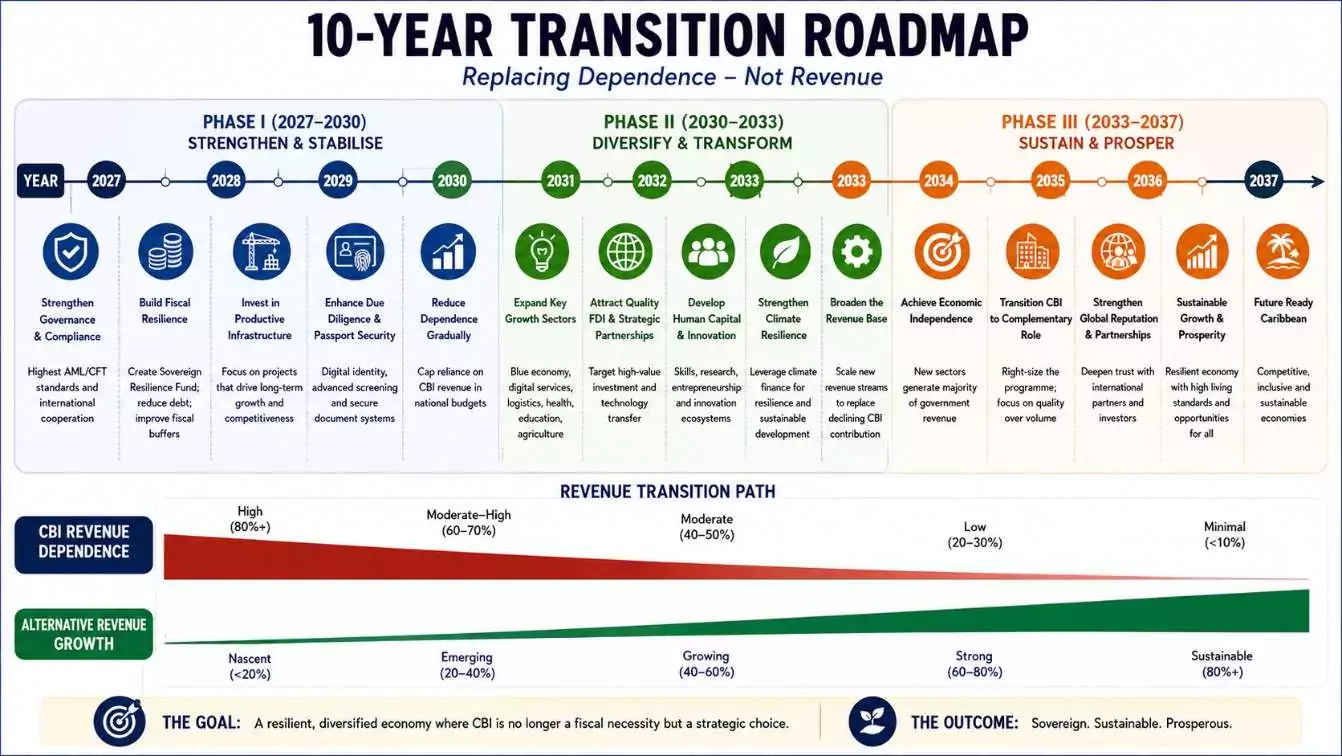
No successful economy relies excessively upon a single source of national income. Oil-dependent countries diversify into manufacturing and services. Tourism-dependent economies invest in technology and finance. Export-oriented nations broaden their industrial base to reduce exposure to external shocks. The same principle applies to the Caribbean.
CBI should be viewed not as a permanent economic pillar but as a transitional financing mechanism that enables governments to invest in the sectors that will ultimately replace it. Properly managed, today’s CBI revenues can finance tomorrow’s economic independence.
A Ten-Year Revenue Transition Strategy
Rather than abruptly terminating CBI programmes, Caribbean governments should adopt a phased transition strategy over approximately ten years.
Phase I (2027–2030): Strengthen and Stabilise
During the first phase, governments should continue operating CBI programmes under the highest international standards while deliberately reducing fiscal dependence upon programme revenues.
Key priorities include:
- creating Sovereign Resilience Funds into which a fixed percentage of CBI receipts is deposited;
- investing in productive infrastructure rather than recurrent expenditure;
- reducing public debt;
- strengthening AML/CFT compliance;
- enhancing passport security and digital identity systems.
This phase buys time. More importantly, it creates fiscal space for investment.
Phase II (2030–2033): Diversification
The second phase should focus on developing alternative revenue streams capable of replacing CBI income progressively. No single sector will replace CBI revenue. The transition must be built upon multiple complementary sources of growth.
Fig 7. The Revenue Diversification
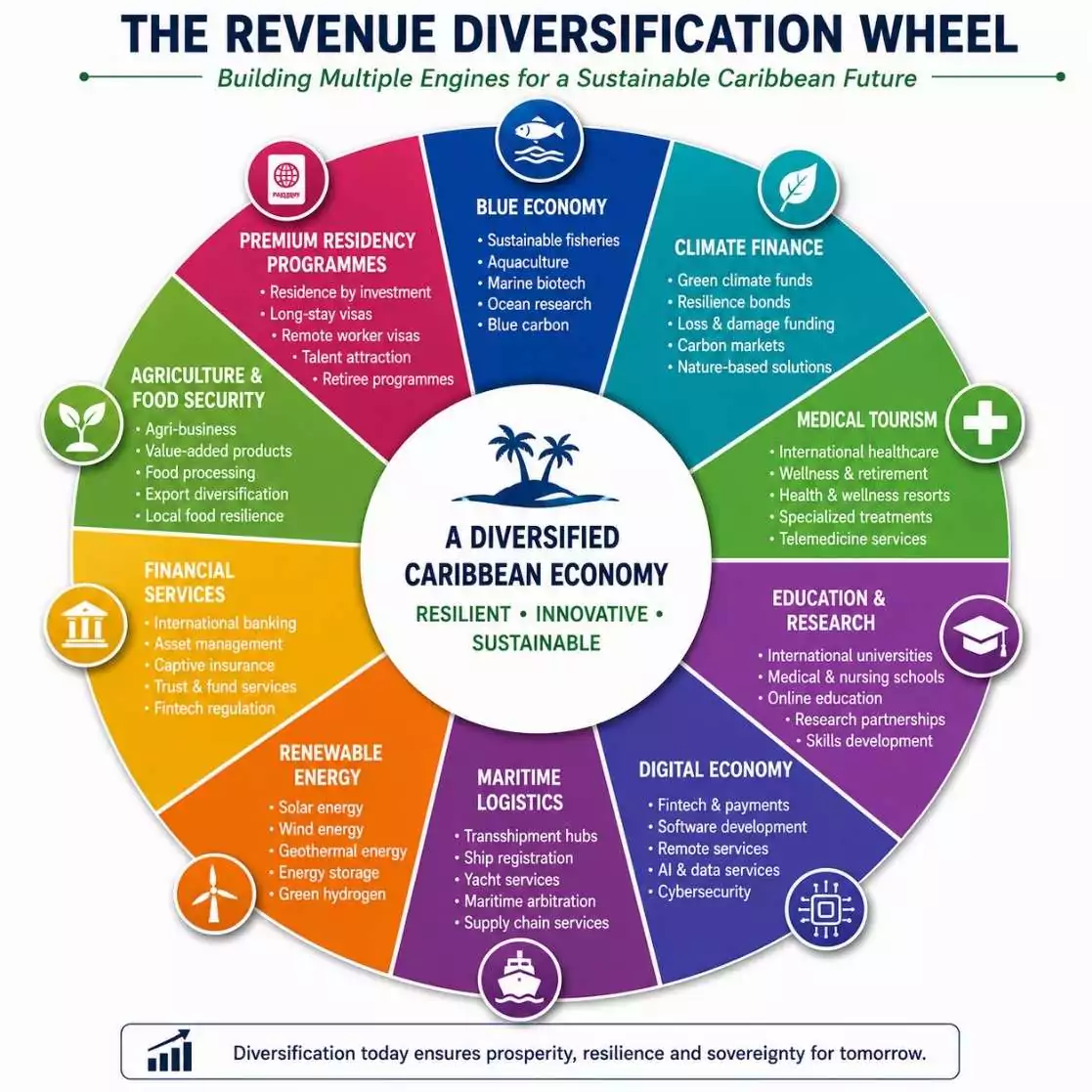
These include:
- Premium Residency Programmes
Rather than selling citizenship, governments could expand residence-by-investment programmes similar to those operating in Portugal, Greece and the United Arab Emirates.
Residence programmes generally attract lower international criticism because they do not immediately confer nationality. They provide investment while preserving citizenship as a long-term legal status rather than a commercial product.
- Medical and Educational Services
The Caribbean already possesses internationally recognised medical schools, particularly in Grenada and Antigua. Expanding medical education, specialised healthcare, retirement communities and health tourism could generate substantial foreign exchange earnings.
The ageing populations of North America and Europe present significant opportunities for high-quality healthcare services in politically stable Caribbean jurisdictions.
- The Blue Economy
Perhaps the region’s greatest untapped asset is neither tourism nor finance. It is the ocean.
Collectively, Caribbean states possess enormous Exclusive Economic Zones extending far beyond their land territory. Sustainable development of the Blue Economy offers opportunities in:
- marine biotechnology;
- aquaculture;
- offshore renewable energy;
- sustainable fisheries;
- maritime logistics;
- ocean research;
- marine conservation financing.
The World Bank estimates that the Blue Economy could become one of the principal drivers of sustainable development for Small Island Developing States.[2]
- Climate Finance
Caribbean countries stand at the frontline of climate change. This vulnerability should also position them to become leaders in climate finance.
International funding[3] is increasingly available through:
- Green Climate Fund;
- Adaptation Fund;
- Loss and Damage Fund;
- climate resilience bonds;
- blue bonds;
- debt-for-nature swaps.
Rather than depending upon passport sales, governments could increasingly finance resilience through international environmental partnerships.
- Digital Services
Digital economies are no longer constrained by geography. Small island states can compete globally in:
- fintech;
- digital payments;
- software development;
- cloud services;
- cybersecurity;
- artificial intelligence;
- regulatory technology (RegTech).
Estonia demonstrated that digital government can become an export industry. There is no reason why Caribbean nations cannot develop similar expertise within specialised sectors.
- Maritime Logistics
Situated along some of the world’s busiest shipping routes, the Caribbean possesses natural advantages for logistics and maritime services.
Investment in:
- transshipment hubs;
- ship registration;
- yacht servicing;
- maritime arbitration;
- customs technology;
- supply chain management;
could significantly expand regional economic activity.
The Security Dividend
Moving beyond dependence on CBI would also generate significant national security benefits. Governments would strengthen relationships with strategic partners by reducing concerns relating to passport misuse and sanctions circumvention.
Enhanced international confidence could facilitate:
- improved intelligence sharing;
- deeper Customs cooperation;
- expanded law enforcement partnerships;
- stronger financial sector credibility;
- reduced exposure to financial sanctions;
- greater confidence among correspondent banks.
For countries whose prosperity depends upon international trust, these benefits possess considerable strategic value.
National security today extends beyond policing. It encompasses financial integrity, cybersecurity, passport credibility and institutional reputation.
A New Narrative for Caribbean Development
Perhaps the most important change required is one of narrative. For too long, Caribbean economic policy has been framed around vulnerability.
- Small populations.
- Small markets.
- Limited resources.
- Climate risk.
While these realities cannot be ignored, they should not define the region’s future.
The Caribbean possesses extraordinary comparative advantages:
- political stability;
- democratic governance;
- English-speaking professional workforces;
- proximity to North America;
- world-class tourism;
- exceptional marine resources;
- globally respected legal systems.
The challenge is not the absence of opportunity. It is the willingness to invest strategically beyond short-term fiscal solutions. CBI has provided valuable breathing space. The next generation of Caribbean prosperity must be built upon productive investment rather than passport sales.
Conclusion: Choosing the Future
History will not judge Caribbean CBI programmes solely by the revenue they generated. It will judge whether governments used those revenues wisely. If today’s CBI receipts finance diversified economies capable of thriving without investor citizenship, history will regard the programmes as successful transitional instruments. If governments remain permanently dependent upon passport sales while international acceptance continues to diminish, future generations may view them differently.
The Caribbean therefore stands at an inflection point. One path seeks to preserve the status quo for as long as possible. The other recognises changing geopolitical realities and begins preparing for the next phase of economic development.
The choice need not be abrupt. Nor should it be. CBI should not end because external powers demand it. It should gradually become unnecessary because Caribbean economies have become stronger, more diversified and more resilient. That is not a concession. It is an affirmation of sovereignty. Ultimately, true national independence is not measured by the ability to sell citizenship. It is measured by the ability to prosper without needing to. The future of the Caribbean will not be secured by the passports it issues. It will be secured by the resilience of the economies it builds.
[1] European Commission, Investor Citizenship and Residence Schemes in the European Union, COM(2019) 12 final; European Commission, Proposal for a Regulation Amending Regulation (EU) 2018/1806 as Regards the Revision of the Suspension Mechanism, COM(2023) 642 final.
[2] World Bank, Toward a Blue Economy: A Promise for Sustainable Growth in the Caribbean (Washington, DC: World Bank, 2016); Organisation of Eastern Caribbean States, Eastern Caribbean Regional Ocean Policy (ECROP) (Castries: OECS Commission, 2024).
[3] Green Climate Fund, GCF Programming Manual: An Introduction to the Green Climate Fund Project Cycle and Project Development Tools for Full-Size Projects (Incheon: Green Climate Fund, 2020) ., United Nations, United Nations Framework Convention on Climate Change, New York, 9 May 1992, entered into force 21 March 1994.





Everything has a limit. Cant keep beating the horse like that. Its abusive.
Keep Selling Citizenship?
This is a big topic. It’s important to think about what’s best for the country in the long run.