












A Strategic Feature for Caribbean Policymakers and Business Leaders

Former Comptroller of Customs Raju Bodd
There is no announced blanket United States (US) visa ban on the Caribbean. But the region is already living with something more complex: a graduated system of full suspensions, partial restrictions, immigrant-visa pauses and financial bonds. The danger is not one dramatic regional prohibition. It is a slow widening of country-by-country controls — unless Caribbean governments can turn diplomatic protest into verified reform.
|
THE POSITION IN ONE MINUTE • Haiti: full suspension of immigrant and non-immigrant entry, subject to exceptions and waivers. • Antigua and Barbuda and Dominica: partial restrictions covering immigrant entry and the main business, tourism, student and exchange categories. • Eleven CARICOM states: included in a separate pause on immigrant-visa issuance. • Antigua and Barbuda, Dominica and Grenada: included in the US visa-bond programme for certain B-1/B-2 applicants. • All CARICOM states: exposed to periodic review and possible additions, removals or escalation. |
A region discovers that access can be withdrawn
For generations, the US has been more than a destination for Caribbean citizens. It has been a commercial corridor, a university campus, a medical referral centre, a family network and, for many small firms, the nearest large market. That familiarity can make access appear permanent. Washington’s recent policy shift is a reminder that it is not.
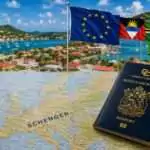
A US presidential proclamation issued on 16 December 2025 and effective from 1 January 2026 placed Haiti under full entry restrictions and imposed partial restrictions on Antigua and Barbuda and Dominica. For the two Eastern Caribbean states, the affected categories include immigrant visas as well as B-1, B-2, B-1/B-2, F, M and J visas — the routes used by business travellers, tourists, students and exchange visitors.1
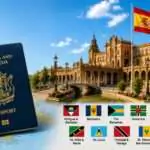
Days later, a separate State Department policy took effect. From 21 January 2026, immigrant-visa issuance was paused for nationals of 75 countries while the department reviewed public-charge and financial self-sufficiency concerns. The Caribbean list includes Antigua and Barbuda, The Bahamas, Barbados, Belize, Dominica, Grenada, Haiti, Jamaica, Saint Kitts and Nevis, Saint Lucia and Saint Vincent and the Grenadines. Applications and interviews may continue, but issuance is paused except where an exemption applies.2
A third instrument adds a financial barrier. Certain otherwise eligible B-1/B-2 applicants from designated countries may be required to post bonds of US$5,000, US$10,000 or US$15,000. Antigua and Barbuda and Dominica entered the programme on 21 January 2026; Grenada followed on 2 April.3
“The threat is not a single Caribbean ban. It is a policy escalator that can move a country from scrutiny to bonds, from bonds to partial suspension, and from partial suspension to a full closure.”
Illustration 1: Washington’s policy escalator
| Stage | Policy tool | Caribbean example / implication |
| 1 | Enhanced scrutiny | More documents, interviews and administrative processing |
| 2 | Immigrant-visa pause | Eleven CARICOM states affected |
| 3 | Visa bond | Antigua and Barbuda, Dominica and Grenada |
| 4 | Partial entry suspension | Antigua and Barbuda and Dominica |
| 5 | Full entry suspension | Haiti |
The stages are analytical, not a formal US sequence. They illustrate how separate instruments can accumulate into progressively tighter access.
Why citizenship by investment has moved to the centre
The most politically sensitive element is Washington’s explicit reference to citizenship-by-investment programmes operated without a traditional residence requirement. That language matters. It shifts the focus from the individual visa applicant to the credibility of the passport system behind the applicant.4
For Antigua and Barbuda and Dominica, the immediate diplomatic challenge is therefore larger than defending the integrity of individual approvals. They must persuade US agencies that their entire chain of identity — birth records, naturalisation files, biometrics, name changes, passport issuance, revocation and international information sharing — can withstand hostile scrutiny.
The concern is not necessarily that every investment citizen presents a risk. It is that remote acquisition of citizenship may make it harder for a receiving country to reconstruct a traveller’s identity history. A passport may be perfectly genuine while the biography behind it remains incomplete. In the post-2025 US framework, that distinction has become decisive.
This is why the issue cannot be answered through public relations alone. The response must include compulsory interviews, biometric enrolment, disclosure of previous names and nationalities, stronger source-of-wealth checks, common rules on prohibited applicants, immediate passport cancellation after revocation and effective sharing of rejected or revoked cases among Caribbean programmes.
| WHAT WASHINGTON IS REALLY TESTING |
|
• Can the state prove who a traveller was before naturalisation? • Can it trace every name change and previous passport? • Does a citizenship revocation automatically cancel the passport? • Are denied applicants shared with neighbouring programmes? • Can criminal, sanctions and lost-passport information be exchanged quickly? • Will the government accept the return of its nationals without delay? |
The human cost hides behind visa classifications
Visa policy is written in categories, but its consequences arrive as personal stories. A B-1 restriction can prevent a small exporter from meeting a buyer in Miami. An F-visa restriction can derail a university place. A J-visa restriction can interrupt a medical fellowship. An immigrant-visa pause can leave a spouse or parent in limbo after years of paperwork.
CARICOM acknowledged that wider impact in its December 2025 statement. The Community accepted the right of states to regulate their borders but expressed concern that the US decision had been taken without prior consultation and could damage legitimate travel, people-to-people exchanges and the social and economic well-being of small states. It also sought clarity about visas already issued before the new rules took effect.5
That is a sound diplomatic starting point, but it is not a complete strategy. The region will gain little from treating the dispute solely as an affront to sovereign dignity. Washington has presented the restrictions as security and immigration-compliance measures. To reverse them, the Caribbean must answer in the same operational language: verifiable identity, reliable records, prompt repatriation, lower overstay risk and auditable programme integrity.

Country risk: not every island stands in the same place
The widespread fear of an impending full suspension across the Caribbean is not supported by an announced US decision. The more credible risk is selective expansion. Countries with similar policy features may be treated similarly; countries with different systems may face different forms of scrutiny.
Illustration 2: Indicative CARICOM exposure, July 2026
|
Risk band |
Countries |
Present exposure |
Priority response |
|
Critical |
Haiti |
Full entry suspension |
Humanitarian exceptions, identity capacity and state-stabilisation support |
|
Very high |
Antigua and Barbuda; Dominica |
Partial suspension + immigrant pause + visa bond |
CBI and passport remediation; written US benchmarks; urgent category relief |
|
High |
Grenada; Saint Kitts and Nevis; Saint Lucia |
Immigrant pause; Grenada also under visa bonds |
Pre-emptive regional CBI reform and technical verification |
|
Moderate |
The Bahamas; Barbados; Belize; Jamaica; Saint Vincent and the Grenadines |
Immigrant-visa pause |
Country-specific reasons, public-charge evidence and overstay/repatriation cooperation |
|
Preventive |
Guyana; Suriname; Trinidad and Tobago; others not listed |
No comparable listed measure in the cited instruments |
Join regional diplomacy and close identity/security gaps before review |
Risk bands are analytical judgements based on current measures and policy characteristics; they are not official US designations.
The diplomatic case must be built around American interests
The most effective Caribbean argument is not that Washington owes the region access. It is that secure Caribbean mobility serves American interests. Reliable passports help US border officers. Rapid criminal-information sharing helps US law enforcement. Orderly repatriation reduces enforcement disputes. Stable Caribbean economies reduce irregular migration. Students, business travellers, patients and diaspora families also generate income for American universities, airlines, hospitals and communities.
This requires a deliberate change in tone. Public confrontation should be reserved for cases in which technical and diplomatic channels have failed. The first objective should be a written, country-specific roadmap stating what the United States believes is deficient, what corrective action is required, who will verify it and when restrictions will be reviewed.
Without that roadmap, governments risk reforming in the dark. They may introduce expensive measures that do not answer the underlying US concern, while Washington continues to rely on confidential or broadly worded security assessments.
A compact, not another communiqué
CARICOM should propose a formal US–Caribbean Trusted Mobility Compact. The mechanism should be narrower and more practical than a conventional annual dialogue. Its purpose would be to close identified gaps and convert verified progress into phased restoration of access.
The compact should bring together the US Departments of State, Homeland Security and Justice with Caribbean foreign ministries, immigration departments, passport offices, police services, financial-intelligence units, CARICOM IMPACS, the Regional Security System and CBI regulators. It should be led by a special Caribbean envoy capable of dealing continuously with Washington rather than through occasional ministerial visits.
The technical offer should cover secure civil registries, biometric passports, INTERPOL reporting of lost and stolen documents, Advance Passenger Information, Passenger Name Record analysis, criminal-information exchange, emergency travel documents and clear deadlines for nationality verification. INTERPOL describes its Stolen and Lost Travel Documents database as a global tool that enables frontline officers to check whether a passport has been reported lost, stolen, revoked or invalid.6
Illustration 3: The bargain that could unlock access
|
Caribbean commitment |
Verification |
US response sought |
|
Secure identity chain and biometric enrolment |
Independent audit and US technical review |
Restore ordinary visitor and student processing |
|
Common CBI due-diligence and revocation rules |
Shared denial/revocation data and compliance reports |
Remove CBI states from partial restrictions |
|
Prompt repatriation and nationality verification |
Service-level deadlines and case tracking |
Avoid escalation based on non-cooperation |
|
Overstay prevention and applicant education |
Disaggregated US data and periodic review |
Replace nationality-wide controls with individual assessment |
|
Criminal and lost-passport information sharing |
Operational tests and secure exchange channels |
Recognise the region as a trusted security partner |
Relief should be phased — and politically achievable
Demanding immediate and complete reversal may sound principled but could produce no practical result. A phased approach offers a better prospect of protecting the people most exposed while broader negotiations continue.
The first request should be administrative clarity: treatment of visas issued before 1 January 2026, transit rules, dual-national cases, renewal procedures and the evidence required for national-interest waivers. The proclamation states that the restrictions principally apply to designated nationals who were outside the United States and did not hold a valid visa on the effective date; it also preserves specified exceptions.7
The second request should be category-specific relief for returning students, urgent medical patients, researchers, government-sponsored exchange participants, essential business travellers, air and maritime crew and close relatives of US citizens or permanent residents.
The third should be a probationary compliance mechanism. Under that model, a country implementing an agreed plan would move from automatic suspension to enhanced individual screening. Progress would be assessed quarterly, and successful verification would lead to restoration of ordinary processing.
What Caribbean governments must do at home
Diplomacy will fail if domestic systems remain fragmented. Every affected government needs an inter-agency task force with authority over foreign affairs, immigration, passports, civil registration, police, customs, national security, financial intelligence and — where applicable — citizenship by investment.
The task force should produce a confidential risk-remediation dossier. It should map every US concern to a responsible agency, legislative measure, deadline and item of evidence. For CBI states, historic files cannot be ignored. Risk-based reviews should prioritise undisclosed name changes, conflicting identity records, sanctioned jurisdictions, politically exposed persons, unexplained wealth and applicants previously rejected by another programme.
The principle must be due process, not retrospective panic. Citizenship and passport revocation should occur only under law and with appropriate procedural safeguards. But once a lawful revocation is final, the associated passport must become unusable immediately and be reported internationally.
Washington is only one theatre
The diplomatic campaign must extend beyond the White House and the State Department. Members of Congress representing Caribbean-American communities can raise family, education and business consequences. Universities can document lost enrolment. Hospitals can explain the effect on medical travel. Airlines and tourism companies can quantify disrupted connectivity. Mayors, churches and diaspora organisations can demonstrate that the restrictions also impose costs inside the US.
The diaspora, however, should be mobilised carefully. A campaign that dismisses every US concern as prejudice may be emotionally satisfying but strategically weak. The stronger argument is that indefinite nationality-wide measures are less effective than cooperative, evidence-based screening — particularly after a government has corrected the deficiencies that prompted the restriction.
The next 180 days
The policy instruments provide for recurring review. That gives the Caribbean a window, but not an unlimited one. The first month should be used to appoint a special envoy, secure written technical consultations, identify urgent humanitarian and student cases and issue accurate public guidance. By day 90, affected governments should have completed passport and civil-registry audits, tightened CBI controls, improved lost-passport reporting and resolved repatriation bottlenecks. Before the next review, CARICOM should submit a consolidated regional offer accompanied by country-specific evidence.8
Illustration 4: A 180-day diplomatic newsroom-style timeline
|
0–30 days |
31–90 days |
91–150 days |
151–180 days |
|
Appoint envoy |
Audit passports and registries |
Invite technical validation |
Submit compliance dossiers |
The bottom line
A full suspension covering all Caribbean countries is not the most likely near-term outcome. The present architecture is country-specific, and the strategic, commercial and security costs of a blanket regional prohibition would be considerable. But complacency would be equally misplaced.
The United States has already demonstrated that it is willing to impose nationality-wide restrictions on Caribbean states. The probable danger is incremental expansion: another CBI country added to partial restrictions; another state placed under visa bonds; another immigrant category paused; another review that becomes permanent because reforms cannot be verified.
For the Caribbean, the choice is not between submission and defiance. It is between fragmented reaction and organised negotiation. The region should defend proportionality and individual treatment while offering stronger identity security, more credible programme governance and faster immigration cooperation.
The diplomatic bargain should be simple: the Caribbean strengthens the systems behind its passports; the United States restores predictable access for its students, families, patients and businesses.
AUTHOR’S NOTE
This article is a strategic policy analysis, not legal advice or an official government assessment. Immigration measures can change quickly, and individual travellers should confirm current requirements with official US sources before applying or travelling. The risk ratings are analytical judgements based on publicly available measures as at 24 July 2026.
————————————————————————————————
- White House, “Restricting and Limiting the Entry of Foreign Nationals to Protect the Security of the United States,” Presidential Proclamation, 16 December 2025, effective 1 January 2026.
- US Department of State, “Immigrant Visa Processing Updates for Nationalities at High Risk of Public Benefits Usage,” effective 21 January 2026; page updated 2 February 2026.
- US Department of State, “Countries Subject to Visa Bonds,” listing Antigua and Barbuda and Dominica from 21 January 2026 and Grenada from 2 April 2026; page updated 13 May 2026.
- White House, Presidential Proclamation of 16 December 2025, country findings for Antigua and Barbuda and Dominica, citing citizenship-by-investment programmes without a residency requirement.
- CARICOM, “Statement by the Bureau of the Conference of Heads of Government of CARICOM,” 19 December 2025.
- INTERPOL, “Stolen and Lost Travel Documents database,” describing checks on documents reported stolen, lost, revoked, invalid or stolen blank.
- White House, Presidential Proclamation of 16 December 2025, provisions on scope, exceptions, waivers and effective date.
- White House, Presidential Proclamation of 16 December 2025, provisions requiring periodic review and recommendations on continuation, modification, termination or supplementation.



WOULD LOVE TO READ AN ARTICLE ABOUT THE DUTY-FREE SCANDAL.
Question, why the photo of the former comptroller of customs?
Thought ragu retired stepped down or something. hmm he taking Saunders place? what a tangled web we weave when first we practice to deceive. I do agree it would be a pleasure to read an article on the vehicle gate scandal..
The Caribbean has to stay prepared and work together as travel rules continue to change.
I always love reading his articles