
“Stranded” astronauts safely return to earth after nine months on space station

by Mick Burrows
The two NASA astronauts who travelled to the International Space Station (ISS) for what should have been eight days, but ended up being nine MONTHS, are finally back on earth.
Barry ‘Butch’ Wilmore and Suni Williams became “stranded” after the Boeing spacecraft which took them out to the ISS in June 2024, developed technical issues which meant it was deemed too risky for them to attempt a return journey and the decision was made to leave them up in space.
They were able to hitch a ride back on the SpaceX Dragon craft, which was sent up to bring another NASA astronaut, Nick Hague and cosmonaut, Aleksandr Gorbunov, back home after they had completed their own six-month mission.
The four of them endured a 17-hour journey on the space capsule, before eventually splashing down off the coast of Florida.
All four were seen grinning as they emerged safely from the vessel, with their landing witnessed by a welcoming committee of dolphins, as the pod curiously inspected the new addition to their ocean surroundings.
The astronauts now face a period of physical readjustment, due to the fact that the months spent in a weightless environment will mean that they will have suffered loss of muscle and bone density.
They will go through a thorough medical evaluation in the coming days, followed by extensive rehabilitation over the next several weeks and months, as their bodies re-adapt to the unfamiliar pull of gravity.
Hurtling towards home
The SpaceX Dragon capsule had made a rapid and fiery re-entry through the Earth’s atmosphere, enduring temperatures of up to 1,600C, thankfully protected by a heat-shield.
An extended de-orbit thruster firing slowed the ship down for re-entry and once the craft hit the atmosphere it quickly slowed down further in the thickening air, causing the astronauts onboard to experience significant g-forces of around four times that of Earth’s gravity.
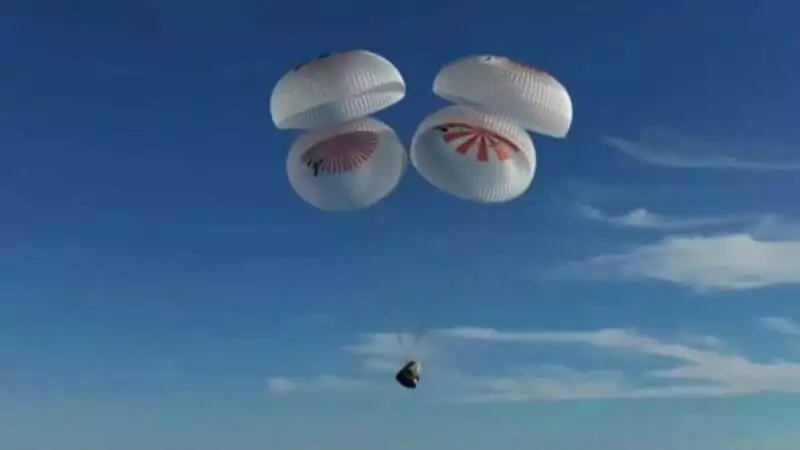
As it sped towards Florida Gulf Coast, south of Tallahassee, four large parachutes opened, enabling the capsule to slow sufficiently for it to come to rest gently on the ocean.
“Welcome home”
“Splashdown! Good mains release,” Astronaut Hague radioed through to SpaceX flight controllers in Hawthorne, California. “Copy, splashdown,” a SpaceX engineer replied. “We see main chutes cut. Nick, Alex, Butch, Suni, on behalf of SpaceX, welcome home.”
After being picked up, the clearly delighted astronauts were taken to Houston and the Johnson Space Center, for reunions with family members and more extensive medical checks.

Sixth in the rankings
For astronauts Wilmore and Williams it closed out a marathon mission that saw them undertake an incredible 4,576 orbits and 121 million miles, making their flight the sixth highest in ranking in the list of single NASA missions.
Their test flight was aboard Boeing’s Starliner, a ship designed to rival SpaceX’s Crew Dragon that is currently used to ferry astronauts into space.
Issues with outward journey from the off
It should have been more or less a “there and back” journey, but it was plagued with problems soon after it blasted off.
The capsule experienced helium leaks, creating problems with the propulsion system, and several of its thrusters would not function correctly.
After carrying out extensive investigations, NASA made the difficult decision to leave the pair where they were and bring Starliner back to Earth empty, eventually landing it safely in the desert of New Mexico.
Experienced duo
Barry “Butch” Wilmore is a veteran of two spaceflights and had accumulated 178 days in space, having previously been a US Navy captain.
Sunita “Suni” Williams is a veteran of two space missions prior to this longer than planned trip. She had an impressive 322 days in space behind her, but would not have thought she would nearly double that total when leaving Earth last June.
Gravity takes some getting used to again
Former astronaut Terry Virts, who once served alongside Wilmore whilst conducting several spacewalks, said the two “overwhelming sensations” on returning to Earth will be feeling heavy and experiencing dizziness.
“You just feel really, really, really heavy; I felt like my helmet weighed 500lbs,” he said. With regards to dizziness he joked: “Your brain is going ‘what just happened’ – there used to be gravity, then there wasn’t gravity for six months, now all of a sudden there’s gravity again!”
This story was first published by Antigua News on : antigua.news/2025/03/19/stranded-astronauts-safely-return-to-earth-after-nine-months-on-space-station. © 2025 Antigua News. Republication without permission is not allowed.

About the author
The Editorial Staff refers to all reporters employed by Antigua.news. When an article is not an original creation of Antigua.news—such as when it is based on a press release, other media articles, letters to the editor, or court decisions—one of our staff members is responsible for overseeing its publication.
Read our editorial standards and corrections policy. Spotted an error? Contact the newsroom.
More from World
View section
Spain Votes After an Eviction Shook Its Government
An elderly tenant’s eviction helped trigger the November 29 snap election. Pedro Sánchez is recovering in some polls, but the right still has the clearer route to a governing majority.
By Dario Item

Dozens of KFC Restaurants Closing Across 10 U.S. States as Major Franchise Operator Files for Bankruptcy
Financial troubles, falling sales and millions in unpaid franchise fees have forced a major KFC operator into bankruptcy, with 72 restaurant locations affected and more closures possible.
By Cory Wayland

Robert Pattinson is the new James Bond
The Twilight and The Batman star succeeds Daniel Craig as 007 in the next James Bond film, directed by Denis Villeneuve and written by Steven Knight.
By Mick the Ram

Microsoft Outage cripples millions globally
Outlook, Teams and Copilot users reported disruptions across 74 countries as Microsoft cited increased load on its infrastructure.
By Mick the Ram
Comments
Be the first to comment.