



















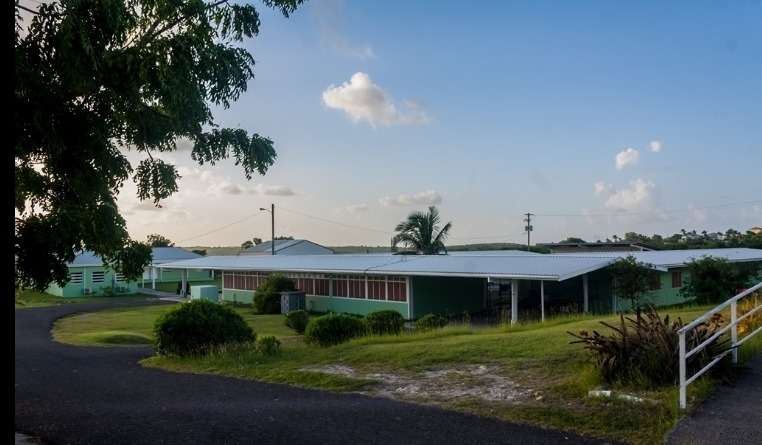
Former Glanvilles Secondary School
The new School of Agriculture, formerly the Glanvilles Secondary School will be ready to open next month.
This was the assurance from Cabinet Spokesperson Maurice Merchant when asked about an update on the readiness of the school.
“Dr. Green has already commenced its work to get the plant ready for the new school year. As you know, Glanville’s was chosen because of its near 100% readiness for this purpose.
“So, it is at a stage that the new amalgamation of all of these tertiary institutions believe that it can be operational during the upcoming school year. Of course, staffing has been considered by the Ministry of Education. All of that has been done, placements of teachers and so forth. So, it will just now require placement of students who are interested in agriculture and developing various programs to utilize that facility, but it will be utilized this coming school year,” Merchant said.
In June, Cabinet approved the merger of the Glanvilles and Pares Secondary Schools.
Dr. Jonah Greene, the Acting Director of Education, reported to the Cabinet that the merger is essential due to declining enrollment numbers at both institutions. Glanvilles Secondary School currently has 163 students, while Pares Secondary School has 178 students.

All current students from Glanvilles will be accommodated at Pares Secondary School, while teachers will either be reassigned to other educational institutions or retained within the Ministry of Education system.
As part of the overall transition, the Cabinet also endorsed a recommendation from the Ministry to repurpose Glanvilles Secondary School as the new home for the School of Agriculture.
This strategic move aligns with the Government’s broader commitment to enhancing food security and increasing access to specialized agricultural education and training.
Glanvilles Secondary School is well-equipped to support this new direction, featuring essential facilities such as a Home Economics Department, a Science Laboratory, animal pens, a hydroponic unit, and established farm plots.




The success of this school will depend on whether the programs are practical. Students need to learn real farming and agri-business, not just theory.
The CXC Agric Science is quite practical. It is hard to teach “Theoretical Agriculture”.
Government must make sure there’s funding and equipment. Agriculture can’t grow if it’s only talk and no investment.
lets NOT RUSH THIS. WE RATHER IT OPEN LATE AND BE WELL EQUIPPED THAT OPEN EARLY AND THEN ITS NOT FULLY READY
Construction delays have been common. Fingers crossed it’s ready for September.
Farming without theory is just an hobby. How can you use fertilizer or understand ripening without solid base of chemistry and biology? how can you manage pests without entomology? how can you manage a farm without solid bases of economic and market strategy?