
















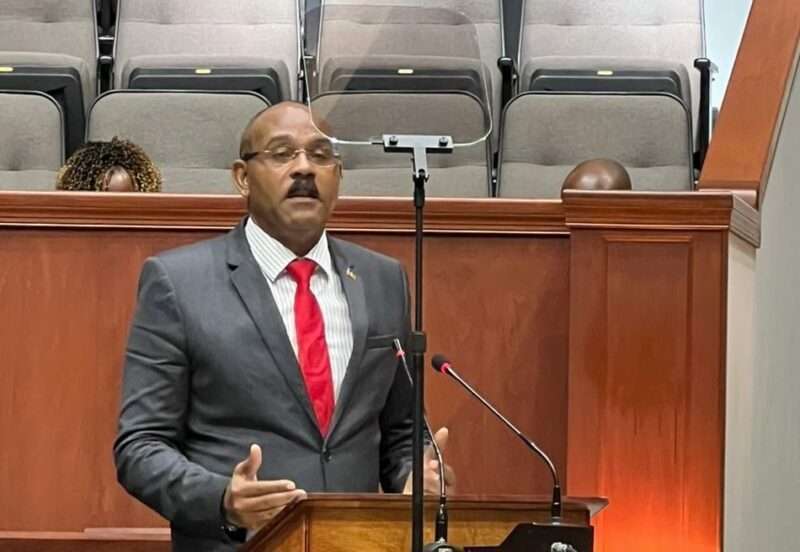
Prime Minister Gaston Browne
Thursday 4th December 2025
INTRODUCTION – Recognizing the distance we have travelled
Mr. Speaker, Honourable Members, and people of Antigua and Barbuda:
I am honoured to present the 2026 National Budget under the theme “People‑Centred Growth and Development.”
This theme reflects a simple truth — development is not about numbers; it is about people.
Yet, after twelve years of steady recovery, rising employment, stronger public services, and visible transformation, some have begun to treat progress as automatic.
But, make no mistake, the gains of the last decade were not inevitable.
They were hard fought, and hard won.
When the Antigua and Barbuda Labour Party assumed office in 2014, the nation was still emerging from the global financial crisis.
Growth was barely 1 per cent; the fiscal deficit stood at 2.7 per cent of GDP; debt exceeded 100 per cent of GDP and, adjusted for unbooked debts, was at least 110 per cent of GDP. The Government then was borrowing more than $250 million annually just to function.
Tourism was fragile, construction inconsistent, and social programmes rested on narrow and uncertain revenue.
That was the Antigua and Barbuda we met.
Today, after sustained real economic growth averaging about six per cent between 2021 and 2025, Antigua and Barbuda is projected to realise a primary surplus of $254.9 million; an overall surplus of $116.3 million. Our debt-to-GDP ratio has been brought down to 61.4 per cent and is almost within reach of the benchmark of 60 per cent set by the Monetary Council of the Eastern Caribbean Currency Union.
We have built an economy that is broader, more resilient, and capable of sustaining people-centred growth and development.
Mr. Speaker, a defining moment in this journey came in 2016, when we abolished personal income tax.
It was a bold choice, and critics foretold collapse.
But instead of decline, consumption strengthened, business turnover increased, and Government met its obligations through disciplined management, stronger fiscal administration, and economic expansion.
Returning money to working people fueled the very growth now taken for granted.
Mr. Speaker, “People‑Centred Growth and Development” is not a slogan; it is a track record of performance.
Our economy is more diversified and resilient.
We have reduced debt, expanded social protection, improved water, housing, health, education & training, and we transformed our infrastructure.
We are governing with energy, purpose and vision. We are reducing cost of living, increasing wages and cutting crime.
Our administration has created more than 1100 jobs annually, reducing unemployment below five percent, which was recorded at 5.5 percent in 2023, by the International Labour Organization (ILO).
We moved from borrowing to survive to generating surpluses to invest.
That is not drift; that is inspired leadership.
The evidence is clear.
Construction and Tourism — A Decade of Expansion
Mr. Speaker, consider construction:
In 2013, construction contributed $273.5 million to GDP.
By 2024, it contributed $900 million — more than triple the value celebrated a decade earlier.
This surge was fueled by hotel renovations, Airbnb villas, PLH Barbuda, and widespread private homebuilding — all signals of confidence in our Government’s stewardship.
Tourism tells a similar story.
In 2013, we received 550,000 cruise passengers from 293 calls.
In 2025, Antigua and Barbuda is on track to exceed one million cruise passengers — an all-time national record — supported by 533 calls, almost twice the number in 2013.
That is not luck; it is the product of planning, investment, and a commitment to national excellence.
Mr. Speaker, our Government is turning harbours into jobs, income for small businesses, and national momentum.
Labour Market and the Paradox of Success
Mr. Speaker.
Active jobs increased from 43,000 in 2014 to over 54,000 in 2025 — the closest Antigua and Barbuda has ever been to full employment.
Reported earnings continue to rise.
Opportunity has spread across nearly every sector.
Yet. Mr. Speaker, success brings its own paradox.
When electricity is reliable, salaries are paid on time, cruise ships fill the harbour, flights arrive at a modern airport, and vulnerable citizens receive support, some begin to believe it was always this way.
It was not.
It took fiscal discipline, effective negotiations, a refusal to cut social protection, and political will.
And it will take continued discipline to maintain it.
This is why Antigua and Barbuda must remain on a steady, people-centred path.
Why We Must Stay the Course
Growth is not only about GDP; it is about helping households withstand economic, climatic, and social shocks without losing dignity or opportunity.
In 2014, we stabilised the State; in 2025, we strengthened communities and empowered our people.
A Clear Contrast
So, Mr. Speaker, when some claim that “nothing has changed,” the facts answer plainly.
In 2014, our Government stabilised a country on the brink of collapse; by 2025, we have created an economy that thrives.
In 2014, our Government inherited a situation in which the previous administration was struggling to fund social programmes; by 2025, we expanded and improved them.
In 2014, the people of this country were burdened with paying personal income tax; by 2025, our Government, having removed that burden from the people, still grew the economy exponentially.
In 2014, our government worked diligently to achieve greater airlift to bring more visitors; in 2026, every room will be needed to host global gatherings.
Mr. Speaker, these gains were not accidental.
They were the product of our Government’s sound economic policies and the active support of our people.
A National Perspective
As I present this Budget, I ask the nation to look back — both for celebration and perspective.
We have moved from deficits to surpluses;
from high debt to sustainable debt;
from uncertainty to investment;
from meagre growth to robust growth and a thriving economy.
Having come this far, we cannot allow complacency or short memories to derail the path of people-centred development.
Budget Structure
This year, I will focus my remarks on the core areas of my portfolio — macroeconomic management, fiscal policy, debt, revenue reform, the public investment programme, and resilience financing.
My Cabinet colleagues will present detailed plans for their ministries, ensuring clarity, accountability, and transparency.
This is a whole‑of‑government Budget, anchored in fiscal discipline and driven by those responsible for execution.
GLOBAL AND REGIONAL DEVELOPMENTS
Mr. Speaker, our national progress does not unfold in isolation.
It is shaped, challenged, and sometimes constrained by a global economy undergoing profound shifts.
The October 2025 IMF World Economic Outlook, projects global growth slowing to 3.1 per cent in 2026 — a reminder that uncertainty is the new normal.
Inflation remains above target in major advanced economies, prolonging tight financial conditions for developing states.
Protectionism has returned in new forms: expanded U.S. tariffs, industrial policy shifts in Europe and Asia, and sharp reductions in global development assistance.
Trade routes continue to be disrupted by geopolitical tensions.
And in our own hemisphere, intensified U.S. counter-narcotics operations in the southern Caribbean are adding new regional pressures.
Mr. Speaker, these are some serious times that demand clear thinking, steady leadership, and people-centred governance.
REGIONAL CONDITIONS
The Caribbean is also feeling the weight of global headwinds.
According to the United Nations Economic Commission for Latin America and the Caribbean (ECLAC), regional GDP growth (excluding Guyana) is expected to slow to 1.9 per cent in 2026, reflecting weaker external demand, higher import costs, and tighter financing.
Tourism has softened in several destinations, and construction is moderating as major projects conclude in neighboring islands.
These trends reinforce what Small Island Developing States have long understood: that resilience is not optional.
It must be built — deliberately and continuously — through diversification, stronger fiscal buffers, and expanded access to concessional finance.
CLIMATE SHOCKS INTENSIFY
Climate shocks are now more frequent, more destructive, and more costly.
Hurricane Melissa’s devastation of Jamaica — with damages estimated by Moody’s at above US$8 billion — underscores the Caribbean’s extreme vulnerability.
No country in our region is exempt.
Climate impacts are no longer projections; they are lived reality.
Yet, Mr. Speaker, despite these headwinds, Antigua and Barbuda continues to navigate global turbulence with discipline and foresight.
Prudent fiscal management, sustained social investment, and a commitment to resilience have anchored our stability.
As the world undergoes profound transformation, our focus remains clear: to safeguard our resilience, seize emerging opportunities, and ensure resilient prosperity.
DOMESTIC PERFORMANCE
Mr. Speaker, it is against this backdrop of global slowdown and regional volatility that Antigua and Barbuda has managed to deliver strong growth, increased employment, and strengthened fiscal performance.
Our resilience at home is not an accident — it is the result of choices by the Labour Party Administration, grounded in discipline, strategic planning, and a clear vision of economic transformation.
We left nothing to chance.
We planned, we implemented, we delivered.
And now, I turn to our domestic performance in 2025.
Mr. Speaker, despite a challenging global environment, Antigua and Barbuda’s economy remained resilient in 2025.
Preliminary projections by the Ministry of Finance indicate real GDP growth of 4.8 per cent in 2025 — outperforming many of our neighbours and exceeding earlier regional forecasts.
This followed a period of elevated growth as the economy rebounded strongly after the pandemic.
We did not merely recover; we strengthened and expanded.
The strength of our economy in 2025 was no accident.
It was the result of strategic investment, policy coherence, and a deliberate commitment to keeping our people at the centre of development.
Growth was broad‑based across all sectors including tourism, construction, financial services, and public administration.
Inflation eased, employment increased, particularly in construction and services—and fiscal and debt performance continued to improve.
We are no longer a fragile, post-crisis economy.
The economy of Antigua and Barbuda is now larger, more diverse, and more resilient than at any point in its modern history.
These, Mr. Speaker, are real accomplishments of which all in Antigua and Barbuda should be justifiably proud.
These are the fruits of our people’s labour.
They are the results of a government that managed the economy effectively and delivered growth and development for the people.
Tourism and Services
Tourism remained the largest contributor to GDP.
By the end of 2024, total visitors reached 1.19 million, the highest in our history.
Arrivals in 2025 are again expected to exceed one million, supported by expanded airlift, increased cruise tourism capacity, and strengthened marketing partnerships.
Stay‑over arrivals are projected at 340,000, and with approximately 1 million cruise passengers, total arrivals are expected to reach 1.3 million in 2025.
Our emergence as a Meetings, Incentives, Conferences, and Exhibitions (MICE) destination has been transformative.
Antigua and Barbuda was named Caribbean’s Leading Meetings and Conference Destination 2025 at the World Travel Awards.
This follows our successful hosting of major international events: the UN SIDS4 Conference in May 2024, the 43rd Caribbean Travel Marketplace in May 2025, and the 55th OAS General Assembly in June 2025.
These events strengthened both our global profile and our economy.
ECCB reports visitor expenditure reached $2.4 billion in 2024, a 48 per cent increase since 2014, and is expected to grow further in 2025, supported by conferences, festivals, and renewed interest in yachting, heritage, sports, and culinary tourism.
This continued expansion demonstrates the success of our strategic investments and the bright prospects ahead for our people.
Construction and Infrastructure
Mr. Speaker, construction remains one of the most dynamic sectors of our economy in 2025, propelled by strategic public infrastructure investments and strong private development.
Government projects advanced nationwide, including road rehabilitation, water system upgrades, and housing under our various affordable housing initiatives.
Nearly every community has seen road improvements this year, and we are preparing to draw down the $100 million loan from local banks, to further expand the programme.
Water capacity and reliability also improved through projects such as the Barnacle Point reverse osmosis plant and the Antigua and Barbuda Pipe Rehabilitation Project.
Housing development continued with new home completions and the expansion of the Build on Your Own Land programme through Central Housing and Planning Authority (CHAPA) and National Housing Development and Urban Renewal Co (NHD).
Upgrades and new developments including Moon Gate, Royalton Chic, Carlisle Bay, Hammock Cove, Nobu Barbuda, and PLH’s Barbuda Ocean Club boosted tourism and expanded high‑end accommodation, while the exponential growth of AirBnB properties has deepened community participation in the sector.
The Development Control Authority recorded higher project values and increased permit approvals, signaling sustained investor confidence.
Port and Trade Activity
Mr. Speaker, our ports reflect the continued strength of the domestic economy.
In 2025, the Port of St. John’s is on track to exceed last year’s performance by 9 per cent, handling 17,976 Twenty-Foot Equivalent Units (TEUs) as of October compared to 16,691 TEUs in 2024.
Growth is driven by rising imports of groceries, construction material, and both dry and refrigerated containers.
Vehicle imports have already surpassed last year’s total, including a notable increase in electric vehicles.
For the first ten months of 2025, the value of imports reached nearly $2 billion—$250 million more than the same period in 2024.
Cement and aggregate imports also increased, reflecting strong construction demand, with three new cement importers entering a market previously served by a single supplier.
Mr. Speaker, Antigua and Barbuda is strengthening its role as a regional logistics hub. Transshipment traffic rose by 64 per cent compared to 2024.
Additionally, a new global shipping service linking Panama, Cartagena, and the Dominican Republic to Antigua has further enhanced our supply chain and solidified the Port of St. John’s as a growing node in regional trade.
Employment and earnings increasing
Mr. Speaker, our expanding economy continues to generate strong job growth across multiple sectors.
Data from the Social Security Board show active jobs rising phenomenally from 50,601 in 2024 to an estimated 54,288 in 2025, with the largest gains in construction, hospitality, education, and public administration.
Job creation has been so robust that available local labour alone can no longer meet demand, requiring the importation of additional workers.
This proves, Mr. Speaker, that there are jobs available in Antigua and Barbuda for everyone who wants to work.
Reported earnings also continue to rise, projected to exceed $2 billion in 2025, up from $1.83 billion in 2024.
The most striking evidence of upward mobility is in the mid‑income brackets: earners making $6,000–$9,999 per month increased from 2,354 to 4,578—a 94% jump—while those earning $10,000–$14,999 more than doubled from 623 to 1,607 in 2024.
These gains help reduce inequality and create a more stable foundation for household welfare.
Mr. Speaker, I make a final point on labour market issues.
Several weeks ago, I indicated that our Government was taking steps to provide another increase in the minimum wage.
I am pleased to report that the Minimum Wage Committee has started its deliberations and is expected to make recommendations early in the new year, to allow for implementation of the new minimum wage by July of 2026.
Social Security
Mr. Speaker, the management of Social Security has confirmed the institution is now financially stronger than in 2014, with rising cash reserves.
To reinforce long‑term viability, the Government will consolidate its obligations into a $437.8 million bond amortised over 25 years and we will make a cash injection of up to $75 million within the next twelve months to be used to diversify the investment portfolio.
These measures will be formalised in a Memorandum of Understanding shortly.
Consumer Prices
Mr. Speaker, inflation moderated significantly in 2025.
Data from the National Bureau of Statistics indicate that headline inflation declined to an average of 1.4 per cent from January to August 2025, down sharply from an average of 6.4 per cent during the same period of 2024. It must be noted that in September of this year, prices reduced by 1 percent.
The reduction in inflationary pressure reflected Government measures to cushion households from external shocks, lower international commodity prices, and improved supply chains. Ours is a caring government, Mr. Speaker, we consistently and continuously act expeditiously to bring down the cost of living to our people, even as we have no responsibility for the high cost of goods that are imported into our country.
That, Mr. Speaker, is the character and quality of this Labour Party government – people first… and always first.
Financial Sector
Mr. Speaker, our financial system remains strong.
The latest published data from the Eastern Caribbean Central Bank for 2025 show, commercial bank assets rose 6 per cent to $6.89 billion from December 2024 to September 2025.
Loans increased nearly 3 per cent to $3.38 billion, and investments surged 15 per cent to $1.38 billion.
Deposits climbed by $253 million to $5.24 billion, and bank’s undistributed profits increased 19 per cent to $515.6 million.
Indigenous banks reported solid profits, including ECAB at $33.7 million and ACB at $35.9 million.
Credit unions also expanded steadily.
Total assets grew by 8 per cent to $686.5 million, deposits by 8.4 per cent to $585.6 million, and loans by 3.3 per cent to $461.1 million. Credit Union’s investments also expanded by 31 per cent to $74.2 million.
Financial soundness indicators confirm that banks and credit unions are profitable, well‑capitalised, and maintain stable lending to key industries. For example, data published by the ECCB indicate that the non-performing loan (NPL) ratio is 3.38 per cent as of September 2025. This is well below the prudential benchmark of 5 per cent.
Despite mild liquidity tightening, the system remains resilient and aligned with prudential standards.
These, Mr. Speaker, were no ordinary achievements in the very turbulent and challenging international environment that engulfs us.
They are a collaboration of the inner resolve of our people and the sound management of the economy by this government.
These are the collective successes of our people, to include the private sector and the government.
Depositor Protection Trust
Mr. Speaker, the Government continues to honour its obligations to the Depositor Protection Trust beneficiaries. We committed over $300 million to resolve ABI Bank in 2015, of which $142 million was allocated to safeguard deposits in excess of $500,000.00. To date we have paid over $110 million to the DPT beneficiaries.
Had it not been for this Administration’s caring intervention, over $500 million in deposits would have been extinguished, thereby destroying savings for retirement, educational, business, and other purposes.
Though delayed, the Government will make good on delivering the balance of the DPT benefit to the remaining beneficiaries in the shortest time possible.
This burden undertaken by our Government further demonstrates our unwavering commitment to our people.
Fiscal Performance 2025
Mr. Speaker, Antigua and Barbuda achieved an historic fiscal turnaround in 2024, recording a primary surplus of $214.5 million (3.6% of GDP) and an overall surplus of $76.2 million (1.3% of GDP)—the strongest in our nation’s history.
After decades of persistent deficits, this marks a decisive shift toward fiscal resilience.
The outlook for 2025 is even stronger, with a projected primary surplus of $254.9 million and an overall surplus of $116.3 million.
These exceed our Fiscal Resilience Guideline targets of a 1.5 per cent primary surplus and maximum 1.5 per cent overall deficit, with 2025 expected to deliver a 3.97 per cent primary surplus and an overall surplus of 1.8 per cent of GDP.
Total revenue and grants are projected to rise to $1.42 billion, driven by a $129.3 million increase in tax revenue to $1.1 billion. Key contributors to this performance include:
- Import Duties: $128.9 million
- Revenue Recovery Charge: $116.9 million
- Tourism Guest Levy: $25.2 million
- Stamp Duties: $66.3 million
- ABST: $465.9 million
- Consumption Tax: $61.2 million
Corporate tax revenue is expected to jump 30 per cent to $146.6 million, while Property Tax collections rise 14 per cent to $30.6 million.
Non‑tax revenue totals $289.7 million, including $157 million from the Citizenship by Investment Programme and $48 million in dividends and surpluses.
This includes dividends from ECAB, the Eastern Caribbean Central Bank, and West Indies Oil Company, and surplus funds from the Antigua and Barbuda Airport Authority and the Citizenship by Investment Unit.
Total expenditure for 2025 is projected at $1.3 billion, including:
- Wages and salaries: $494 million
- Pensions and transfers: $305.4 million
- Goods and services: $177.6 million
- Interest payments: $138.6 million
Capital expenditure is projected to surge by 85 per cent from $77.7 million in 2024 to $143.7 million in 2025. This is mainly a result of increased investment in road infrastructure.
Finally, public debt is expected to decline from $3.98 billion in 2024 to $3.94 billion in 2025. The debt‑to‑GDP ratio is projected to fall from 66.8 per cent to 61.4 per cent, nearing the ECCU target of 60 per cent.
Bilateral and Multilateral Partners
Mr. Speaker, before outlining our plans for 2026, I wish to recognise the vital contributions of our bilateral and multilateral partners to the social and economic gains our nation has achieved in recent years.
Our friendships with the People’s Republic of China, the United States, Canada, the Dominican Republic, Cuba, the United Kingdom, the Kingdom of Saudi Arabia, Venezuela, and many other trusted partners have delivered tangible benefits to our people—through funding and technical assistance in agriculture, education, healthcare, climate adaptation and mitigation, housing, infrastructure, and national security.
We also continue to deepen cooperation, and build new alliances, with the Organisation of Eastern Caribbean States (OECS), the Eastern Caribbean Central Bank, the Caribbean Development Bank, the Commonwealth Secretariat, the United Nations, CARICOM, CARTAC, and the Development Bank for Latin America and the Caribbean.
PEOPLE-CENTRED BUDGET: 2026 AND BEYOND
Mr. Speaker, as we look ahead to 2026, we do so with confidence and renewed purpose.
Our nation is poised for another year of strong expansion, with the economy projected to grow by an impressive 5 per cent, fueled by the major transformational projects scheduled to begin or be ramped up in the coming year.
By the end of 2026, our GDP at market prices is expected to reach $6.9 billion.
This is a clear testament to the resilience, dynamism, and unwavering determination of our Government, and the contribution of the people.
The economic activity propelled by the transformational projects will be undeniable and our people can expect the creation of meaningful jobs in every sector, more profitable local enterprises, and elevated standard of living for households across our unitary State.
This growth is not theoretical; it is tangible, it is inclusive, and it is positioning Antigua and Barbuda for long-term prosperity.
It is for this reason, Mr. Speaker, that I urge all in our nation to continue working with our government, secure in the knowledge that every step forward is building a stronger, more prosperous economy which benefits all.
Mr. Speaker, economic resilience is not a slogan; it is the ability of a nation to withstand shocks, adapt to new realities, and continue delivering opportunities for its people.
The 2026 Budget strengthens the core pillars of our economy — investment, tourism, construction, infrastructure, energy security, and digital transformation — ensuring that Antigua and Barbuda remains competitive in an uncertain world.
Before I present the estimates for 2026, I outline the priorities that will shape this Government’s work over the next twelve months.
This is not a budget built on numbers; it is a budget built on people.
Our Government has always put our people at the centre of growth and development.
Every policy, every dollar, every programme must answer one fundamental question: does it improve the lives of Antiguans and Barbudans?
The 2026 Budget is therefore anchored firmly in the Medium-Term Development Strategy, ensuring that our annual actions align with a coherent, long-term plan for national transformation.
And consistent with that Strategy, the 2026 Budget is built around three interlinked national priorities: Social Resilience, Economic Resilience, and Climate Resilience.
Social Resilience
Mr. Speaker, a people-centred budget must begin with the social foundations that allow every citizen to live with dignity, to participate fully in national life, and to benefit from the progress we continue to make as a nation.
Our priority for 2026 is therefore Social Resilience, ensuring that every resident, regardless of income or circumstance, has equitable access to opportunity, security, and basic services.
Our Government has always believed that development must touch people where they live.
In 2026, we will deepen this commitment by investing in the systems that support families, empower communities, and strengthen inclusion.
Modernising Healthcare and Enhancing National Well-being
A healthy nation is a productive nation.
In 2026, we will press ahead with major upgrades to community health infrastructure.
Seventeen of twenty-three clinics have already been rebuilt or renovated, including the Cobbs Cross clinic which was recently reopened after two decades and the fully upgraded Liberta Health Clinic, which now delivers comprehensive services.
As more clinics provide stronger care closer to home, the Sir Lester Bird Medical Centre will expand its specialised offerings, thereby reducing reliance on overseas treatment.
A major milestone is the $10 million Renal Care Centre, opening in 2026.
This facility will offer expanded space, improved services, advanced equipment, and greater capacity for dialysis patients.
It is being delivered with technical support from the Caribbean Development Bank and financing from the Inter-American Development Bank as well as the Consolidated Fund.
The Centre forms a core part of our response to non-communicable diseases, ensuring timely, reliable, high-quality treatment for every patient.
In 2026, my government will also establish a Chest and Cardia Centre in collaboration with the affiliated hospital of Hangzhou Normal University in the People’s Republic of China.
The Cancer centre will also be reopened in the first quarter of 2026.
Next year will also see the launch of National Health Insurance (NHI), replacing the nearly 50-year-old Medical Benefits Scheme.
NHI will provide lifetime coverage, stronger financial protection, and universal access to healthcare.
With the support of UWI St. Augustine, a pilot begins in early 2026.
Mr. Speaker, we are advancing a comprehensive vision of national well-being, and mental health is central to it.
Mental health touches families in every community—often quietly, and without the support they need.
Our Government will not allow it to remain in the shadows.
In 2026, we will implement a new National Mental Health Policy, expand community-based mental health services, and carry out major upgrades to the newly acquired Antigua and Barbuda Behavioural Health Institute, ensuring compassionate, modern care in a safe and dignified environment.
Investing in Education and Human Capital
Mr. Speaker, our people have always known that education is the key to a better life.
Our government acts on that truth.
That is why the Government continues to invest in a modern, inclusive education system that prepares our young people to lead the next phase of our economic transformation.
The University of the West Indies Five Islands Campus is central to that vision.
As the newest member of the UWI family, it has grown from 173 students in 2019 to 1,403 in 2025—clear proof of our commitment to expanding access to tertiary education, innovation, and regional leadership.
Its growth will continue in the year ahead with new programmes, including a BSc in Software Engineering in partnership with Guangdong University in China; a Bachelor of Laws delivered with UWI Mona; and a Food and Agriculture Programme with UWI St. Augustine.
To widen access, the Government—through the Board of Education and the Prime Minister’s Scholarship Programme—will continue to provide scholarships to Antiguan and Barbudan students at UWI Five Islands, nurturing local talent and investing in our future leaders.
In 2026, the campus will advance its major physical expansion with a $200M investment: new classrooms, laboratories, a multipurpose auditorium, a modern gym, a sporting complex with track and field facilities, and expanded student housing to attract regional and international students.
Construction of the new Five Islands Primary School will also move forward, ensuring completion by January 2027 and delivering modern classrooms, labs, and inclusive learning spaces for the children of the surrounding communities.
As one of responses to reduce the cost of living, our Government has decided to introduce a tuition-free study programme at UWI Five Islands for eligible citizens. This will commence upon the expansion and upgrade of the physical campus to accommodate more students.
Effective from the 2026 school year, students at Antigua & Barbuda College of Continuing Studies (ABCAS) will enjoy tuition free study.
In addition, our government will cover all CXC exam fees for our students.
Mr. Speaker, our mission is unwavering: to provide easy access to post secondary and university education; to equip the next generation with the skills, confidence, and creativity to shape the Antigua and Barbuda of tomorrow.
Housing for Vulnerable and Working Families
Mr. Speaker, housing is a human right and the foundation of dignity.
In 2026, the Government will expand the National Housing Programme, prioritising low-income and vulnerable households.
At least 120 new homes will be delivered through CHAPA in Bolans, Glanvilles, and North Sound, alongside infrastructure for 300 additional parcels of land. National Housing will also build out a further 150 homes.
A cornerstone of our urban renewal effort is the 150-unit Booby Alley Housing Project in St. John’s, financed by the People’s Republic of China.
This transformative project will be completed by mid-2026 and will improve the standard of living for hundreds of residents and uplift an entire community.
Additionally, 50 condominium homes will be built in Barbuda and 50 in Bolans, funded by the People’s Republic of China.
We will continue to fund the Home Advancement Programme for the Indigent (HAPI), ensuring no citizen is left behind due to poverty or crisis. HAPI will be further expanded to provide building material to the poor and indigent to improve their homes.
Affordable financing for young professionals and land initiatives for first-time homeowners will also persist, enabling more families to secure homes. Given the significant demand for housing, we will undertake a new initiative to provide land for contractors and developers to construct homes for our people.
These contractors and developers will be able to access the same concessions and infrastructure support that is provided by our Government to CHAPA and National Housing.
Our land initiatives for first-time homeowners will persist, enabling more families to take that crucial first step toward securing a place they can proudly call their own.
Mr. Speaker, through these initiatives, we are not just constructing houses; we are forging pathways to opportunity and progress.
We are ensuring that every family, irrespective of their background, income, or starting point, can aspire to a secure place to call home.

Advancing Sports and Youth Development
Mr. Speaker, sport is more than recreation; it is a force that builds discipline, confidence, and opportunity for our youth.
In 2026, we will intensify upgrades to community playing fields, strengthen school sports and coaching programmes, and continue supporting national teams and elite athletes to raise Antigua and Barbuda’s profile across the region and beyond.
We will further expand the facilities around Sir Novelle Richards Academy and the renewed Potters sporting complex, establishing a centre of excellence with a youth academy, to improve the international competitiveness of our athletes.
These expanded and upgraded facilities will include a swimming pool, high performance gym, and other supporting infrastructure, including an outdoor fitness area.
The Caribbean Premier League remains a positive contributor to economic activity during the tourism off-season.
Next year, Antigua and Barbuda will host even more games, attracting larger crowds and creating greater opportunities for local businesses, performers, and workers across multiple sectors.
After their triumphant return last year, the Antigua and Barbuda Falcons—who captured the nation’s imagination—are poised to soar even higher in 2026.
Our Government is providing the means for the Falcons to give pride and pleasure to all our people.
Supporting Vulnerable Households and Managing the Cost of Living
Mr. Speaker, development must ensure that no household is left behind.
In 2026, we will continue the social programmes that protect families and uphold dignity.
The Government’s food voucher program will be expanded in 2026, to provide further reach, in assisting the poor and vulnerable.
Our School Uniforms and School Meals initiatives will keep ensuring that every child has a meal and the basic requirements to attend school and learn.
Our Senior Citizens Utility Subsidy and Peoples Benefit Programme will continue to support nearly 7,000 pensioners and 1,674 vulnerable households, with PDVCAB allocating about $10 million each year to these vital interventions.
We have also safeguarded the transport sector.
Between January and October 2025, the Government provided 76,800 vouchers—valued at $1.1 million—to 198 bus operators.
That support kept operators viable and shielded commuters from the impact of fuel price increases.
Mr. Speaker, even as inflation eases, we remain committed to protecting the purchasing power of our people.
In 2026, we will maintain ABST zero-rating on essential food items; continue subsidies on fuel, LPG, and electricity; and suspend the Common External Tariff on selected foods—lowering the cost of beans, butter, vegetables, fruits, cereals, oils, canned meats, fish, and baby foods.
We will also deepen our partnership with Guyana to import affordable staples, diversify our supply chains, and reduce supermarket prices.
These measures will safeguard real incomes and ensure that economic growth translates into lower costs and a better quality of life for every family.
Mr. Speaker, this is proactive, visionary, and caring leadership – concerned always with the welfare of the people.
National Security and Public Safety
Mr. Speaker, prosperity means little if our people do not feel safe.
Antigua and Barbuda remains one of the safest countries in the Caribbean, but we are determined to go further.
In 2026, we will intensify crime prevention and strengthen our borders.
We are investing over $4 million to train additional police recruits and equip our officers with the tools to stay ahead of criminal networks. Modern security equipment, additional arms and ammunition, and specialised crime-prevention and detection technologies, including targeted surveillance will be delivered in 2026.
We are also upgrading our maritime security.
Earlier this year, we handed over the 38-foot interceptor Swordfish to the Defence Force.
Cabinet has approved US$1 million for Phases 2 and 3 of upgrading our communications and radar systems, and a lease to purchase agreement, for a patrol vessel to reinforce maritime operations.
Mr. Speaker, this is a people-centred security agenda: better training, smarter technology, stronger borders—and a clear message to the small minority who would prey on our communities.
I say to the criminal elements in our society, we will find you; we will prosecute you, and we will keep Antigua and Barbuda safe.
Beautification of the Nation
Mr. Speaker, a clean and beautiful Antigua and Barbuda is not only a source of pride—it is a competitive asset.
Our tourism economy, our investment climate, and our community well-being all rely on the quality of our public spaces.
In 2026, the Government will intensify programmes that keep our country orderly, and attractive.
Nationwide cleanups will mobilise schools, communities, and civic groups to restore neighbourhoods and strengthen civic pride.
Tree and flower planting will convert highways and public spaces into vibrant corridors, that reflect the natural beauty on which our tourism sector depends.
We will refurbish government buildings to project national pride, and we will remove derelict vehicles to eliminate eyesores, improve safety, and restore order.
These practical, cost-effective measures will make every corner of Antigua and Barbuda more welcoming to residents and more compelling to investors and visitors alike.
Economic Résilience
Mr. Speaker, the second pillar of our people-centred development agenda is Economic Resilience—building an economy that is stronger, more competitive, more innovative, and capable of withstanding external shocks.
In uncertain times, our mandate is simple: secure steady growth, expand opportunity, and protect the foundation on which every Antiguan and Barbudan builds a better life.
Production is the engine of resilience, and 2026 will be a year of expanding output, exports, and competitiveness.
Tourism remains our anchor, and under Vision 2032 we are positioning Antigua and Barbuda as the Caribbean’s premier year-round marquee destination—attracting more visitors, improving the quality of our offerings, and ensuring that benefits reach workers, communities, and local businesses.
Major investments reflect this confidence.
The US$465 million One & Only development at Half Moon Bay will break ground in the second quarter of 2026, creating 400 construction jobs and hundreds more upon opening.
A US$40 million local-investor project at Buccaneer Beach adds 150 construction jobs and 30 permanent posts. Early in 2026, the Ayre Group launches residential sales for the US$400-plus million Nikki Beach Residences.
On Barbuda, the US$300 million MurBee Resorts development begins construction in the first half of the year.
Nobu has already invested US$70 million, with another US$40 million committed for 2026. And at Yepton Beach, the new Marriott, which is under construction, is scheduled to open for the 2027 winter season—further strengthening our position in the luxury tourism market.
Mr. Speaker, the Barbuda Ocean Club (PLH Development) remains central to national growth and development.
In 2026 alone, PLH will generate more than US$100 million in direct expenditure and support 800 jobs, over 80 per cent held by Barbudans.
ABST revenue to the Barbuda Council now exceeds $5 million yearly and growing.
With the opening of the Burton-Nibbs International Airport, tourism on Barbuda has surged: more than 200 international flights arrived in 2025, and over 300 are expected in 2026.
PLH is also working closely with the Barbuda Council and the Central Government on sustainability initiatives—monitoring turtle populations and birdlife, protecting 30 acres of wetlands and mangroves, planning a new recycling plant, and extending the concrete road network by five miles in 2026. We will also broaden nature-based solutions on Barbuda to include expansion of the artificial reef system.
As occupancy rises and the next phase of this US$3-billion investment accelerates, ABST revenue is expected to increase by at least 20 per cent.
The project has already injected more than US$750 million into our economy and will continue powering growth for the next decade.
Mr. Speaker, the Barbuda Ocean Club encapsulates the Tom Fazio golf course, which is one of the finest golf courses in the hemisphere.
Outside tourism, key projects advancing in 2026 include the $23 million local brewery—a joint venture between Government and the Antigua Distillery Ltd.; the US$10 million renovation of the 350-room Jolly Beach Resort; US$55 million in upgrades to VC Bird International Airport; and the US$40 million waterfront upland development by Global Ports.
Together, these initiatives represent US$1.5 billion in investment over the next 24 to 36 months, driving diversification, job creation, and sustainable national development.
Mr. Speaker, we will also expand our role as a premier Meetings, Incentives, Conferences, and Exhibitions hub.
In 2026, we will again host the Caribbean Travel Marketplace, and—most significantly—we will welcome the Commonwealth Heads of Government Meeting, the largest assembly of world leaders ever to gather on our shores.
This honour is reserved for nations that are stable, respected, and able to deliver.
Such events do more than fill hotel rooms: they elevate our global visibility, strengthen diplomacy, support small businesses, and create year-round economic activity.
They show the world that Antigua and Barbuda is not only participating in global affairs—we are hosting them, shaping them, and leading from the front.
This has all become possible because of the leadership that your government has had the courage and the intellect to show, and the respect it has earned in the global community.
Agriculture
Mr. Speaker, agriculture is central to our food security and to reducing the $175 million import bill, in line with CARICOM’s goal of a 25 per cent reduction by 2030.
We recently acquired $4 million in heavy duty and farming equipment to raise production in this sector. A further $4 million will be invested in 2026 to build two new abattoirs and upgrade the existing one—strengthening livestock production and keeping more food dollars at home.
Additionally, we will develop an agro-industrial park at Diamonds Estate, while collaborating with UWI to establish an eco-lodge at Christian Valley to promote sustainable agricultural tourism.
Mr. Speaker, these investments are not only about national food security; they open real opportunities for farmers, agri-businesses, and individual and corporate investors.
Modern agriculture is now a viable, profitable sector for individual enterprise and for companies seeking new avenues of growth.
Mr. Speaker, as part of this drive toward inclusive growth, our Government will collaborate with the Inter-American Institute for Cooperation in Agriculture (IICA) to introduce a Mushroom Production Programme, designed to open new entrepreneurial pathways for women and youth.
Mushroom cultivation is an emerging, high-value, low-cost agricultural niche with strong demand across the domestic market.
This initiative will empower new entrepreneurs, reduce reliance on imports, and help diversify the nation’s agri-business ecosystem.
Together, these initiatives will modernise the sector, expand production, attract private investment, and diversify the economy—securing long-term growth and greater food sovereignty for Antigua and Barbuda.
Small Business and Access to Finance as Engines of Inclusive Growth
Mr. Speaker, micro, small, and medium enterprises are the backbone of jobs, innovation, and community development.
In 2026, we will expand support for women-owned businesses, youth entrepreneurs, digital start-ups, and agri-processing ventures.
The Entrepreneurial Development Programme (EDP)—now with over $7 million in loans disbursed to 181 entrepreneurs since 2019—will remain central to this expansion.
We will also deepen collaboration with financial institutions, strengthen access to credit through the Eastern Caribbean Partial Credit Guarantee Corporation, and maintain concessions under the Small Business Act to help firms grow and compete.
These reforms will unlock financing for agriculture, manufacturing, tourism, and green-economy projects; ensuring that small businesses have the capital, skills, and opportunities to thrive.
The success of local entrepreneurs will contribute to the advancement of our nation – and that is the goal to which our government is working.
Infrastructure and Utilities: A Better Quality of Life
Mr. Speaker, infrastructure is not just concrete and steel—it is opportunity, equality, and progress.
It ensures that children reach school safely, businesses expand, and communities flourish.
Islandwide road rehabilitation continues at an unprecedented pace.
With support from the UK-funded Road Infrastructure Rehabilitation Project and the CDB-financed Second Road Infrastructure project, more than $110 million has improved Sir George Walter Highway, Friars Hill Road, Old Parham Road, Anchorage Road, Valley Road North, and the Sir Sydney Walling Highway.
In 2025, the programme expanded further.
More than $40 million in roadworks has already been delivered across nearly every community through the new Infrastructure Development Fund.
Additionally, we have secured over $100 million through a syndicated facility arranged by a domestic bank to redevelop All Saints Road and rehabilitate roads and drains nationwide.
The Honourable Member for Works will outline this transformative programme in greater detail.
Barbuda is rising as well—with a planned $50 million road project, a new $14 million cargo and tourism port, a primary school funded by the Dominican Republic, and continued expansion of the Burton–Nibbs International Airport.
These investments are structured to empower local contractors and strengthen the island’s long-term development.
Beyond roads, our Administration is investing in clean water, stronger electricity grids, renewable energy, and digital connectivity, including a US$15 million subsea cable.
The provision of broadband services is a public good. In 2026, APUA will offer a broadband Vitz model with a cost under $100 monthly. This again is in response to reducing the cost of living, which is not limited to food prices.
These initiatives ensure reliable, affordable services that support homes, businesses, and innovation.
Mr. Speaker, Antiguans and Barbudans can see the progress and benefit from its impact every day.
These infrastructure investments reflect our unwavering commitment to improving the quality of life for all our citizens and to building a stronger, more resilient future for our nation.
Climate Resilience
Mr. Speaker, our third priority for 2026 is Climate Resilience. For the Caribbean, climate change is not theory—it is lived reality.
Hurricanes Irma and Maria in 2017, Beryl in 2024, and Melissa in 2025 have shown, with brutal clarity, the vulnerability of Small Island Developing States.
Even though our emissions are negligible, we continue to face the full force of a crisis we did not create.
In 2026, we will intensify disaster preparedness and climate-smart development.
Resilience will be built into every layer of national infrastructure: hurricane-resistant construction, stronger utilities, improved drainage, and strict enforcement of building codes and land-use rules.
Mr. Speaker, Antigua and Barbuda is not only defending itself—we are helping to lead the global climate fight.
We co-created the Antigua and Barbuda Agenda for SIDS (ABAS), the new ten-year international framework for all Small Island Developing States. And through our historic victories at the International Tribunal for the Law of the Sea and the International Court of Justice, we have secured authoritative rulings that major emitters have legal duties to prevent climate harm and to support vulnerable nations.
Already, our Green Climate Fund accreditation has expanded fivefold—from US$10 million to US$50 million—greatly increasing our direct access to climate finance.
In 2026, Antigua and Barbuda will continue to lead by example, showing what is possible when sound policy, appropriate financing, and effective implementation move together.
Our message remains clear: when storms come, Antigua and Barbuda may bend, but we will not break.
And in 2026, we will press vigorously for the climate finance—grants, concessional funding, and loss-and-damage resources—that our people need and that the world now has a legal and moral obligation to deliver.
Most of the funding will be utilised to refurbish and build climate resilient houses for our people.
Fiscal Resilience and Public Financial Management
Mr. Speaker, the Fiscal Resilience Oversight Committee, established in February 2024, is now fully operational and today we table its first report.
The Committee—drawing expertise from academia, the private sector, labour, the public service, the Eastern Caribbean Central Bank, and the Opposition—provides independent oversight of our Medium-Term Fiscal Strategy.
Its report confirms strong economic performance, continued post-pandemic recovery, and compliance with the fiscal targets set out in the Fiscal Resilience Guidelines.
The Committee recommends accelerating debt-management reforms and establishing a dedicated Debt Amortization Fund.
It also calls for improved ABST compliance through electronic invoicing, stronger audits, broader property-tax reform, and greater diversification of non-tax revenue.
Further recommendations include a public-sector wage review linked to performance, more targeted subsidies for vulnerable groups, and enhanced fiscal transparency through quarterly reports and a Citizens Transparency Portal. The award of government contracts, tax concessions and payments to contractors and suppliers will be published on the Transparency Portal.
Mr. Speaker, the Government welcomes these recommendations. They align with our broader effort to strengthen fiscal discipline, modernise public financial management, and reinforce public trust.
A More Targeted and Strategic Concessions Policy
Mr. Speaker, we are refining our concessions policy to ensure that incentives support growth while safeguarding the national interest.
Concessions will remain pro-investment, but they will now be tied directly to performance—job creation, export expansion, and increased local content.
We are digitising the entire concessions process to improve transparency, reduce processing time, and provide clearer oversight.
An annual review mechanism will ensure that incentives remain aligned with fiscal realities and sector priorities.
This is why all investors have been asked to reapply—not as a burden, but as a necessary step to guarantee that incentives deliver real and measurable benefits for investors and the people of Antigua and Barbuda alike.
Debt Sustainability
Mr. Speaker, debt sustainability remains central to our economic strategy.
We have stabilised the debt-to-GDP ratio through disciplined management and improved economic performance.
To build on this progress, the Government will establish a new Debt and Development Finance Office to bring together debt management, resource mobilisation, and access to climate finance under one strengthened institutional framework.
We are pursuing debt-for-climate swaps and are finalising a liability-management operation with the support of the Development Bank of Latin America and the Caribbean (CAF).
The financing generated will fund climate-resilient and sustainable-development projects while reducing domestic arrears that arose during the COVID-19 period.
Our overarching goal remains clear: secure the lowest-cost, longest-term financing, maintain timely payments, and provide predictable fiscal operations that inspire confidence among creditors, investors, and the public.
Revenue Enhancement
Mr. Speaker, revenue enhancement will be a major pillar of our fiscal agenda in 2026.
Despite progress, Antigua and Barbuda still ranks lowest in the OECS in tax revenue as a share of GDP.
This must change.
We are improving ABST compliance through digitisation, enhanced monitoring, and stronger enforcement.
Customs and Inland Revenue systems are being fully modernised to reduce human interference and improve efficiency.
With technical support from CARTAC, we are closing loopholes that facilitate evasion, implementing rotation strategies to reduce the risk of collusion, and deploying modern scanning technology for better container inspection and reduced leakages.
A new tax administration system at the Inland Revenue Department will streamline collections and make compliance simpler for taxpayers.
Expenditure Management and Public-Sector Efficiency
Mr. Speaker, responsible expenditure management and improved public-sector performance are essential to a modern and credible state.
We are tightening expenditure controls to ensure that every dollar supports national priorities.
Reform of State-Owned Enterprises is underway to improve performance and reduce fiscal risks.
The Treasury Department will undergo structural changes in 2026 to modernise its operations and deliver services at the standard our people deserve.
Public-sector productivity reforms are advancing following extensive engagement with Permanent Secretaries, and UWI Five Islands will deliver a specially designed professional-development programme for public servants.
We are also strengthening audits and accountability mechanisms to ensure that public resources are protected, well-managed, and used solely for the benefit of the people of Antigua and Barbuda.
Estimates of Revenue and Expenditure – 2026
Mr. Speaker, the 2026 Budget is a blueprint for resilience, growth, and shared prosperity.
It reflects continuity, discipline, and measurable results, fully aligned with our Medium-Term Fiscal Framework and Development Strategy for 2024–2028.
Our mission remains clear: strong fiscal health, sustainable debt, and growth that benefits every citizen.
Full details of the revenue and expenditure estimates are presented in the appendices, but I will highlight the major elements.
For 2026, we project a primary surplus of $207.9 million and an overall surplus of $69.5 million—another year of prudent financial management and fiscal stability.
These outcomes are grounded in strong revenue performance.
Recurrent revenue is projected at $1.49 billion, including $1.25 billion in tax revenue, equivalent to 18 per cent of GDP—an improvement of two percentage points over last year, though still below the ECCU average of 20 per cent and the regional benchmark of 25 per cent.
The major contributors to tax revenue are the Antigua and Barbuda Sales Tax at $506.9 million, Corporation Tax at $159.4 million, Import Duties at $162.3 million, the Revenue Recovery Charge at $127.2 million, Property Tax at $42.9 million, Stamp Duties at $72.1 million, Consumption Duties at $81.4 million, and the Tourism Guest Levy at $27.4 million. Non-tax revenue is expected to reach $240.7 million, including $120 million in CIP receipts and surpluses from state-owned enterprises.
Turning to expenditure, recurrent spending is projected at $1.21 billion, comprising $504.5 million in wages and salaries, $231.2 million for goods and services, $336.4 million in pensions and transfers, and $138.4 million in interest payments.
Capital expenditure is projected at $230.8 million, with significant allocations for ongoing roadworks and the refurbishment of public buildings.
Mr. Speaker, these estimates reflect a disciplined, confident government—one that protects stability, strengthens growth, and ensures that the benefits of our progress are shared by every Antiguan and Barbudan.
Allocations to Ministries
For the 2026 Recurrent Expenditure Budget, $220.1 million is allocated to the Ministry of Education, Sports and Creative Industries.
This is followed by the Prime Minister’s Ministry and Ministry of Finance and Corporate Governance with an allocation of $196.9 million and the Ministry of Health, Wellness, the Environment and Civil Service Affairs with $147.5 million.
These allocations align with the Government’s commitment to enhance access to education and affordable health care and ensuring sound macroeconomic management.
The 2026 recurrent budgetary allocations for the other Ministries are as follows:
- Ministry of Works and Housing: $121.7 million
- Attorney General’s Office and Ministry of Legal Affairs, Public Safety, Immigration and Labour: $124.6 million
- Ministry of Foreign Affairs, Trade and Barbuda Affairs: $35.5 million
- Ministry of Tourism, Civil Aviation, Transportation and Investment: $39.1 million
- Ministry of Information, Communication Technologies, Utilities and Energy: $15.9 million
- Ministry of Agriculture, Lands, Fisheries and the Blue Economy: $29.5 million
- Ministry of Social Transformation and Urban Renewal: $31.9 million
Budget 2026 also includes allocations for other offices, such as the Legislature, the Judiciary, Audit, Cabinet, the Office of the Governor General, Ombudsman, Electoral Commission, and others.
Full details of all budgetary allocations are available in the Appendices.
Budget Financing
Mr. Speaker, the 2026 Budget forecast for Total Revenue and Grants is $1.51 billion while total expenditure (excluding amortization payments) is projected at $1.44 billion. Amortization payments amount to $636.6 million which means our net financing requirement will be $567.1 million or 8 per cent of GDP.
To meet the net financing requirement for Budget 2026, we will primarily rely on the issuance of securities on the Regional Government Securities Market, which will amount to $335.5 million, and disbursement of loans and advances amounting to $231.6 million.
Allocations for the Prime Minister’s Ministry and the Ministry of Finance and Corporate Governance
Mr. Speaker, during the debate in this Honourable House, Ministers will address the allocations to their Ministries and explain the purposes, programmes and projects on which monies will be spent.
In addition to improving revenue performance and expenditure management, priorities in the Ministries for which I am responsible will include:
- Completing the National Housing and Population Census
- Upgrading procurement management through legislative and administrative reforms
- Strengthening the operations of and capacity within the Antigua and Barbuda Defence Force and the Office of the National Drug and Money Laundering Control Policy
- Implementing the Government’s arrears clearance strategy to egularize amounts due to suppliers. Mr. Speaker, $15 million was allocated in Budget 2025 for this purpose and, to date, we have settled arrears of over $40 million to numerous merchants and contractors through a combination of tax set-offs and cash payments.
Back Pay and Collective Bargaining
Mr. Speaker, a Government’s character is revealed not in slogans, but in how it treats its workers.
Since 2022, this Administration has cleared nearly $60 million in retroactive wages owed to public servants.
We did not hide from this responsibility; we faced it head-on.
And later this month, we will make a further payment, ensuring that every eligible worker—including those who left the public service before December 2022—receives what is rightfully theirs.
Civil Servants will also benefit from a further upgrade in pay, as a result of the reclassification that will be completed by July 2026.
Mr. Speaker, others talked about fairness; we delivered it.
To prevent these arrears from ever mounting again, we are restructuring the entire wage-negotiation process.
Unions have already been invited to submit their proposals, and we are driving toward timely, disciplined bargaining so that new salary increases take effect by July 2026.
No drift, no excuses—a modern public service deserves modern collective bargaining.
Mr. Speaker, in 2024 we raised minimum Government and Social Security pensions to $1,000 and $500 respectively and increased all other Government pensions—except those of parliamentarians—by at least 7 per cent.
We made that choice deliberately: because workers and retirees should never be asked to tighten belts while others loosen theirs.
In that same spirit, we are again reviewing Government pensions and will deliver a further increase, also effective July 2026.
Let it be clear:
Our Government honours its obligations, respects its workers, and protects its pensioners.
We do not postpone justice; we do not defer dignity.
When we say we put people at the centre of development, we mean it—and every payment made, every arrear cleared, every pension increased is proof of our commitment to empowering our people.
That is the way of good governance.
That is the way of caring leadership.
That is the way of the Antigua and Barbuda Labour Party.
CONCLUSION
Mr. Speaker, as we look toward 2026, this Budget makes one solemn promise: that the progress of Antigua and Barbuda will remain people-centred, inclusive, and shared by all.
We have presented a programme that strengthens our social fabric, deepens our economic foundations, and builds the resilience required in an unpredictable world.
But no Budget—and no Government—can fulfil this vision alone.
Our future will be shaped, as it always has been, by the courage, creativity, and participation of our people.
It is that spirit that carried us from crisis to confidence… from recovery to renewal… and from uncertainty to national ambition.
It built our democracy, sustained our fore parents, and defined who we are.
And it is that same spirit of resilience that has driven the real, measurable progress of the last decade.
Mr. Speaker, the facts tell the story.
In 2014, our debt-to-GDP ratio stood at 100.2 per cent.
By the end of 2025, it will be 61.4 per cent.
In 2014, we ranked 58th on the Human Development Index.
Today, we stand 53rd of 193 nations—the highest in the Caribbean. This ranking will continue to improve in the ensuing years.
Active jobs have risen to over 54,000—proof that opportunity is reaching our people.
GDP per capita has climbed from just over $40,000 to more than $61,000—a rise of more than 50 per cent in ten short years.
And while the former administration could not build 50 homes in a decade, we have delivered more than 1,000 homes in dignity; in concrete and steel; and for the good of our people.
So, Mr. Speaker, judge us by the facts.
Judge us by the results.
And judge us by our performance.
Judge us by the Antigua and Barbuda that stands today stronger, fairer, and more prosperous than at any time in our history.
And know this: we are only just beginning.
Nation-building is not the work of a few; it is the responsibility of all.
This Budget charts the path, but we—the people of Antigua and Barbuda—must walk it together… with discipline, with unity, and with unwavering confidence in our national purpose.
And as we step forward into the year ahead, let us take strength from the words of the Prophet Isaiah:
“They that wait upon the Lord shall renew their strength;
they shall mount up with wings as eagles;
they shall run and not be weary;
and they shall walk and not faint.”
Mr. Speaker, with that strength…
and with that hope,
I thank you
I commend this Budget to this Honourable House.


Anyone who can fix their mouth to say the twin island nation has not progressed under this administration is a liar. I am my beloved Prime Minister Browne’s biggest fan, so I can see where some might say I’m biased, but facts speak for themselves. While we have a way to go, we have come a long way thanks to the stewardship of this administration so keep up the good work Prime Minister Browne and your administration. You are appreciated.
I’m cautiously optimistic
Thank y’all so much 🙏
I eagerly anticipate what the opposition has to say