
LETTER: Economic Sovereignty Is Not Insolence

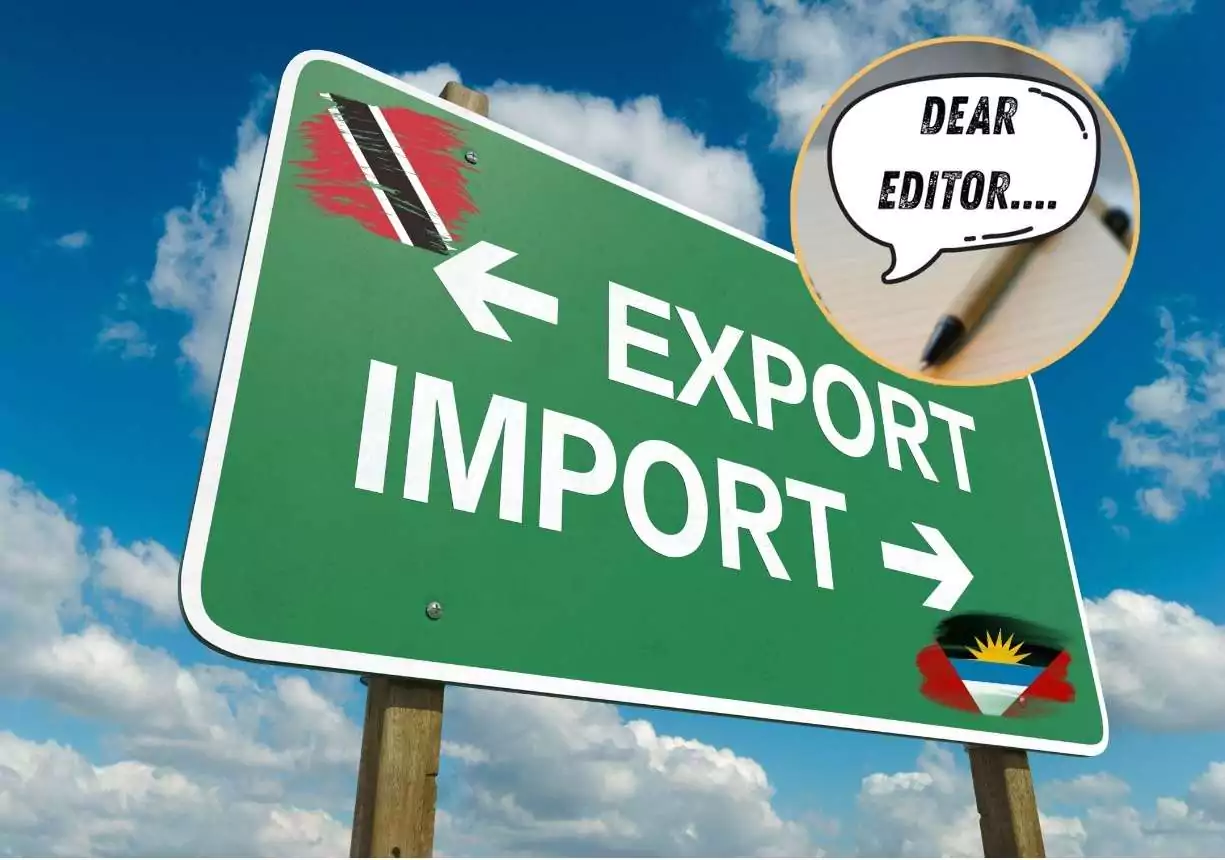
By any serious measure of political economy, the recent posture adopted by the leadership of Trinidad and Tobago toward Antigua and Barbuda is not merely diplomatically careless; it is economically presumptuous. It rests on a dangerous assumption, that Antigua and Barbuda is a dependent consumer with limited agency, rather than a rational actor in a regional marketplace whose purchasing power has long underwritten Trinidad and Tobago’s manufacturing sector.
Let us speak plainly, and with facts rather than sentiment.
For decades, Antigua and Barbuda—like many OECS states—has been a net importer of Trinidadian manufactured goods: food products, building materials, household items, beverages, and light industrial outputs.
Trinidad and Tobago’s manufacturing base, already under pressure from global competition and declining energy rents, relies heavily on guaranteed regional markets. Antigua and Barbuda is not a marginal customer; it is part of the economic scaffolding that keeps several Trinidadian firms viable.
To antagonize such a market while simultaneously deriding regional institutions that protect that very access is not strength. It is strategic incoherence.
Buying Power Is Leverage—Not Charity
Economic relationships are reciprocal. Antigua and Barbuda’s consumers do not purchase Trinidadian goods out of obligation or sentimentality; they do so because tariffs, historical trade patterns, and CARICOM preferences have made those goods competitive. The moment those political and diplomatic underpinnings are weakened, the commercial logic collapses with them.
In this context, Antigua and Barbuda must begin to think and act as a sovereign economic actor, not a passive participant in an asymmetrical relationship.
It is therefore entirely reasonable, indeed prudent, for the Government of Antigua and Barbuda to initiate a structured review of import taxation, particularly on goods where identical or functionally equivalent products are readily available from alternative markets. Where consumers can obtain comparable goods from extra-regional suppliers at lower cost or better quality, protective taxation in favor of a hostile or dismissive partner becomes economically irrational.
This is not retaliation. It is policy realism.
Tax Policy as Consumer Protection
Removing or reducing taxes on “like products” from non-traditional suppliers would:
* Lower consumer prices in a high-cost economy;
* Increase competition, forcing regional manufacturers to improve efficiency and pricing;
* Reduce artificial dependency on any single regional supplier;
* Strengthen Antigua and Barbuda’s negotiating position in future trade discussions.
In economic theory, this is a textbook case of welfare-enhancing liberalization in response to market distortion. In political practice, it is a signal that respect in diplomacy is inseparable from respect in trade.
CARICOM Is Not a One-Way Street
Regional integration was never designed to function as a shield for larger economies while smaller states absorb both the costs and the insults. CARICOM survives only if mutual benefit and mutual respect are preserved. When one state openly questions the value of the community while continuing to enjoy preferential access to its markets, it invites recalibration.
Antigua and Barbuda is not obliged to subsidize contempt.
A Strategic Moment for Leadership
The Prime Minister of Antigua and Barbuda would be acting well within reason—and in the clear interest of citizens—by directing the Ministry of Trade and Finance to:
* Identify product categories dominated by Trinidadian imports;
* Assess equivalent alternatives from Latin America, Asia, and North America;
* Remove or reduce import taxes on those alternatives where feasible;
* Allow the market, not political nostalgia, to determine outcomes.
Such a policy would not weaken Antigua and Barbuda. It would strengthen consumer sovereignty, discipline regional manufacturers, and reaffirm that economic respect must flow in both directions.
In the final analysis, nations, like firms, must respond to changed incentives. When a partner forgets the value of your market, the appropriate response is not protest alone, but policy.
And policy, grounded in economics rather than emotion, is the most damning response of all.
Son of the Soil
This story was first published by Antigua News on : antigua.news/2025/12/23/letter-economic-sovereignty-is-not-insolence. © 2025 Antigua News. Republication without permission is not allowed.

About the author
The Editorial Staff refers to all reporters employed by Antigua.news. When an article is not an original creation of Antigua.news—such as when it is based on a press release, other media articles, letters to the editor, or court decisions—one of our staff members is responsible for overseeing its publication.
Read our editorial standards and corrections policy. Spotted an error? Contact the newsroom.
More from Letters to the Editor
View section
LETTER: Employees Raise Management And Safety Concerns At Denis Bowers Rehabilitation Centre
Concerned employees call for an independent investigation into alleged management failures, staffing shortages and conditions affecting staff and residents.
By Editorial Staff

LETTER: A Call for Immediate Action on Excessive Noise, Traffic Obstruction and Blocked Emergency Routes
A public letter urges police to address loud music, traffic obstruction and blocked emergency access near Valley and Desouza Road.
By Editorial Staff

OPINION: THE $3 BILLION WAKE-UP CALL: Who Owns Caribbean Tourism?
By Editorial Staff

LETTER: Concerned Parent Raises Questions About Fairness at Clare Hall Secondary School
By Editorial Staff
Comments (5)
Apex Jones December 23, 2025, 6:05 PM
Rita Brathwaite December 23, 2025, 6:27 PM
Rita Brathwaite December 23, 2025, 6:28 PM
Randy December 23, 2025, 7:09 PM
Informed citizen December 23, 2025, 10:26 PM