
















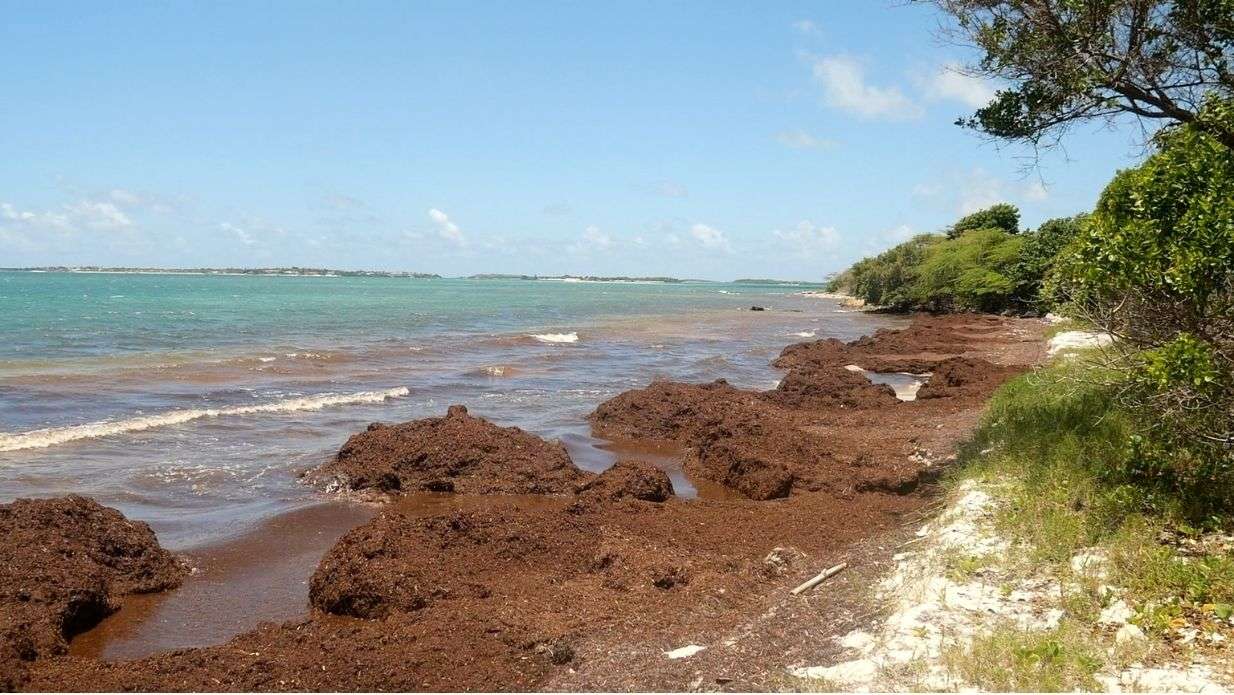
Sargassum build up on a Northern Antiguan beach (picture by Cory Wayland – Antigua.news)
Caribbean islands, including Antigua and Barbuda, are being advised to prepare for a gradual increase in sargassum activity during the first quarter of 2026, according to a new regional outlook issued by climatologist Dale C. S. Destin.
Destin reports that satellite imagery shows rising sargassum abundance across the Central Atlantic, a trend that typically precedes increased influxes into the Caribbean. While widespread or extreme events are not expected during the early months of the year, conditions suggest impacts will steadily intensify as the season progresses, particularly toward late March.
For Antigua and Barbuda and other northern islands, mild sargassum influxes are expected during January, with conditions likely to worsen to moderate levels during February and March. Destin cautions that this period is expected to be more challenging than last year for northern territories, as ocean currents and prevailing winds favour earlier and more consistent arrivals of the seaweed.

Met Office Director, Dale Destin
Last year, Antigua experienced several episodes of sargassum accumulation along its eastern and northeastern coastlines, affecting popular beaches, nearshore waters, and small fishing operations. While the impacts were not continuous throughout the year, periodic build-ups disrupted marine activities, created unpleasant odours from decomposing weed, and required repeated clean-up efforts by authorities and private operators.
Destin notes that the projected 2026 pattern suggests a return of similar pressures, with the potential for longer-lasting accumulations if early monitoring and mitigation are not put in place.

Further south, islands such as Martinique, St. Lucia, St. Vincent and Barbados are expected to see mostly mild conditions through most of the outlook period, with heavier influxes becoming more likely toward the end of March. For the southern Caribbean, including Grenada, Tobago and Trinidad, impacts are expected to remain limited during the early months of the year.
The climatologist is encouraging coastal communities, tourism stakeholders and marine managers to remain alert and to plan early responses, emphasizing that timely action can significantly reduce environmental, economic and public health impacts associated with sargassum.
The outlook is based on the Sargassum Sub-regional Outlook Bulletin produced by the Centre for Resource Management and Environmental Studies (CERMES) at The University of the West Indies, Cave Hill Campus. The next update is expected in early April 2026.


Is how long we hearing they making gas out of that .
Visitors don’t understand sargassum season. It affect bookings and reviews.
I thought by now we realise is a normal thing to look out for every year?
Net full up with weed instead of fish. That does cost us money.
Eastern coast always get it worst. We need long-term solutions, not just cleanup after.
We adapt, as always. Locals know the drill
Hotels need support to manage it properly, especially smaller properties
Beach quality is part of the product. We can’t ignore this.