



















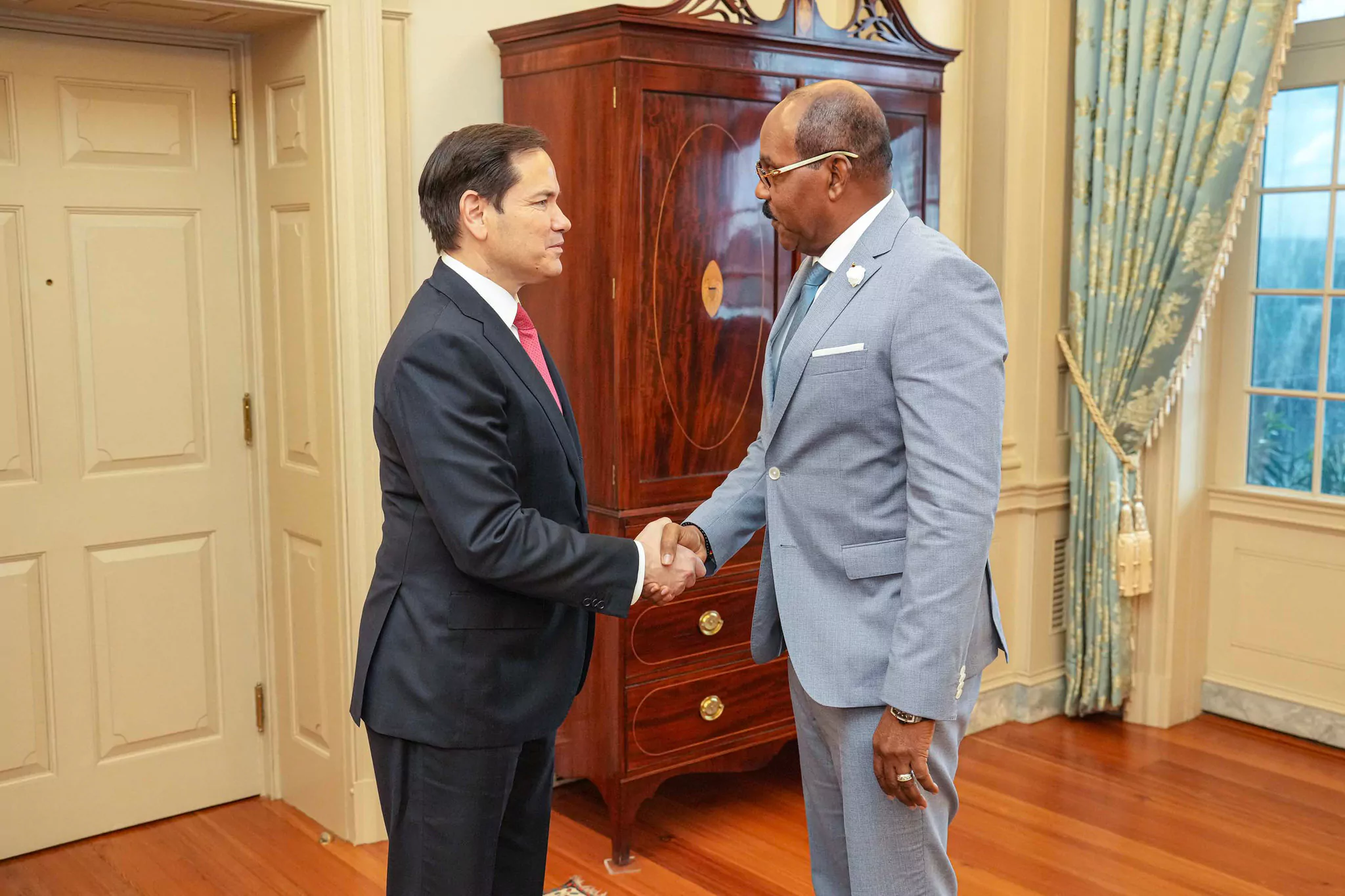
PM Browne and U.S. Secretary of State Marco Rubio
As the United States continue to enact new visa restrictions on Antigua and Barbuda and Dominica citizens with the latest revelation that nationals can no longer obtain ten-year US visitor visas, Prime Minister Gaston Browne says that US Secretary of State Marco Rubio has assured him that the situation is temporary.
Speaking to state media following the 50th CARICOM Heads of Government meeting in St Kitts and Nevis, the Prime Minister said that Rubio informed him during their discussions that visa restrictions currently affecting Antigua and Barbuda and Dominica are temporary and form part of a broader overhaul of US immigration policy expected to be completed by June.
“I had the distinction of putting that question directly to Secretary of State Rubio, and his response to me in the presence of all of my other colleague heads was that these restrictions are temporary,” Browne said, adding that Rubio indicated the US is working toward a new visa policy framework that would affect all countries, not just those currently under restriction.
State Department reciprocity schedules for both countries now show B-1/B-2 visas have been capped at three months and a single entry, down from 10 years with unlimited entries.
This means Antiguans currently without a US visa, who need to travel to the US would have to make a new appointment at the US Embassy every three months or after they travel to the US on their visa.
Antiguans, Barbudans and Dominicans were also named alongside 38 other countries subject to a new visa bond requirement.
Any citizen or national traveling, who is found otherwise eligible for a B1/B2 visa, must post a bond for $5,000, $10,000, or $15,000 with the amount determined at the time of the visa interview.
All visa holders who have posted a visa bond must enter and exit the United States through the Boston Logan International Airport, JFK International Airport, Washington Dulles International Airport, Newark Liberty International Airport, Hartsfield-Jackson Atlanta International Airport, Chicago O’Hare International Airport, or the Los Angeles International Airport.
Other designated ports of entry include the Toronto Pearson International Airport and the Montréal-Pierre Elliott Trudeau International Airport.

The restrictions extend beyond tourist and business visas, with student, exchange visitor, intracompany transfer and religious worker visas also affected.
Other visa categories include transit visas, airline and ship crew visas, temporary worker visas, media and journalist visas, extraordinary ability visas covering sciences, arts, education, business, athletics and entertainment, athletes and entertainer visas, and cultural exchange programme visas. Diplomatic categories were not affected.
Browne said Rubio told him Antigua and Barbuda and Dominica should not interpret the restrictions as a targeted action against either country.
“He said, look, it’s a global rollout of a new visa policy. Evidently, they have had to use some countries as examples. It’s unfortunate that Antigua and Barbuda and Dominica ended up as two of the countries within CARICOM,” Browne said.
The Prime Minister said the restrictions were driven primarily by American concerns about citizens overstaying visas and accessing social services, and that the new policy framework aims to address illegal immigration more broadly.
He noted that OECS leaders with populations under 200,000 argued to Rubio that their overstay numbers are inconsequential relative to the US population, saying the overstay rate within the OECS region stands at approximately 1.3 to 1.4 percent.
Visa restrictions affecting the two countries stem back to December 2025 when the White House proclamation named Antigua and Barbuda and Dominica among 15 countries placed under partial visa restrictions, citing national security concerns, with the Citizenship by Investment (CBI) programme as the stated reason.
Browne reiterated that the current restrictions apply only to new visa applications made during the period of the proclamation and do not affect existing valid visas.
He advised Antiguans to refrain from applying for US visas at this time unless travel is urgent, noting that the Ministry of Foreign Affairs can seek national interest exemptions in cases involving medical emergencies.


“Temporary” is doing a lot of work in this statement. Our PM is taking Rubio’s word for it while Trump and the White House does what it wants. Why must Antiguans pay thousand dollar bonds and have their visa they spent weeks trying to get become a single use stamp?
And if our overstay rate is only 1.3%, why are we being used as an “example”? Trinidad, Jamaica and other Caribbean countries have larger overstay issues and would be more measurable for the US than just simply repressing visa application processes
Mr. PM they are pressuring you to take the refugees no sir lift all the bond and requirements never take him and Trump word 😉 anyway election is on us in America so we can wait turning America blue soon 😉
The US seem to be going from one extreme to another
Honestly Gaston just need fu shut his mouth right now. He is just a liard n trying to fool the ppl of Antigua and Barbua but we seeing right through him now.
Continue to fool those who wants to be fooled. The internet is a hell of a thing n most people READ now a days. It’s not Iike before where they speak becuz they had all the means to do so.
If our overstay rate is only around 1.3 to 1.4 percent, it does seem harsh to impose such sweeping measures. Hopefully common sense prevails in the final policy.
The US hates us why do we shake hands with em