


















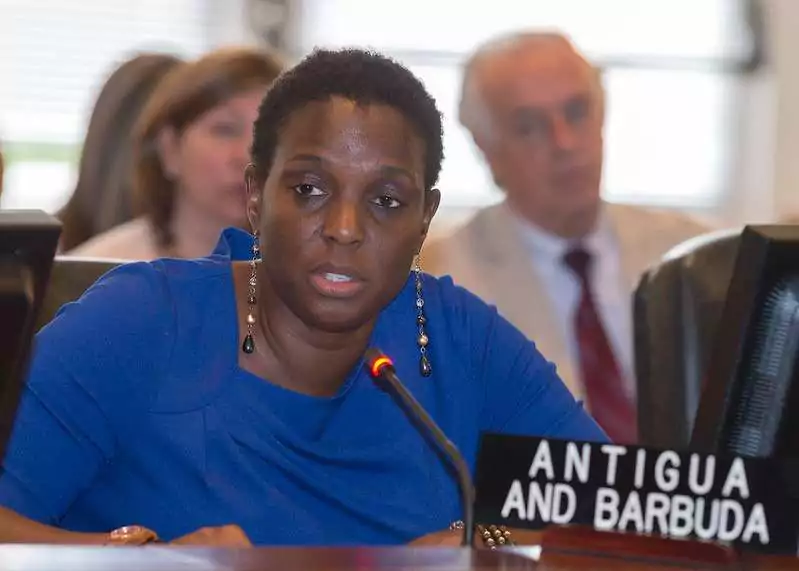
Joy-Dee Davis-Lake, Antigua and Barbuda’s Alternate Representative to the OAS (photo by Juan Manuel Herrera/OAS)
Antigua and Barbuda’s Alternate Representative to the OAS, Joy-Dee Davis-Lake said that when female voices are absent from teams designing algorithms, platforms, and digital systems, bias becomes embedded into those systems.
Speaking at the special sitting of the Organisation of American States commemorating International Women’s Day, Ambassador Davis-Lake said the consequences of that exclusion extend beyond technology into democracy itself.
“When women are excluded from digital spaces, from innovation, from leadership, from decision making, democracy becomes weaker, narrower, and less representative,” she said. “A digital system that reflects only part of society cannot claim to serve the whole.”
Under the theme “Women in the Digital Transformation of the America, Ambassador Davis-Lake outlined several barriers women continue to face across the Americas, noting they are less likely to have reliable internet access, less likely to receive advanced digital training, and less likely to work in or shape technology sectors.
She said the consequences of this exclusion include voices being silenced in online political spaces, and economic and civic opportunities narrowing for women who lack digital skills.
Antigua and Barbuda’s position, she said, is that digital transformation must be inclusive if it is to strengthen democracy and development in the region.
“A digital system that reflects only part of society cannot claim to serve the whole,” she stressed, calling for investment in girls’ science and technology education, affordable and safe internet access, protection from online harassment, and greater women’s leadership in digital governance.

Inter-American Commission on Human Rights (IACHR) Commissioner and Rapporteur on the Rights of Women, Marion Bethel, said technology has created both opportunity and danger for women.
Digital platforms and mobile applications have expanded women’s access to health information and services, connectivity initiatives have worked to close the digital divide in education, and technology has enabled survivors of gender-based violence to seek help through mobile applications and panic buttons.
However, Bethel warned that the same space has become a new domain for discrimination and violence, citing data showing at least 73 percent of women in the region have experienced some form of online violence.
She said women are subjected to harassment, cyber-stalking, doxing, non-consensual sharing of intimate images, deepfakes, and AI-generated sexual content, much of it occurring on privately-owned platforms where data is not always accessible to authorities.





Notice how all the big tech CEOs are men and watch whose platform basically allows sexual harassment, deepfakes and misogyny occurs.
Big respect to the AB diplomat for highlighting this at the OAS. Conversations like these need to reach the policymakers and tech creators because change doesn’t happen unless people see the problem.