


















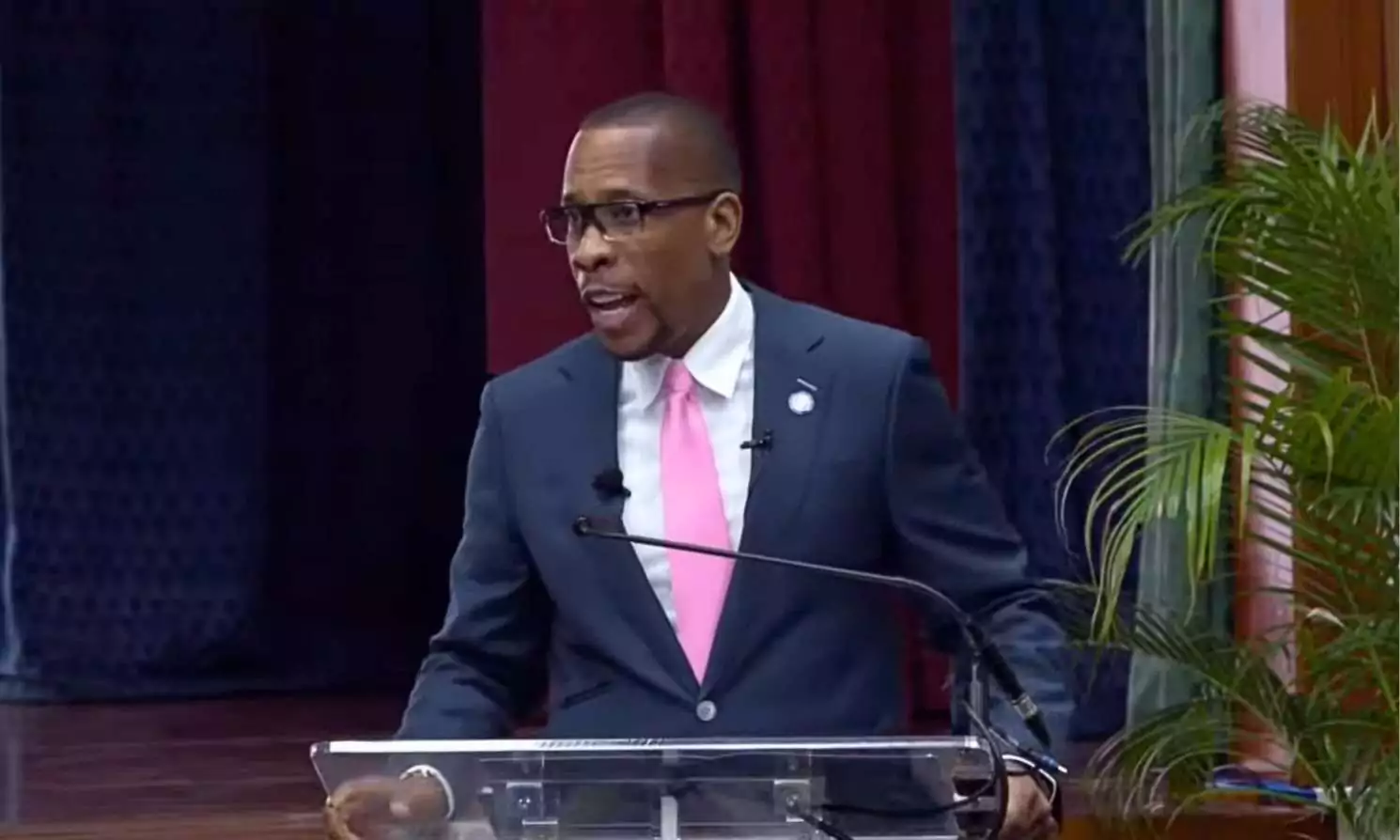
Timothy Antoine, ECCB Governor (screen shot of ECCU)
The Eastern Caribbean Central Bank (ECCB) will introduce deposit insurance across the Eastern Caribbean Currency Union (ECCU) as part of its newly launched 2026-2031 Strategic Plan, a measure Governor Timothy N.J. Antoine said is aimed at strengthening protection for depositors across the eight-member currency union.
Antoine made the announcement during the launch of “The Big Push: Collective Action for Shared Prosperity in the ECCU,” where he outlined several new financial stability measures the bank intends to implement over the next five years.
“Job number two is [to] keep your deposits safe,” Antoine told those gathered for the launch. “Under this plan we will introduce deposit insurance to strengthen depositor protection.”
The governor placed deposit insurance under the plan’s second pillar of financial stability, which he described as one of the ECCB’s two core responsibilities alongside monetary stability.
He noted that without stability there can be no confidence, investment, or sustained growth.
The bank plans to establish an Office of Financial Conduct, tasked with holding banks accountable and ensuring fair treatment of customers.
He said the ECCB will exercise oversight of bank fees and charges as part of that mandate.
“The first two pillars, monetary stability and financial stability, are our core responsibilities,” Antoine said, adding that without these foundations, the broader development ambitions of the strategic plan cannot be realised.
Deposit insurance schemes, where they exist, protect depositors by guaranteeing a portion of their savings in the event a financial institution fails.
No timeline or coverage limits for the ECCU scheme were outlined at the launch.

Deputy Governor Dr Valda Henry, who delivered opening remarks at the launch, said the plan was designed to go beyond incremental change.
“This is a time for bold, coordinated, and transformative action,” Henry said, adding that progress on the plan’s objectives would require governments, financial institutions, the private sector, development partners, and citizens working together.
The 2026-2031 strategic plan is organised around six themes: maintaining monetary stability, preserving financial stability, advancing payment modernisation and financial inclusion, promoting inclusive economic growth and partnerships, enabling a digital and data-driven culture, and enhancing organisational effectiveness.
Director of the ECCB’s Corporate Governance Unit, Theresa Smith, who presented an overview of the plan, said the framework is built around strategic themes, objectives, and initiatives designed to be monitored, evaluated, and adjusted over time.
“The 2026-2031 ECCB strategic plan provides a framework of practical trackable actions,” Smith said.





0 Comments