



















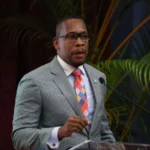
ECCB Governor Timothy N.J. Antoine during a Q and A session at the launch of the 2026-2031 Strategic Plan (ECCB screenshot)
Eastern Caribbean Central Bank (ECCB) Governor Timothy N.J. Antoine has identified population decline as one of the most serious structural threats to economic growth in the Eastern Caribbean Currency Union (ECCU), calling for managed immigration of skilled workers and coordinated strategies to attract diaspora nationals back home.
Speaking at the launch of the ECCB’s 2026-2031 Strategic Plan, Antoine told attendees the region cannot credibly pursue its ambition of doubling the size of ECCU economies over the next decade while six of its eight member countries are losing or failing to grow their populations.
He named Antigua and Barbuda as one of only two countries in the currency union where the population is currently increasing.
“How do you grow and double the size of an economy with a falling population?” Antoine said. “We have to wrestle with these issues, and we have to solve them.”
The Governor’s warning reflects a challenge that has deepened across the region for decades.
The International Monetary Fund has noted that close to two thirds of ECCU citizens reside abroad, mostly in the United States, Canada, and the United Kingdom, and that among the top 10 countries globally with the largest diasporas, five are ECCU members.
The IMF’s 2025 staff report on ECCU common policies identified rapid population ageing as one of the key factors weighing on the medium-term growth outlook for the currency union.
Low fertility rates, ageing, non-communicable diseases, limited opportunities for youth, and outmigration have emerged as some of the most pressing demographic trends confronting the Caribbean region.
Data from the United Nations Department of Economic and Social Affairs puts the proportion of the Antiguan-born population living abroad at 14 percent, with the figures considerably higher for other ECCU members, with 60 percent for St Kitts and Nevis, 35 percent for St Vincent and the Grenadines, and 44 percent for Jamaica.
Antoine said reversing the trend would require improving healthcare infrastructure, ensuring reliable digital connectivity so diaspora nationals could work remotely from the region, and a willingness to attract skilled immigrants.
He acknowledged the sensitivity of the latter, pushing back on what he described as a double standard in how the region approaches migration.
“We can go to New York and England and Canada and live and work and develop, no problem,” Antoine said. “But once we talk about people coming here, we get concerned about they will come and take what we have.”

He pointed to Antigua and Barbuda’s own experience as an example of how inward migration can support economic growth, noting the country has drawn workers from across the region including from Dominica, Jamaica, St Kitts, Grenada, and Anguilla.
The Antigua and Barbuda Statistics Division put the 2024 population estimate at 103,603, which includes all residents regardless of citizenship status.
Antoine was careful to distinguish between the ECCB’s role and the sovereign authority of member governments on immigration policy, noting the central bank has no direct jurisdiction over who enters or remains in any member country.
He said, however, that the Monetary Council was aligned on the need for a coordinated, joint approach to the issue across the currency union.
The Governor also addressed the question of deportees arriving from third countries, suggesting that while numbers may be modest, some could bring useful skills to small economies where tradespeople remain in short supply.
The ECCB’s Growth and Resilience Dialogue, scheduled for April 22 to 24, is expected to provide a further platform for discussion on population, economic diversification, and the big push priorities outlined in the new strategic plan.



0 Comments