


















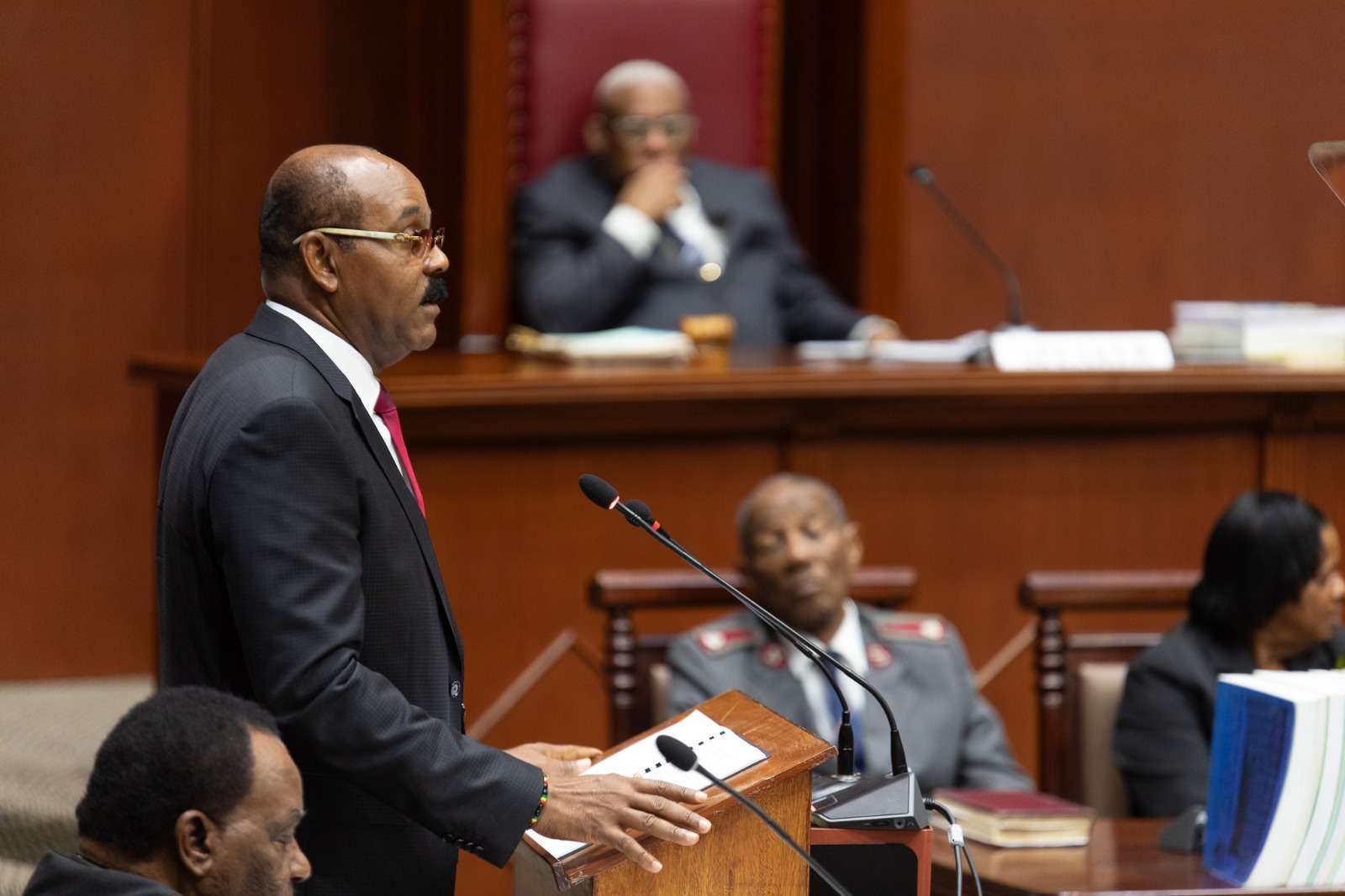
Prime Minister Gaston Browne gives 2026 Budget Presentation
A Constitutional Series in Four Parts
By Gavin V. Emmanuel
Part Two: When the Calendar Fails in Practice
Part One established that the Westminster doctrine of responsible government, as enshrined in Sections 60 and 69 of the Antigua and Barbuda Constitution, is structurally incompatible with fixed election dates, and that any statute purporting to impose such a calendar would fall foul of Section 2’s supremacy clause. But what if the reformers went further? What if the Constitution itself were amended to accommodate fixed dates? Part Two examines whether that path fares any better, drawing on the cautionary experience of the United Kingdom and on the administrative realities specific to Antigua and Barbuda.
A constitutional amendment to impose fixed dates would not solve the problem of the prerogative of calling an election at any time. It would simply relocate it. The United Kingdom learned this lesson at considerable cost. The Fixed-term Parliaments Act 2011, born of coalition politics, attempted to do precisely what Caribbean reformers now propose: replace the prerogative of dissolution with a statutory calendar. The result was what constitutional scholars came to call a “zombie parliament” during the Brexit impasse of 2017 to 2019. The government of the day could not pass its primary legislation, yet the opposition refused to grant the two-thirds majority required to trigger an early election, holding the country in a state of suspended animation. Parliament could neither legislate nor dissolve. The Act was eventually repealed in 2022 by the Dissolution and Calling of Parliament Act, restoring the prerogative system and affirming, in the words of the legislation’s architects, a return to “tried and tested” constitutional practice. The lesson of the British experiment is not that fixed terms were implemented imperfectly. It is that in a fused parliamentary system, fixed terms are fundamentally incompatible with the logic of confidence government. When the executive cannot appeal to the electorate to break a deadlock, accountability disappears entirely.
There is a further dimension to this problem that is specific to small island states and that tends to be overlooked by advocates of calendar-driven reform. Sections 62 through 65 of the Antigua and Barbuda Constitution establish the Constituencies Boundaries Commission and define the process by which electoral districts are reviewed and redrawn. This is not an administrative footnote. Boundary reform is a constitutionally significant exercise, subject to extensive consultation and frequently to legal challenge, as the experiences of 2013 and 2022 both illustrate. The flexibility to call an election allows a government to align the vote with the completion of a legitimate boundary review. A fixed date removes that flexibility. It may force the country to go to the polls on boundaries that are outdated or contested, undermining the democratic legitimacy of the result before the first vote is cast. The 2022 Boundaries Commission report expressly recommended early appointment of a new Commission following each election precisely because the parliamentary cycle must accommodate these administrative realities, not the other way around.

Across Commonwealth jurisdictions, the pattern is consistent. Canada adopted fixed election dates at both the federal and provincial levels, yet the enabling legislation explicitly preserved the Governor-General’s prerogative to dissolve Parliament at the discretion of the Crown. In practice, early dissolutions continued to occur. Australia maintains a constitutional three-year maximum term, and any extension would require a national referendum. No Westminster system of government has succeeded in imposing a genuinely rigid election calendar without either preserving the prerogative in law or discovering, as the United Kingdom did, that the attempt generates constitutional dysfunction. The Antigua and Barbuda Constitution already reflects this consensus. What the framers of 1981 built was not a failure of imagination. It was a considered design. I dare say that Antigua and Barbuda’s Constitution is, in this regard, perfectly suited to the Westminster system of government and an attempt to transplant elements from the presidential system would only serve to weaken that system.
The argument for fixed dates typically rests on the claim that prime ministers exploit the timing of elections for partisan advantage, calling elections when conditions favour the incumbent rather than when governance requires it. This is a legitimate concern, and it deserves a serious response. But the remedy cannot be a mechanism that severs the link between parliamentary confidence and executive authority. The flexibility of the prerogative is not the problem. Its abuse is. And abuse of a power is not corrected by abolishing the power. It is corrected by strengthening the institutions that constrain how the power is exercised: an independent elections commission, codified caretaker conventions, robust campaign finance regulation. Antigua’s Constitution already provides a framework for these tools. The task is to build on that framework, not to dismantle its foundations.
The constitutional power to dissolve Parliament any time before the maximum limit of five years is not a threat to democracy. In a Westminster system, it is democracy’s ultimate safeguard: the mechanism by which the people are called upon to resolve what their representatives cannot.



0 Comments