
Credit Suisse AT1 fraud claims survive in New York, extending UBS legacy exposure

By Dario Item
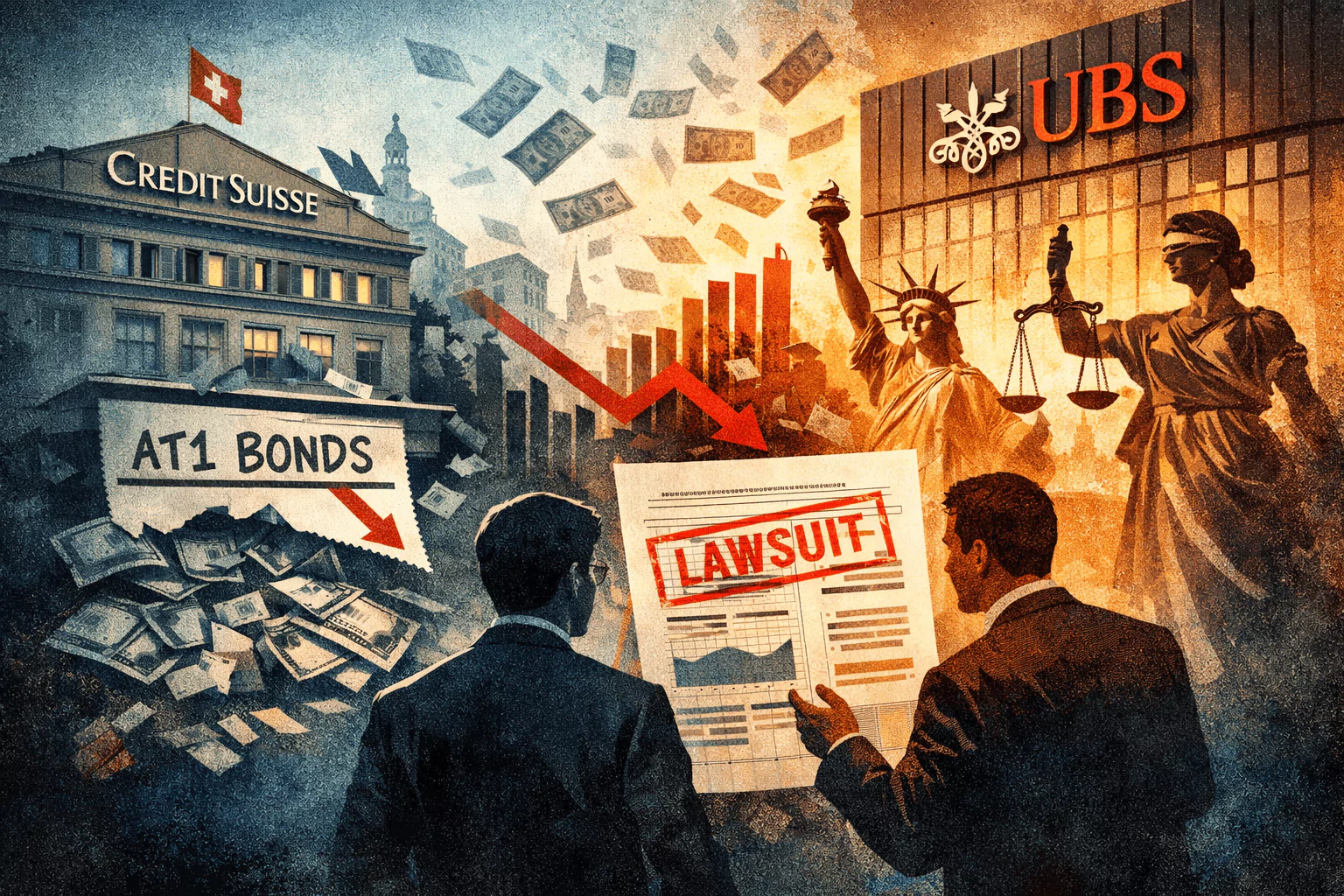
A New York ruling has kept alive fraud claims tied to Credit Suisse’s AT1 bond wipeout during the 2023 rescue
A U.S. judge has allowed investors suing over Credit Suisse’s 2023 AT1 wipeout to pursue securities-fraud claims in New York. In a March 26 ruling, Judge Colleen McMahon of the Southern District of New York dismissed the plaintiffs’ New Jersey racketeering claims in Palomino Master Ltd. v. Credit Suisse Group AG, but allowed claims under Section 10(b) of the Securities Exchange Act and Rule 10b-5 to proceed. She also ordered the case to be consolidated for pre-trial purposes with related Credit Suisse securities litigation already pending in Manhattan.
The ruling does not determine whether fraud occurred. It does, however, keep the core case alive. McMahon held that the plaintiffs — Palomino, Azteca and Appaloosa — had plausibly alleged domestic transactions in Credit Suisse AT1 bonds, which is enough at this stage to keep U.S. securities law in play. She also noted that, on this motion, the defendants did not challenge falsity, scienter or materiality.
The backdrop was the March 2023 banking panic. Credit Suisse, Switzerland’s second largest bank, runs to the Swiss National Bank for a bailout after a distressing fall in stock recorded the rush for emergency support, while Switzerland’s biggest bank, UBS, buys Credit Suisse to halt banking crisis tracked the state-backed sale to UBS. As part of that rescue, FINMA ordered the write-down of roughly CHF 16 billion of Additional Tier 1 bonds, a class of loss-absorbing bank capital instruments.
The New York case turns on what Credit Suisse and its senior executives said in the narrow window before that write-down. According to the court’s summary of the complaint, former chief executive Ulrich Körner and former chairman Axel Lehmann reassured markets on March 14 and 15, 2023 about liquidity and the bank’s position, while a March 14 fixed-income investor presentation restated Credit Suisse’s capital position and loss hierarchy. Plaintiffs say they bought AT1 bonds between March 14 and March 19 in reliance on those statements, only for the securities to be wiped out days later. The same factual tensions were at the centre of CREDIT SUISSE AT1s CASE: The Unspoken Things and AT1 case: Credit Suisse relationship managers lied to clients, too. (antigua.news)
McMahon said the complaint had done enough, for pleading purposes, to allege domestic trades. It said orders were placed from New Jersey, quotes were received in U.S. dollars, payment went through Goldman Sachs as a U.S.-based prime broker, the executing counterparties appeared to be U.S.-based, and the bonds were trading in the United States. That was sufficient, in the court’s view, to allow the federal fraud claims to move forward.
The judge did narrow the case. She held that the New Jersey RICO counts were not barred by SLUSA because the complaint concerned AT1 bonds rather than covered securities listed on a U.S. exchange. But she dismissed those claims because the plaintiffs had not adequately pleaded a distinct enterprise or a racketeering conspiracy. What remains is the securities-fraud case.
UBS is not named as a defendant in this action, but it is not detached from the corporate side of the dispute. Under Swiss law, a legal entity acts through its governing bodies and is bound by their acts. That matters here because Lehmann and Körner were acting as Credit Suisse organs. If a court ultimately finds that they misled investors while acting in those capacities, the issue would not necessarily stop with the two former executives but would also engage the company they represented. UBS Group AG succeeded by operation of Swiss law to all assets and liabilities of Credit Suisse Group AG when the parent merger took effect in June 2023; when the bank merger was completed in May 2024, UBS AG succeeded to all rights and obligations of Credit Suisse AG, including its outstanding debt instruments.
Separate disclosure disputes have continued alongside the main claims. Swiss proceedings addressed disclosure of FINMA records linked to the AT1 write-down and Credit Suisse’s effort to limit access to documents tied to FINMA’s March 22, 2023 order. In New York, the bondholder case moved into discovery, and Credit Suisse and FINMA later renewed privilege-based objections.
The Swiss proceedings have also raised the stakes. In October 2025, the Swiss Federal Administrative Court partially revoked FINMA’s March 19, 2023 AT1 write-down decree, reopening questions about the legal basis for the wipeout. Those proceedings do not determine the New York fraud case, but they run in parallel to it: one track concerns the legality of the write-down, the other concerns what investors were told before it happened.
For UBS, the practical effect is that the legal aftershocks of the rescue continue to run through parallel proceedings, discovery disputes and a New York fraud case that has survived dismissal. For investors, the question is narrower and more damaging: whether Credit Suisse’s public assurances during the decisive week of March 2023 matched its internal picture of liquidity stress and official support.
This story was first published by Antigua News on : antigua.news/2026/04/12/credit-suisse-at1-fraud-claims-new-york-ubs. © 2026 Antigua News. Republication without permission is not allowed.

About the author
Dr. Dario Item is the Head of Mission of the Embassy of Antigua and Barbuda in Madrid. He is an experienced financial crimes lawyer with nearly 30 years of practice. He holds degrees in law and political science, a Ph.D. in criminal law and an LL.M. in transnational financial crime.
Read our editorial standards and corrections policy. Spotted an error? Contact the newsroom.
More from Credit Suisse AT1 Case
View section
Credit Suisse AT1 wipeout: the price of UBS’s ‘yes’
UBS demanded protection. Bern resisted an unlimited guarantee. The cancellation of SFr16.5bn in bonds was part of the agreement that followed — despite Credit Suisse’s warning that the contractual conditions had not been met.
By Dario Item

Credit Suisse fraud case: US judge moves towards private review of FINMA files
The Swiss watchdog declined to join a New York hearing while defending secrecy over an inquiry into the bank’s final months. The court is weighing investors’ demand for the records.
By Dario Item
Arbitrator finds Credit Suisse write-down trigger never fired
By Dario Item

Credit Suisse AT1 Arbitration moves behind closed doors as Switzerland’s paper trail stays hidden
By Dario Item
Comments
Be the first to comment.