





















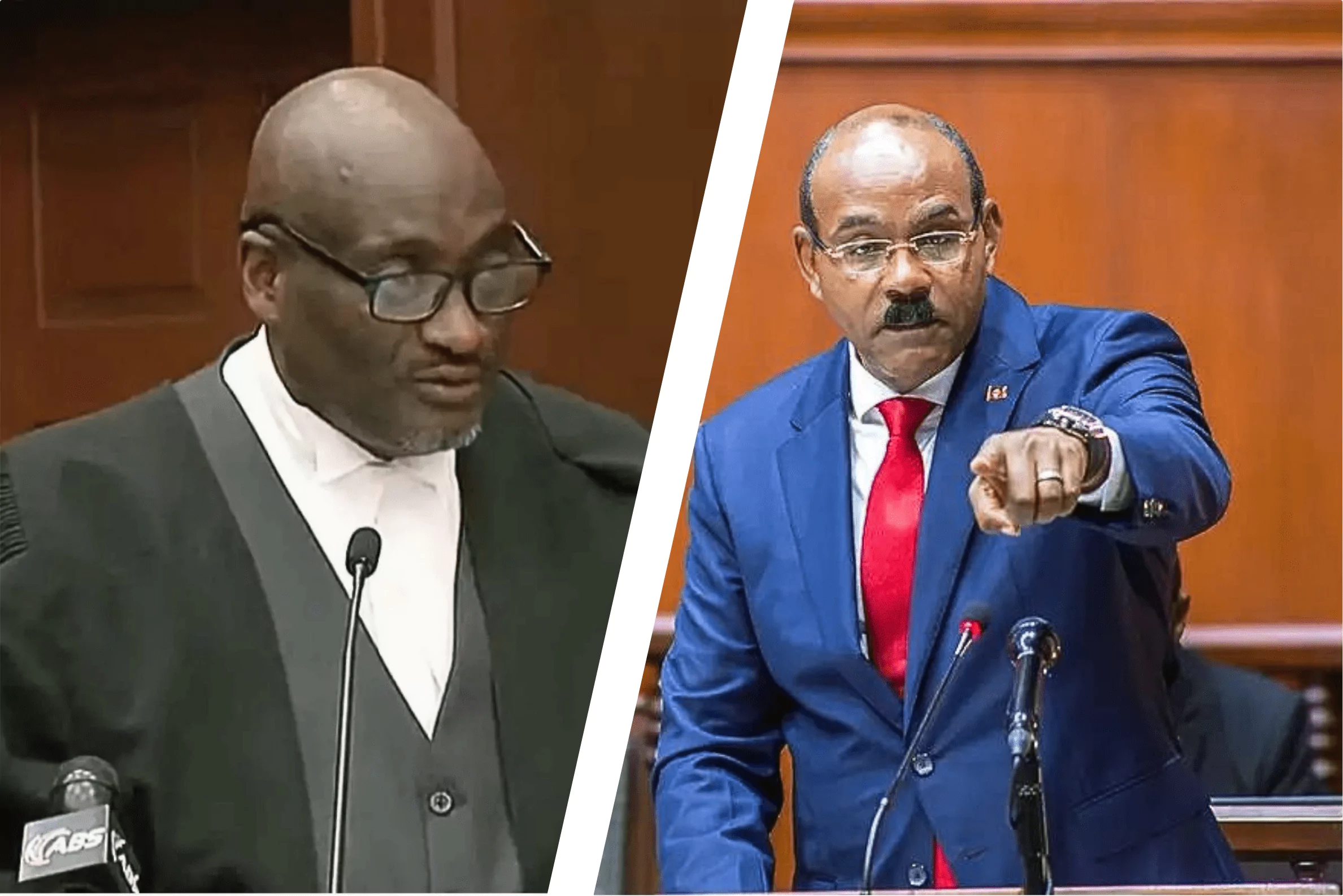
Director of Public Prosecutions Clement Joseph (L) & Prime Minister Gaston Browne (R)
Prime Minister Gaston Browne has publicly pushed back against comments made by Director of Public Prosecutions Clement Joseph that he does not owe the public an explanation for decisions taken by his office.
The exchange follows controversy surrounding the dismissal of two cases by the Office of the Director of Public Prosecutions, a move that has sparked public debate and calls for greater transparency.
In an interview with Observer Media, Joseph defended his constitutional authority to exercise prosecutorial discretion, arguing that he is not obligated to explain individual decisions to the public. He maintained that while his actions can be challenged through judicial review if they are unreasonable or constitute an abuse of authority, there is no constitutional requirement for him to provide explanations simply because members of the public demand them.
Browne, however, took issue with that position in a social media post on Friday.
“Really Mr DPP? You are El Supremo – beyond reproach?” the Prime Minister wrote.

He questioned whether a public official could claim to be free from accountability to the citizens who fund and support the institution he leads.
“As a public servant, you are not accountable to the public who pays your bill and at whose ultimate discretion and pleasure you serve?” Browne asked.
The Prime Minister went on to suggest that the statement attributed to Joseph may have been reported inaccurately, saying he hoped it was a misquotation rather than the DPP’s actual position.
“I believe that this reckless statement, which has the potential to erode public confidence and trust in the DPP, is perhaps a misquotation,” Browne stated.
He emphasized that accountability is a cornerstone of public service and should apply to everyone, regardless of office or authority.
“For any avoidance of doubt, no one is above the law and no one is beyond reproach; tout, moun, sam and bagay are accountable,” he added.
The public disagreement comes as questions continue to be raised about the level of transparency expected from the country’s chief prosecutor, particularly in cases that attract widespread public attention.
Joseph has maintained that some matters must remain confidential and that his office cannot disclose information simply to satisfy public curiosity or political pressure. He has also pointed out that the DPP’s office provides periodic public addresses outlining prosecutorial trends and developments within the justice system.
The issue has reignited discussion about the balance between prosecutorial independence and public accountability, with legal observers and members of the public offering differing views on how much explanation should accompany major prosecutorial decisions.



What about an over $15 million fraud case that never made it to the office of the DPP
Who exactly did that Mr. Pelle., please clarify.
Hahahah trust Gaston. I gotta love this man