
OECS Heads Seek Talks with EU as PM Browne Hopes ETA Proposal Prevents Loss of Visa-free Access

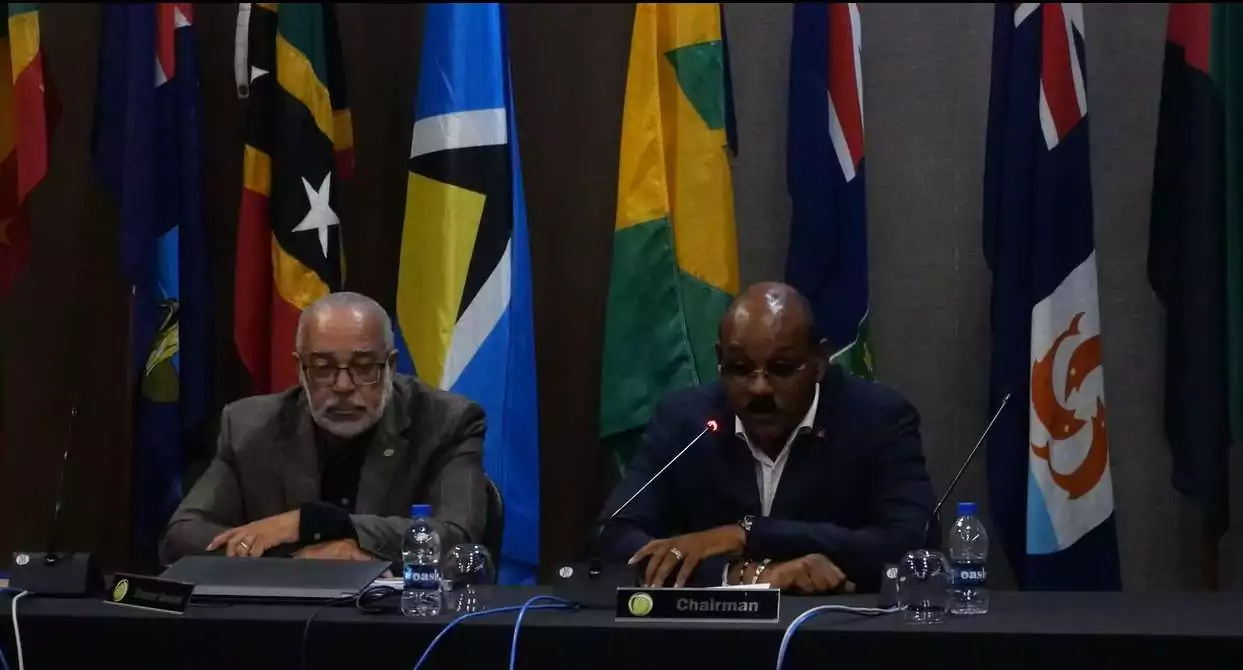
OECS heads of government are seeking high-level talks with European Union officials by the fall of this year as they look to head off a threat to discontinue visa-free Schengen access tied to citizenship by investment programmes across the sub-region.
The matter was raised during the 78th meeting of the OECS Authority, held in Antigua and Barbuda, with Chairman and Prime Minister Gaston Browne briefing media on the outcome of the heads’ deliberations.
“We also have discussions about the CIP, and the fact that there has been a threat by the European Union that they could discontinue visa-free access, that is, the Schengen visa-free access,” the Prime Minister said.
Among the alternatives under consideration is the possible introduction of the Electronic Travel Authorisation, a system that would fall short of the full suspension of visa-free access the EU has floated.
“Possibly to introduce an ETA, Electronic Travel Authorisation, rather than suspending visa-free access,” PM Browne mused, adding that heads want to secure high-level discussions with European officials before any decision is made.
The push for EU engagement comes as the region moves to formally stand up the regulatory body Browne has championed for years as the answer to European concerns.
At Sunday’s opening ceremony of the 78th meeting, OECS Director General Didacus Jules announced that Antigua and Barbuda had taken another legal step to formalize that body.
“We are in the final stages of establishing an independent regulatory authority to hold our citizenship by investment programmes to the highest standards,” Jules told the gathering. “I am proud to announce that Antigua and Barbuda has today deposited its instrument of accession to this guarantee of integrity.”
The Eastern Caribbean Citizenship by Investment Regulatory Authority, known as ECCIRA, was created by the Prime Minister Browne and other leaders from Dominica, Grenada, Saint Kitts and Nevis and Saint Lucia, following a series of talks between government officials, CIP agents, regulators, international observers and members of the public in 2025.
The formal agreement was signed by all five states in September 2025 with the Parliament passing the enabling legislation, the Eastern Caribbean Citizenship by Investment Regulatory Authority Agreement Act, in October 2025, with all five participating states completing ratification by early 2026 and the regulator now moving toward full operations from its headquarters in Grenada.
The Prime Minister has long argued that a regional regulator, rather than each country defending its own programme individually, gives Caribbean governments stronger footing in disputes with international partners.
“I think the assumption is that countries will hide any deficiencies in their programs,” Browne has said of the rationale for the body. “If we have an independent regulator, which could even involve individuals from, let’s say, the United States, Canada, Europe, to serve in that commission, then I think it will give added impetus, or let’s say we provide greater confidence in our program and to assure international partners that our programs are well regulated.”
ECCIRA’s mandate includes centralised vetting, standardised due diligence run through the CARICOM Implementation Agency for Crime and Security, biometric data collection and annual compliance reporting across all five participating jurisdictions.
The authority’s creation has already been cited by US Treasury officials as a sign of regional good faith; the fourth US-Caribbean Roundtable on citizenship by investment, held in Antigua and Barbuda in December 2025, credited the OECS states’ regulatory push as evidence of stronger governance over the sector.
Browne said citizenship by investment revenue carries outsized weight for several OECS economies, describing it as a critical funding source outside of traditional tax streams.
“They are a very important source of non-cash revenue for the respective countries,” he said, “and without any compensatory income, clearly, it will result in some significant displacements in our respective countries, especially those countries that are heavily reliant on CIP revenues.”
The EU has scrutinised Caribbean citizenship by investment programmes in recent years amid concerns relating to due-diligence standards, security vetting and the potential for visa-free Schengen travel to be exploited, with the bloc’s own scrutiny intensifying after the European Court of Justice struck down Malta’s investor citizenship scheme in April 2025.
This story was first published by Antigua News on : antigua.news/2026/06/23/oecs-heads-seek-talks-with-eu-as-pm-browne-hopes-eta-proposal-prevents-loss-of-visa-free-access. © 2026 Antigua News. Republication without permission is not allowed.

About the author
The Editorial Staff refers to all reporters employed by Antigua.news. When an article is not an original creation of Antigua.news—such as when it is based on a press release, other media articles, letters to the editor, or court decisions—one of our staff members is responsible for overseeing its publication.
Read our editorial standards and corrections policy. Spotted an error? Contact the newsroom.
More from Antigua and Barbuda
View section
Chinese Embassy Welcomes Caribbean Youth Parliamentarians for Cultural Exchange
Ambassador Jiang Wei calls for greater understanding through dialogue, while House Speaker Osbert Frederick praises the young leaders.
By Shermain Bique-Charles

LETTER: A Safe Reunion Should Not End Questions About a Child’s Welfare
Delores Harris calls for greater accountability and child protection measures following the safe reunion of a young child found wandering alone.
By Editorial Staff

Browne Demands Climate Finance and Action to Protect Small Island States
Speaking in Australia, the Prime Minister urged major emitters and financial institutions to turn climate commitments into practical support for vulnerable nations.
By Shermain Bique-Charles

Three-Year-Old Girl Found in Nut Grove Safely Reunited with Family
Police thank the public for responding to an appeal and urge parents and guardians to remain vigilant.
By Shermain Bique-Charles
Comments (1)
Juju Bee June 23, 2026, 1:50 PM