











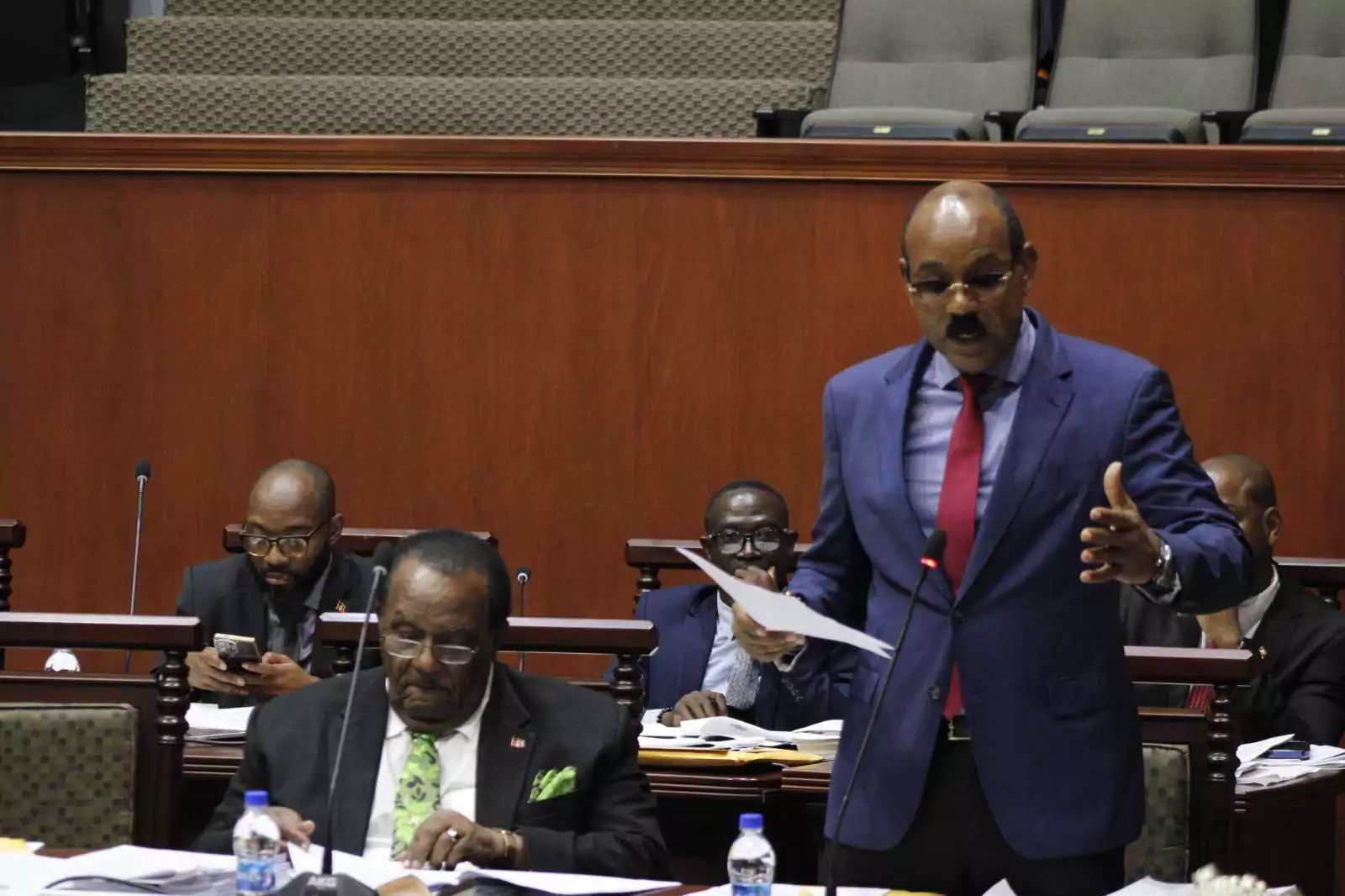
Prime Minister Gaston Browne addresses Parliament (photo by Robert Andre Emmanuel)
Prime Minister Gaston Browne told the House of Representatives that Antigua and Barbuda may need to decide whether to suspend its Citizenship by Investment Programme if visa restrictions tied to the programme persist.
Browne raised the possibility during Tuesday’s debate on a resolution governing the potential transfer of third-country nationals from the United States, telling members the CIP issue and the deportee negotiations could ultimately require the same kind of hard trade-off.
“If it is a CIP issue that persists, then we have to have a broader discussion as to whether or not we need to maintain our CIP programme, or if we should suspend it so that we can get full visa access again to the U.S., European Union too,” he said.
The remarks come three weeks after the European Commission formally requested that Antigua and Barbuda phase out its CIP by June 1, 2028, under a revised Visa Suspension Mechanism that took effect December 31, 2025, and treats the mere operation of a citizenship by investment programme as grounds for suspending Schengen access regardless of how well the programme is managed.
Brussels’ letter, dated June 25 and signed by EU Commissioner Magnus Brunner, offered a 24-month transition window but required interim vetting measures by September 2026.

The United States separately restricted several visa categories for Antigua and Barbuda from January 1, citing both screening deficiencies and the investor-citizenship pathway, with Browne previously arguing that decision was also tied to the country’s refusal to sign an unrestricted third-country nationals arrangement with Washington.
The Prime Minister said in early July that he believed that the CIP should continue no matter the outcome with Brussels.
“With or without those visa-free arrangements, our CIP programme continues,” he said at the time, calling the programme too important a source of non-tax revenue to abandon. The government’s 2026 budget projected EC$157 million in CIP revenue, and the programme has generated more than EC$1.4 billion since 2013.
In Tuesday’s sitting, however, Browne framed the decision in stark financial terms that suggested more openness to suspension than his previous statements.
“If it is that we want to maintain access in the European Union, visa-free, then we have to have a discussion as to whether or not we should continue the CIP and give up $100 million,” he told the House.
He said the government was working toward a position within a short timeframe.
“We are consulting, and we are hoping within a matter of weeks to come up with a consensus,” Browne said, adding that he would consider bringing a separate resolution before the House specifically on the CIP question to allow for a dedicated debate.
The prime minister directed pointed remarks at the opposition on the issue, telling members that any such debate would be an opportunity to move past criticism and present solutions.
“This will be your time now to show the people your mettle, all of the nonsense you have said about CIP. This is your time now, now that the rubber has hit the road, for you to come now and to show how responsible you are and what solutions you have,” he said.



Does visa-free travel guarantee a better economy? They aren’t helping us now, why should we end the programme that gives us a better look to the wider world? Gaston better make a good decision here.
The only reason why the passports are appealing is the visa free access. If we get banned every where these people won’t want it again
Say yes we will worry about it in two years, 2028 between now and 2 years you can get all the investors you need, we are not closing no doors, teck all, we don’t hold tomorrow God does, government will change in America for sure in 2 years 2028. Yes yes yes 💰 💰 💰 is a win for us and win for them.
Is the CIP as marketable without visa free entry? Looking like either way we stand to lose CIP revenue. Antigua people relay on visa for business and study. Being part of the wider world holds sway.
This is a very difficult decision. The CIP has funded so many projects, but losing visa-free travel affects every Antiguan.
What projects U speak if? And the country look so. Maybe projects fu Minister’s pockets. Thought these ppl that buy these passports should at least be doing some sort of investment as one of the clause. But we selling so much n no investment. Help me make this make sense. I stand corrected if needs be!!!
But with or without visas they still don’t have much to offer us everywhere is getting hard why jeopardize what you have and you don’t know what your are going to get remember these people mind like weather so we have to be extra careful here cause sometimes what is done cannot be undone
This is quite a pickle we’re in right now.
Indeed!
Keep, EU, Visa, and CIP if we live to see 2028 we will worry about it, get ton load of investors, in 2 years, then we can give EU them money back from the billions, Trump and maga will be gone 😀 Gaston finance 😀