












ICSID will eventually publish a redacted award, but the hearings, evidence and most filings in the Japanese bondholder case will remain secret — including any Swiss files the tribunal may force Bern to produce
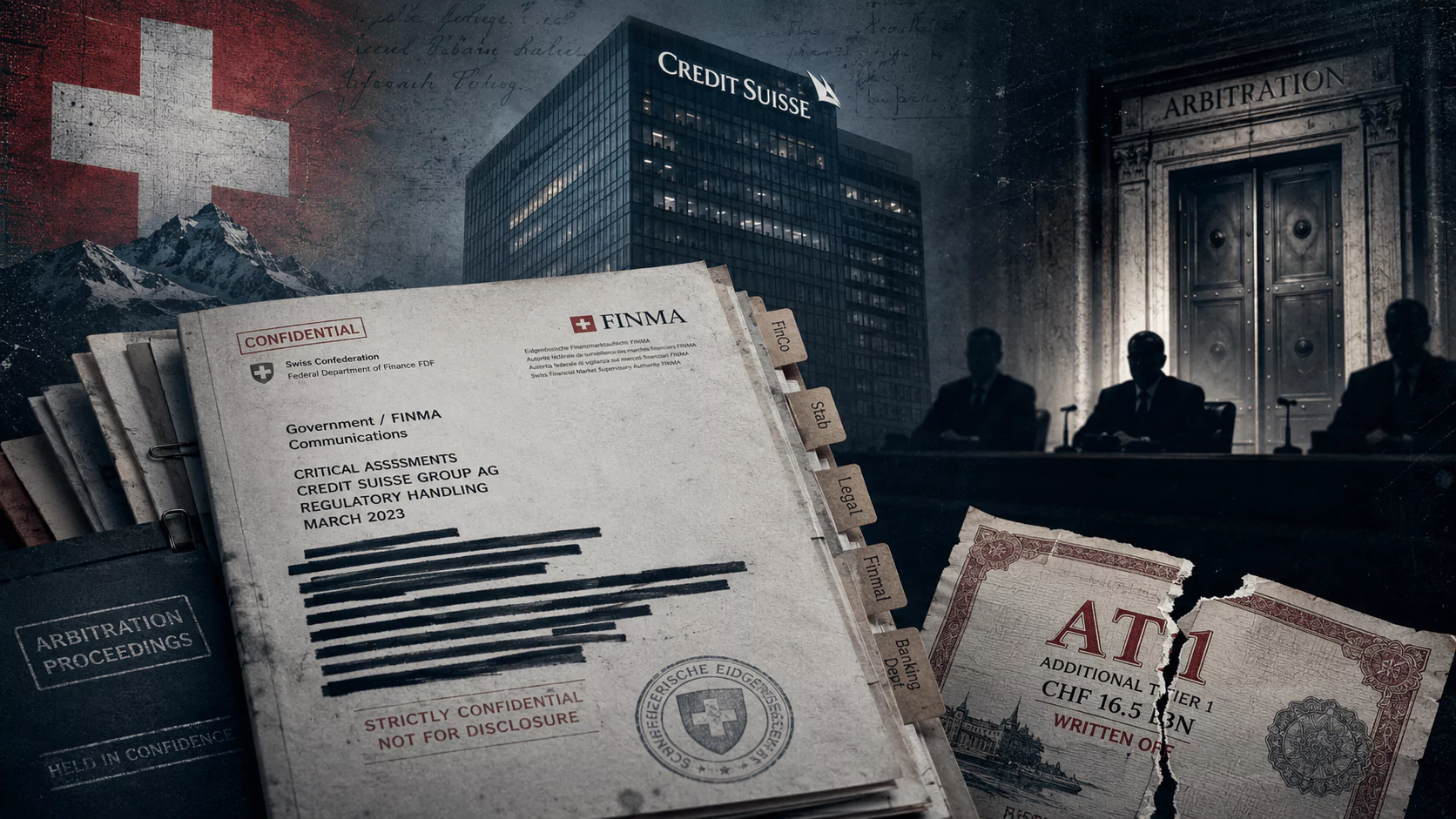
Switzerland is being asked to justify the erasure of CHF16.5bn of private claims. The public may never see most of the evidence used to decide whether it acted lawfully.
That is the real significance of Procedural Order No. 2 in Hiroshi Osumi v Swiss Confederation, ICSID Case No. ARB/26/1. ICSID added the order to its website on August 27. The document itself is dated July 10 — 48 days earlier — and was signed by Marinn Carlson, president of the three-member tribunal.
The order says nothing about whether Switzerland breached its treaty obligations, whether the Credit Suisse AT1 write-off was lawful or whether investors are entitled to compensation. It does something more procedural, but no less consequential: it determines who will be allowed to see the record on which those questions are decided.
The answer is stark. A redacted award will eventually be published. The hearings, documentary evidence, witness statements, expert reports and much of the written case will ordinarily remain behind closed doors.
The order emerged just as Switzerland asked the tribunal to require security for its potential legal costs and separately sought an arrangement concerning advances on the arbitration’s expenses. The amount requested, the evidence relied upon and the claimant’s full response are not public.
A disclosure that required someone to ask
The official ICSID case page records the order’s publication on August 27, while the PDF bears the date July 10.
That gap is not explained. Paragraph 14 provides that ICSID will publish tribunal orders and decisions only when one of the parties requests publication. Someone therefore appears to have asked for this order to be released. The public record does not identify which side, when the request was made or whether the 48-day interval resulted from the redaction process, the timing of the request or administrative delay.
It is a small unanswered question in a proceeding designed to generate much larger ones.
The order records that the tribunal circulated a draft on May 27, received comments from the parties on June 22 and discussed the proposed regime at its first session on June 29. It incorporates both agreements between the parties and decisions made by the tribunal. It does not disclose which restrictions were proposed or resisted by either side.
Transparency, by permission
The definition of protected information is broad. It includes material shielded by Swiss law, information whose release the state considers contrary to its essential security interests, and information whose publication could aggravate the dispute or undermine the integrity of the arbitral process. The tribunal may resolve disputes over those classifications.
Paragraph 8 then imposes confidentiality on virtually every category of material created for the arbitration: written submissions, witness statements, expert reports, correspondence, procedural directions, transcripts, recordings, decisions and awards. It also protects non-public documents filed or produced by the opposing party.
There are conventional exceptions. Information already in the public domain or lawfully obtained elsewhere may be used. Disclosure is permitted where required by law, to advisers and witnesses bound by confidentiality, and where necessary to pursue or protect a legal right. A party may also use documents it created itself in another proceeding. It may not, however, reveal documents or information obtained solely from its opponent through this arbitration.
The public-access rules are restrictive at every stage. The final award will be published only after protected information has been redacted, with the parties given 60 days from dispatch to submit their proposals. Orders and decisions will appear only if a party asks ICSID to publish them. A party may request publication of its own memorial, counter-memorial, reply or rejoinder, but the evidence supporting those pleadings will remain outside the public file. ICSID will not publish exhibits, legal authorities, witness statements or expert reports.
The hearings will be closed. A transcript may be published only if one party requests it and the other does not object within 21 days. Even then, the parties may seek redactions. Audio and video recordings are excluded altogether.
This is not an open proceeding with narrowly defined exceptions. It is a closed proceeding with a few doors that a party may choose to unlock.
Confidentiality is common in investment arbitration, and legitimate commercial, personal and security interests deserve protection. The order also reflects agreements between the parties, not merely unilateral demands by Switzerland. But this is not an ordinary private commercial quarrel. It concerns an exceptional exercise of public power that wiped out CHF16.5bn of private claims in a single weekend.
A confidentiality rule may protect genuine secrets. It should not become retrospective insulation for public decision-making.
The 592-document blind spot
The consequences become clearer when the order is read alongside Procedural Order No. 1.
Osumi’s December 12, 2025 request for arbitration sought production of 592 documents. According to the tribunal, those records were cited in, but not published with, the Swiss Parliamentary Commission of Inquiry’s December 2024 report into the collapse of Credit Suisse — an inquiry whose limits Antigua.news examined at the time.
The request did not merely ask for an undefined archive. Its annex named or described each document, gave its date and identified the footnote in the parliamentary report where it appeared.
Switzerland refused to produce them.
The tribunal declined to compel immediate disclosure because Switzerland had not yet filed its defence and the request did not explain the relevance and materiality of each document in the form normally required during document production. It also found no urgent need for disclosure before Osumi filed his merits memorial.
But the denial was expressly without prejudice. Osumi may ask for the same records again during the formal document-production phase.
Procedural Order No. 1 contains one limited safeguard: where a party withholds a document or makes substantial redactions on grounds of privilege or confidentiality, it must identify the document and the basis for doing so in a privilege or confidentiality log. Yet Procedural Order No. 2 provides no route for the public to inspect that log.
The result is an unusually deep transparency deficit. Outsiders may never learn whether Osumi renewed all 592 requests, how many documents the tribunal ordered Switzerland to produce, how many Bern withheld, which grounds it invoked, what the tribunal accepted and which records ultimately influenced the award.
If Switzerland is ordered to produce documents solely within the arbitration, Osumi will ordinarily be barred from disclosing them. ICSID, for its part, will not publish them as supporting evidence. The tribunal could therefore inspect records cited by the Swiss Parliament but withheld from the public, while investors, journalists and citizens receive only a redacted account of what those records supposedly show.
The Swiss Confederation is the respondent; FINMA is not. But records held by the regulator and other federal bodies are likely to be central to any account of how the write-off was designed and ordered. Swiss public authorities collectively hold much of the paper trail over which the state is now litigating.
Justice cannot live on institutional authority alone
The disclosure dispute did not begin at ICSID. In the Swiss litigation, FINMA argued that investor access to case files should be restricted, in part because documents might reach the media or be used in foreign proceedings. Antigua.news later reported on delays and continuing disputes over access to the record.
The same struggle crossed the Atlantic. In New York, AT1 investors secured an important opening when fraud claims survived and discovery was allowed to proceed. Credit Suisse and FINMA then invoked privilege to resist access to documents concerning the bank’s final days and the regulatory decisions surrounding the write-off.
Different forum, same missing paper trail.
Courts and tribunals sometimes need to protect sensitive material. But credible justice also depends on trust, and trust does not arise merely because an institution declares that a process was fair. It is earned when reasons can be tested against a record.
An independent tribunal may conduct the case with complete integrity. That alone does not resolve the legitimacy problem. If the public cannot know what the state produced, what it withheld, why it withheld it and which evidence the tribunal relied upon, an eventual award may be reasoned without being meaningfully verifiable.
A redacted award is not a substitute for an accessible evidentiary record. It tells readers what the tribunal chose to say about the evidence. It does not allow them to test omissions, context, competing interpretations or the weight assigned to individual documents.
Secrecy does not prove misconduct. But when a state intervention destroyed CHF16.5bn of private claims and a federal court has already held that the write-off lacked a sufficient contractual and statutory basis, secrecy prevents the authorities from dispelling suspicion. It asks the public to trust the same institutions while withholding much of the material needed to decide whether that trust is deserved.
Justice must sometimes protect secrets. It cannot credibly be built out of secrecy.

Switzerland seeks security for its legal costs
The confidentiality regime also covers a potentially decisive application now before the tribunal.
The public docket records that Switzerland filed two requests on August 3: one for security for costs and another concerning advances on the arbitration’s costs. Osumi filed observations on both applications on August 24. None of those submissions is publicly available.
Under ICSID Arbitration Rule 53, a tribunal considering security for costs must examine the claimant’s ability and willingness to satisfy an adverse costs award, the effect an order would have on the claimant’s ability to continue the case, the parties’ conduct and all other relevant circumstances, including any third-party funding.
The existence of the application does not establish that Osumi has third-party funding or that Switzerland relied on it. Without the request and the evidence, the basis for Bern’s application cannot be independently assessed.
Rule 53 normally requires a decision within 30 days of the last authorised submission. If Osumi’s August 24 observations were the final submission, the indicative deadline would be September 23. Any further round of pleadings would move that date.
The application does not automatically halt the arbitration. If security is ordered, the tribunal must set the amount, terms and deadline for compliance. Failure to comply may lead to suspension. After more than 90 days of suspension, the tribunal may discontinue the proceeding after consulting the parties.
A decision capable of affecting whether the claimant can continue the case may itself remain invisible. Under Procedural Order No. 2, an order on security for costs will be published only if one of the parties asks ICSID to release it.
Procedural Order No. 1 shows that ICSID initially requested $500,000 for the opening phases of the case. Osumi paid $250,000 in February and Switzerland paid the same amount in June. Bern’s later request concerning advances was therefore filed after both sides had paid their initial shares. The public record does not reveal whether Switzerland seeks a reallocation, an additional advance or some other protection.
One named claimant, 184 investors in reporting
ICSID’s public record names only Hiroshi Osumi, a Japanese national, as claimant.
Reuters reported in December 2025 that 184 Japanese investors had filed the arbitration request. Citing Drew & Napier, it said the investors alleged that Switzerland had acted unfairly, arbitrarily and without due process, amounting to an effective expropriation under the Switzerland-Japan free-trade agreement.
Reuters also reported that the firm represented about 560 Asian bondholders across Japan, Hong Kong and Singapore with combined claimed losses exceeding $300mn.
Those figures should not be treated as the claimant population or value of ARB/26/1. Neither procedural order explains whether Osumi acts as a lead or representative claimant, and the public docket does not list 184 co-claimants. The face value of the bonds at issue, the damages claimed, the relevant series and the ISINs remain undisclosed.
The current official record identifies Mori Hamada & Matsumoto as counsel for Osumi. Switzerland is represented by the State Secretariat for Economic Affairs and LKK Arbitration.
Carlson chairs the tribunal. Gabriel Bottini was appointed by Switzerland and Peter Turner KC by the claimant. Paris is the legal place of the proceeding, which is being conducted in English.
A treaty claim against the Swiss state
The case is brought under the 2009 Switzerland-Japan Agreement on Free Trade and Economic Partnership, which allows qualifying investors to submit certain disputes with the other state to international arbitration.
The tribunal has not decided whether it has jurisdiction, whether Switzerland breached the treaty or whether compensation is payable. Osumi’s complete factual and legal case is not public.
The arbitration runs in parallel with the Swiss proceedings over FINMA’s March 19, 2023 decree, which ordered Credit Suisse to write down its entire AT1 capital to zero during the state-engineered takeover by UBS.
In October 2025, the Swiss Federal Administrative Court held in case B-2334/2023 that the write-off lacked a sufficient contractual and statutory basis and revoked FINMA’s decree. Antigua.news analysed the ruling and its limits; the court’s official release is available here.
The court did not order the bonds reinstated or investors repaid. FINMA appealed, and the judgment is not final.
Procedural Order No. 2 changes none of those substantive positions. It does not make Switzerland more liable or the investors more likely to recover. Its significance is more basic: it determines how much outsiders will be able to verify while those issues are litigated.
The next deadlines — and the limits of what we will learn
Osumi’s merits memorial is due on October 16. Switzerland must indicate about four weeks later — approximately November 13 — whether it intends to seek bifurcation, asking the tribunal to decide jurisdictional or preliminary objections separately from the merits.
If Bern pursues bifurcation, its formal preliminary objections would ordinarily follow by November 30, subject to any extension. No hearing date has been fixed.
The memorial will not automatically become public. Osumi may ask ICSID to publish it, but the witness statements, expert reports and exhibits intended to prove its allegations will remain excluded. Switzerland’s defence will be subject to the same asymmetry: its principal submission could be released at its request, while the underlying state documents stay hidden.
The public is therefore likely to see the procedural skeleton of the case while being denied much of its factual substance. It may eventually learn what the tribunal concluded without being able to inspect most of the Swiss record that made the conclusion possible.
Switzerland may ultimately persuade the tribunal that it acted lawfully. The claim may fail on jurisdiction or on the merits. But whichever result emerges will have to carry the weight of public confidence. An award resting on an unseen record will struggle to repair the damage to trust caused by the original intervention and the disclosure battles that followed.
For a dispute born in an emergency act of state power, confidentiality is no longer procedural background. It has become part of the credibility problem the proceeding is supposed to resolve.
Justice cannot demand trust while withholding the material on which trust depends.




0 Comments