












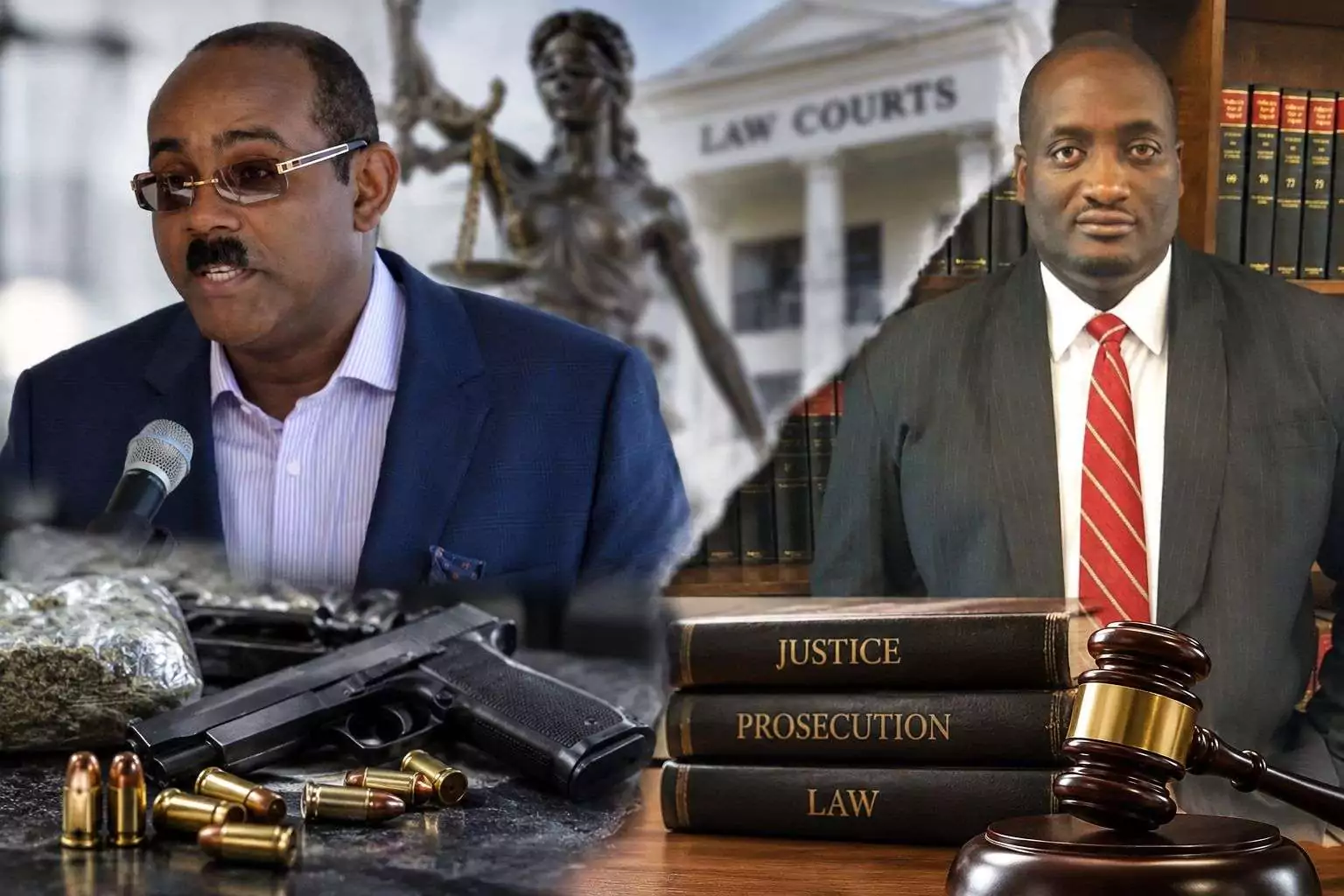
Prime Minister Gaston Browne has again taken aim at Director of Public Prosecutions Clement Joseph, questioning why his office has withdrawn a number of criminal cases involving drugs, firearms and ammunition.
In a strongly worded social media post on Friday, Browne asked why the DPP appeared to be “so quick to withdraw cases” involving people accused of serious offences.
“Why is our DPP so quick to withdraw cases against criminals involved in narcotics, fire arms and ammunitions?” Browne wrote, before adding: “Let the blasted courts decide.”
The Prime Minister’s latest criticism comes just days after firearm and ammunition charges against Shiloh Martin and Wayne Knowles were dismissed midway through their trial before Chief Magistrate Ngaio Emanuel.
Joseph instructed prosecutors to withdraw the charges because of weaknesses in the evidence. The two men had been accused in connection with two firearms, a Taurus .40-calibre pistol and a Smith & Wesson 9mm, along with ammunition, magazines and four ballistic vests allegedly found during a police search at a Liberta residence in October 2024.
The development appears to have renewed a wider disagreement between Browne and Joseph over the DPP’s use of prosecutorial discretion, particularly in serious criminal matters.
It is not the first time this year that the withdrawal of charges by the DPP’s office has attracted controversy.

In June, a drug case against Jamaican-born businessman Francis Young was discontinued. Young and Nadeem Brandon Doumith had been charged following the discovery of 62 pounds of cannabis in a cargo shipment at Deep Water Harbour in May 2025. Charges against Doumith remained before the court.
That followed the discontinuation of another drug prosecution involving Canadian national Roselynee Crisostomo, who had been accused of possessing 67 pounds of cannabis at V.C. Bird International Airport. Joseph later explained that Crisostomo was suffering from advanced cancer and said consideration had been given to Antigua and Barbuda’s ability to adequately support her medical needs if she were incarcerated.
Those decisions prompted questions earlier this year about whether the DPP should provide greater public explanations when major cases are discontinued.
Joseph has defended the independence of his office and his constitutional authority to decide whether prosecutions should proceed. In June, he argued that he was not constitutionally required to explain individual prosecutorial decisions to the public, while maintaining that his decisions could be challenged through the courts if considered unreasonable or an abuse of authority.
Browne publicly challenged that position at the time, arguing that public officials remain accountable and warning that a lack of explanation in high-profile cases could undermine public confidence.
The latest criticism also comes as the Browne administration takes a tougher public position on gun crime. In recent weeks, the Prime Minister has pressed for stronger consequences for firearm offenders and requested an independent review of sentencing for gun crimes, violent offences and repeat offenders.
Joseph, meanwhile, has previously pointed to the performance of his office in defending its record. At the opening of the 2026 law year, he reported an 89 per cent conviction rate for 2025 despite the DPP’s office operating with only half of its authorised staff. He also raised concern at the time about an increase in firearm offences.
Friday’s post suggests the tension between the Prime Minister and the country’s chief prosecutor over the handling of serious criminal cases is far from settled.
While Browne’s position is that such matters should be allowed to run their course before the courts, the DPP has maintained that prosecutors must assess the strength of the evidence and exercise their constitutional discretion when deciding whether a case should continue.



Why is only one man gone to jail for Nigel christian murder case
Wat happen to the other 2 plus the forth one that pull the trigger.
The Prime Minister has a valid concern. When serious gun and drug charges are withdrawn, the public deserves a clear explanation.
“Let the courts decide” sounds reasonable, but cases with weak or unreliable evidence should never be pushed forward simply to satisfy public pressure. The police must also answer questions. Why are major cases repeatedly reaching the court with evidence that prosecutors consider insufficient?
Two firearms, ammunition and ballistic vests are serious matters. The public needs to understand exactly what evidential weakness caused the prosecution to collapse.
Hmmmm I will let detective Browne lead that case while I stand back and observe