











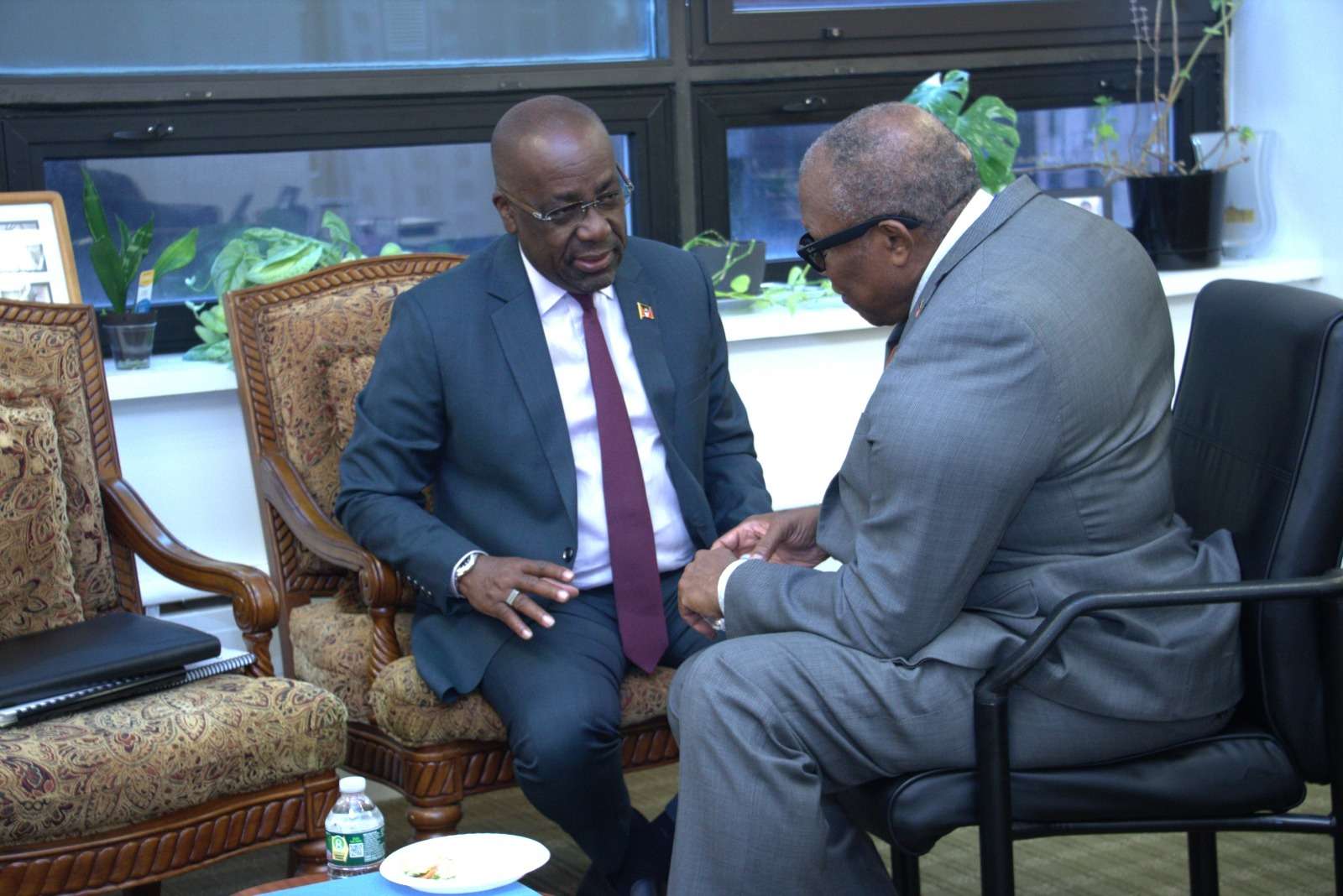
Minister Greene arrives in New York and is being briefed by H.E. Aubrey Webson
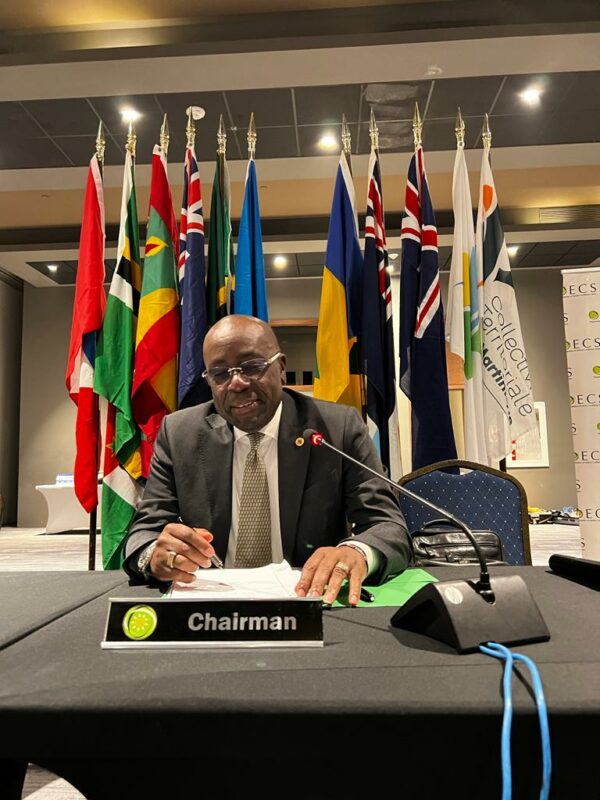
Antigua and Barbuda’s Foreign Affairs Minister, E.P. Chet Greene, has assumed the chairmanship of the OECS Council of Ministers of Foreign Affairs with a warning that the region is facing a global environment capable of reversing decades of progress.
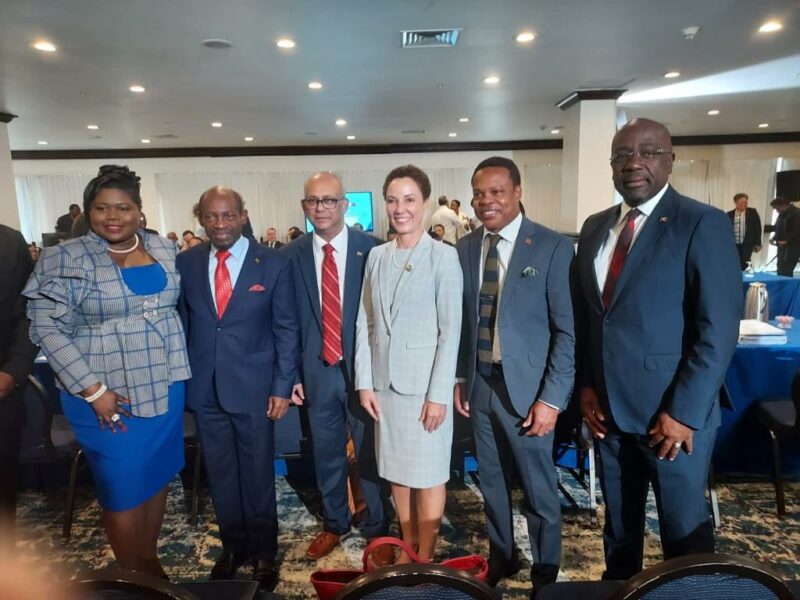
Greene accepted the leadership role during the Council’s tenth meeting in New York on Sunday, calling for a more coordinated, self-reliant and action-driven Organisation of Eastern Caribbean States.
“We are at a moment of crisis. There is no rescue waiting on the near or distant horizon,” Greene told fellow ministers, diplomats and OECS officials.
He said nationalist and protectionist policies are weakening the rules-based international trading system, while vulnerable supply chains and heavy dependence on a single market continue to expose OECS countries to decisions beyond their control.
Visa restrictions and changing entry requirements are also disrupting business, education, family life and official travel, he said. At the same time, member states continue to face international pressure over legitimate development programmes, including citizenship by investment and financial services.
“This meeting must mark the beginning of disciplined collective action,” Greene declared.
The incoming chairman said the OECS already possesses a strong foundation for joint action, pointing to its single currency, Eastern Caribbean Central Bank, Economic Union, freedom of movement, common Supreme Court and other shared institutions.
“Among sovereign states, ours is one of the deepest integration arrangements in the world, second only in important respects to the European Union,” he said. “The issue is not whether we possess a platform. It is whether we are prepared to use it fully.”
Greene outlined an ambitious agenda centred on expanding trade within the OECS, strengthening regional institutions, improving transportation, diversifying supply markets and mobilising regional capital.
He called for a structured partnership between governments and the private sector to determine which goods and services can be produced competitively within the Economic Union and to remove barriers preventing businesses from treating the OECS as a single domestic market.
He also urged governments to support qualified OECS suppliers through public procurement wherever legally and practically possible.
Standards, licensing requirements and digital systems should be harmonised, Greene said, allowing an enterprise established in one Protocol Member State to operate across the Union without unnecessary duplication.

The Foreign Affairs Minister also questioned the financial sense of small administrations independently duplicating expensive specialised services.
He proposed shared pools of experts in financial services, citizenship by investment, international taxation and anti-money-laundering compliance. He also recommended expanded joint procurement of medicines, equipment and technology, a regional cybersecurity capability, stronger statistical systems and a dedicated team of trade specialists.
“Where a shared service would be better, stronger and less expensive than seven separate national units, we should build it together,” Greene said.
Transportation was identified as another urgent priority, with Greene arguing that freedom of movement has limited value if people and goods cannot travel reliably and affordably.
He called for stronger air connections between OECS countries, regular maritime transportation for passengers and cargo, and new links with Central and South America.
Governments, he said, must work with airlines, shipping companies, ports, exporters, importers, financial institutions and investors to design and finance commercially viable services.
Greene also advocated reducing the region’s excessive reliance on a single supply market by expanding trade with Central and South America.
However, he cautioned that diversification would require more than diplomatic visits. It would demand market research, Spanish-language skills, shipping arrangements, payment and insurance systems, business-to-business relationships and coordinated purchasing.
Food security must also be addressed collectively by matching available land, water, expertise, capital and markets across the OECS, he said.
“No member state needs to produce everything, but together we should be able to produce and distribute much more of what our people consume,” Greene told the meeting.
He further proposed mobilising OECS savings, pension funds and financial institutions to support viable regional businesses and projects in transportation, renewable energy, agriculture, manufacturing, tourism, digital services and the blue economy.
According to Greene, regional integration should allow a successful business to access the capital and market of the entire Economic Union rather than being restricted to the resources of its home country.
Climate resilience was another central feature of the incoming chairman’s agenda.
He called for a shared pipeline of bankable resilience projects, pooled expertise for climate-finance applications, coordinated insurance and disaster-risk financing, regional emergency stockpiles and common resilience standards for public infrastructure.
The OECS should also pursue joint renewable-energy projects and possible interconnection to reduce emissions and the imported fuel costs that undermine regional competitiveness, he said.
Greene renewed calls for vulnerable small-island states to gain fairer access to concessional financing, arguing that per-capita income should not be used as a crude measure for determining eligibility.
He said OECS states should collectively campaign for vulnerability-based financing, wider use of the Multidimensional Vulnerability Index, reform of development-bank rules, climate-related debt clauses and faster post-disaster disbursements.
At the same time, Greene acknowledged that member states must strengthen their ability to turn approved financing into completed projects.
He proposed reforming the OECS Commission to create a regional project-preparation facility staffed by technical, legal and financial experts.
“Such a focused unit could serve all members and ensure that available financing does not remain unused because individual administrations lack capacity,” he said.
Greene also wants OECS foreign policy to become a direct instrument of the region’s economic and development agenda.
He proposed a limited set of core foreign-policy priorities, including protection of the Economic Union’s development interests, fair treatment of citizenship by investment and financial services, access to climate finance, improved air and maritime links, and the defence of multilateralism and international law.
An implementation mechanism comprising diplomats and technical specialists should also be established within a reimagined OECS Commission, he said.
The body would turn ministerial decisions into work plans, assign responsibilities, establish deadlines, coordinate overseas missions and regularly report on progress.
Greene stressed that greater coordination would not diminish the individual foreign policies of member states but would instead give each country greater diplomatic reach.
“On those shared interests, our partners should hear one clear and consistent OECS position,” he said.
Closing his inaugural address as chairman, Greene warned that failure to act decisively could place the region’s hard-earned gains at risk.
“If, however, we use the institutions we have built, pool our sovereignty where it multiplies our strength, engage our private sector as a full partner, diversify our markets and alliances, and hold ourselves accountable for implementation, the OECS can emerge more resilient, more self-reliant and more influential,” he said.
“As Chair, I will work with each of you and with the Commission to turn our decisions into measurable action. We must now summon the determination to act.”



0 Comments