
The $70,000 problem with Nvidia’s $312 million options rumour
Trading records contradict the claim that one trader turned $3.4 million into $312 million on Jensen Huang’s return as CEO. A separate set of bets drew scrutiny at Polymarket.

By Dario Item

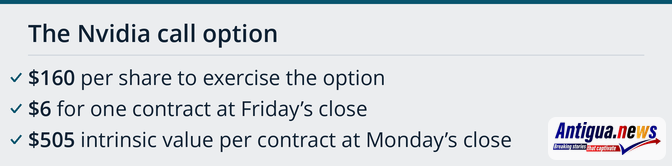
At Friday’s close, six dollars bought the right to purchase 100 Nvidia shares at $160 apiece through Monday, November 23. By the closing bell that day, Jensen Huang was back as chief executive and the contract had an exercise value of $505. It was an extraordinary return. It also gave a story about a $312 million windfall just enough truth to travel.
An account on X called Mike Investing claimed that an unnamed trader had spent $3.4 million on those options shortly before the previous Friday’s close. The $312 million figure was the supposed value of the position on Monday. Trading records reveal a problem with the story before the question of a buyer’s identity even arises.
How a $6 Nvidia call became worth $505
On Friday, November 20, Nvidia closed at $125.53, down about 14 per cent in the sell-off that dragged the Nasdaq down 5.3 per cent. The call option gave its holder until Monday to buy shares at $160. Nvidia would have to rise nearly 28 per cent in a single trading session just to reach that price. The contract’s last recorded price on Friday was six cents a share, or $6 for the standard 100 shares.
On Sunday, Nvidia’s board voted to reinstate Huang, the co-founder who had overseen its rise to the world’s most valuable listed company in 2024. The company announced his return at 8.55am New York time on Monday. Its shares rose 31.5 per cent to $165.05. At expiry, a call holder could pay $16,000 for stock worth $16,505. The $505 difference was the contract’s value before deducting the original $6 outlay.
The $70,000 limit on the supposed $3.4 million bet
The online account specified the exercise price, the expiry and the day of purchase. That left a claim that could be checked against the exchange record. FT Alphaville’s analysis of Bloomberg data found 11,677 contracts in that particular series changed hands all Friday. The average price, weighted by trading volume, was just under six cents a share. Altogether, buyers paid about $70,000 in premiums.
One buyer would have had to spend nearly 49 times the amount the entire market spent that day. The discrepancy concerns this particular series of calls. Other Nvidia options traded in far greater size.
Consider a trade documented by Bloomberg. On the same Friday, a buyer also chose a $160 exercise price, but bought calls that ran until January. On Monday, the buyer sold half the position and locked in a $23.8 million gain. Two buyers can back the same stock at the same price and still be trading quite different contracts.

The Polymarket bets before Jensen Huang’s return
On Polymarket, traders could bet directly on Nvidia’s choice of chief executive. Public Citizen traced nine purchases by an account that usually bet on sport. Between 8.21am and 8.47am on Monday, it spent $18,874 on an outcome that would pay if Nvidia named no successor to Huang by year-end. The final purchase came eight minutes before the company’s announcement. At 2.28pm the account sold the position for $101,901.
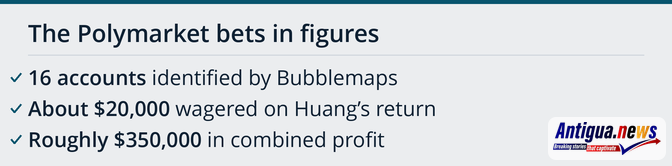
Separately, blockchain analysts at Bubblemaps identified 16 Polymarket accounts that together wagered about $20,000 on Huang’s return and made roughly $350,000 in profit. Eleven accounts received funds in the hours before the announcement. All 16 placed their first bets within about six minutes of receiving funds. The researchers found similar trading patterns without establishing a direct financial link between the accounts.
The BBC reported on November 24 that Polymarket was reviewing a small number of Huang-related transactions. Public Citizen called for an investigation into bets on Polymarket and Kalshi. Its co-president, Robert Weissman, acknowledged that the timing alone could not establish what any bettor knew.

Traders also had a public reason to expect a change of heart. On Sunday evening, Donald Trump had urged Nvidia to bring Huang back. Within 40 minutes of his post, the odds of a return on Polymarket’s US platform had risen six percentage points, according to Wired.
As of November 26, there was no public confirmation that the US Securities and Exchange Commission had opened an insider-trading inquiry into the alleged $3.4 million options purchase. The SEC inquiry reported by Reuters concerned Nvidia’s accounting and was already under way before the board voted. The record tells us exactly when the sports bettor placed that last wager. What the bettor knew at 8.47am remains an open question.
This story was first published by Antigua News on : antigua.news/2026/11/26/nvidia-options-trade-312-million-rumour-jensen-huang-polymarket. © 2026 Antigua News. Republication without permission is not allowed.

About the author
Dr. Dario Item is the Head of Mission of the Embassy of Antigua and Barbuda in Madrid. He is an experienced financial crimes lawyer with nearly 30 years of practice. He holds degrees in law and political science, a Ph.D. in criminal law and an LL.M. in transnational financial crime.
Read our editorial standards and corrections policy. Spotted an error? Contact the newsroom.
More from Business and Finance
View section
Nasdaq plunges 5.3% as AI fears deepen stock market sell-off
Doubts over artificial intelligence spending and the prospect of higher interest rates send technology shares tumbling, extending a bruising decline.
By Dario Item
Comments (1)
Vivienne November 26, 2026, 10:10 AM
Excellent analysis. The distinction between suspicious trading patterns and actual evidence of insider trading is particularly important. A refreshing example of rigorous financial journalism in an era of sensational headlines
Reply