
Why the Atlantic had one hurricane and the eastern Pacific had ten
Isaias was the Atlantic’s only hurricane with two days left in the 2026 season. On the other side of the Americas, eight eastern Pacific hurricanes reached Category 3 or higher.


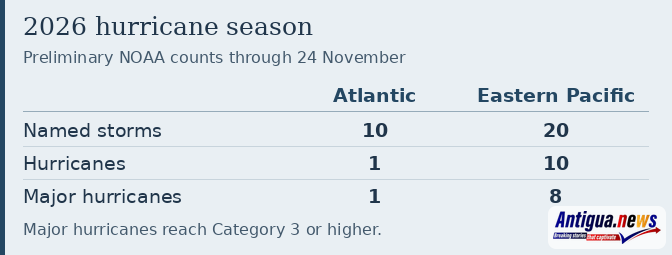
The Atlantic had to wait until 7 October for its first hurricane of 2026. With two days left in the official season, Isaias remains its only one. In the eastern Pacific, ten storms became hurricanes and eight of them reached Category 3 or higher.
The US National Oceanic and Atmospheric Administration (NOAA) puts much of the difference down to one of the strongest El Niño events on record. Its preliminary season review covers the period through 24 November. The National Hurricane Center reported no active tropical cyclones in either basin early on Saturday.
How the Pacific changed Antigua’s forecast
In May, Antiguan climatologist Dale Destin was watching two competing influences. The tropical Atlantic was warm enough to fuel storms. El Niño, then developing in the Pacific, could make it harder for them to grow. His early outlook, reported by Antigua.news, projected about 16 named Atlantic storms and seven hurricanes.
The connection lies in the winds high above the Caribbean. During El Niño, westerly winds tend to strengthen over the tropical Atlantic. When the wind changes speed or direction with height, it can push thunderstorms away from a developing storm’s centre before they have time to organise around it. Forecasters call this vertical wind shear.
By 1 September, as El Niño strengthened, Destin had revised his forecast to ten named storms and three hurricanes. Ten named storms did form. Only Isaias became a hurricane, against a long-term average of seven.
In the eastern Pacific, El Niño generally gives storms more favourable conditions to develop. Hurricane Polo reached Category 5 before weakening and coming ashore twice in Mexico. Across the eastern and central Pacific combined, the season set a record for accumulated cyclone energy, which measures both how hard the winds blow and how long the storms last.
What one hurricane did to the Gulf Coast
Isaias reached Category 3 at sea before hitting the Florida Panhandle as a Category 2 hurricane on 9 October. When its centre crossed the coast near Destin that evening, its sustained winds were still 105 mph. At Panama City Beach, a tide gauge recorded water 5.6 feet (1.7 metres) above the average height of the higher daily tide.
The scale that assigns a hurricane its category measures wind speed alone. Water posed a different problem on each side of the state line. In Florida, seawater washed over coastal roads and stripped sand from beaches. Inland at Bellwood, Alabama, nearly 13 inches (330 millimetres) of rain fell, according to the National Weather Service’s October report.
By early afternoon the next day, Florida officials counted more than 439,000 electricity accounts without power. Holmes County asked the state for crews to cut up fallen trees blocking roads.
The outages were visible from space. In NASA’s night-time images, the normally bright stretch of US Route 98 between Pensacola and Destin was broken by dark patches on 11 October. By the following night, lights were coming back on along the same road.
This story was first published by Antigua News on : antigua.news/2026/11/28/2026-hurricane-season-el-nino-atlantic-eastern-pacific. © 2026 Antigua News. Republication without permission is not allowed.

About the author
Michael Williams is a journalist with over a decade of experience in news reporting. At Antigua.news, he covers international affairs, with a particular focus on major global news events, geopolitical developments and the evolving dynamics of international relations.
Read our editorial standards and corrections policy. Spotted an error? Contact the newsroom.
More from Culture, Science and Tech
View section
Tidal to remove 27 million AI-generated tracks. Most had no listeners
The streaming service says 96% of the tracks it flagged went three months without a play. Musicians who use AI to help produce their own recordings can still upload them.
By Michael Williams

China Post puts 45 humanoid robots to work on a Hangzhou parcel line
The machines turn small packets and feed them onto a conveyor. At a second Chinese mail centre, postal staff say experienced workers still have the edge on speed.
By Michael Williams

Five-million-year-old coral atoll found 900 metres beneath the Atlantic
A Brazilian-led expedition filmed a garden of living deep-water corals growing on a reef that once stood in sunlit shallows.
By Michael Williams

SpaceX Wins Approval for Up to a Million AI Satellites. What Will Telescopes See?
SpaceX’s Starmind data centers would run on sunlight. Astronomers in Chile have modeled what happens when that light reflects into a telescope long after sunset.
By Dario Item
Comments
Be the first to comment.