
COMMENTARY: ANTIGUA AND BARBUDA HAS SECURED A CIP REPRIEVE – HOW SHOULD IT USE IT?
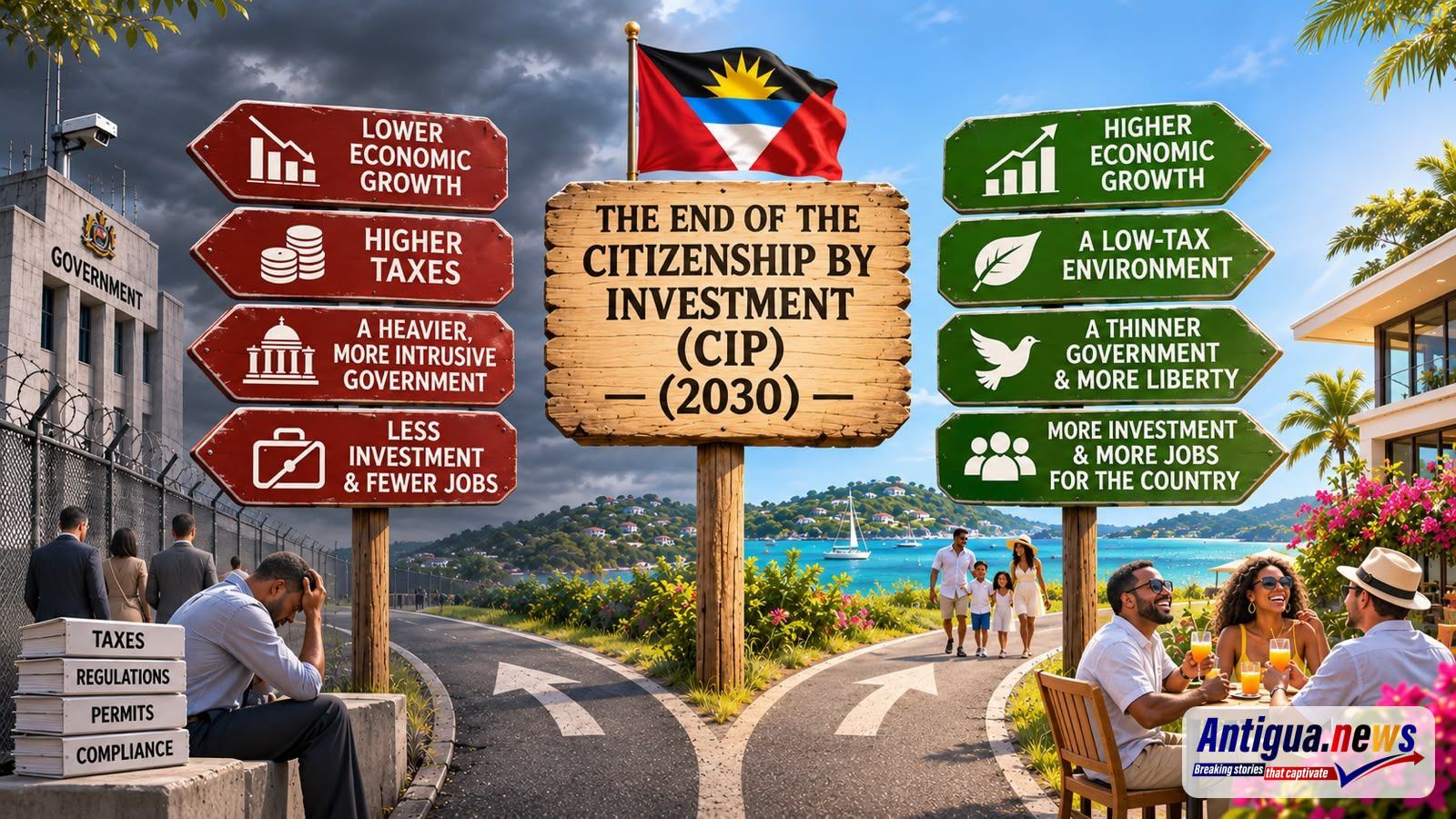
The extension secured from the European Commission gives Antigua and Barbuda three years to prepare for the end of its Citizenship by Investment Programme. With economic growth, budgetary discipline and new investment opportunities, the transition need not require higher taxes or substantial cuts to public services.

The European Commission’s decision to extend the deadline for the closure of Antigua and Barbuda’s Citizenship by Investment Programme (CIP) represents an important diplomatic achievement for Prime Minister Gaston Browne and provides the country with valuable additional time to prepare its economic transition.
Having initially requested that Antigua and Barbuda discontinue its programme by June 1, 2028, the European Commission responded on November 25 to the Prime Minister’s letter of October 30, acknowledging the economic and budgetary challenges associated with its termination.
Under the revised timetable, new applications will be accepted until January 31, 2029, with processing continuing until December 31, 2029. The programme will formally conclude on January 1, 2030.
The Government has therefore secured an additional 19 months compared with the original deadline, while pursuing the preservation of visa-free travel to Europe for Antiguan and Barbudan citizens. The Commission has also expressed its willingness to cooperate with the country on economic diversification during the transition.
By publicly advocating a longer transition period and placing the economic consequences of an abrupt closure at the centre of negotiations, Antigua and Barbuda helped establish a more constructive framework for discussions with Brussels. St. Kitts and Nevis, which pioneered citizenship by investment in 1984, has subsequently confirmed an identical timetable.
The question now is how best to use this additional time.
According to the 2026 Budget Statement and detailed government estimates, Antigua and Barbuda anticipated EC$120 million in direct CIP receipts and a further EC$40 million in surplus transfers from the Citizenship by Investment Unit. Together, these represent approximately EC$160 million, or US$59 million, equivalent to nearly 11 per cent of projected recurrent government revenue.
Replacing this income will be one of the country’s principal budgetary challenges over the next three years.
Broadly speaking, there are three ways to compensate for the disappearance of a source of government revenue: generate additional revenue through economic growth, reduce public expenditure, or increase taxation.
The first option offers a particularly promising opportunity for Antigua and Barbuda.
The International Monetary Fund projects nominal economic growth of 4.9 per cent in 2026 and 4.5 per cent in 2027. Continued economic expansion naturally has the potential to increase government revenue without requiring changes to existing tax rates.
The 2026 budget projects approximately EC$1.25 billion in tax revenue. If these revenues were to increase by an average of 4.5 per cent annually over the following three years, they would reach approximately EC$1.43 billion in 2029.
This would represent an additional EC$176 million in annual tax revenue, potentially exceeding the entire budgeted contribution of the CIP.
The essential condition, however, is that additional government revenue must not automatically translate into additional government expenditure.
By maintaining expenditure as close as possible to current levels, prioritising essential public investment and avoiding unnecessary new recurrent commitments, Antigua and Barbuda could progressively create the budgetary room needed to absorb the disappearance of CIP revenues.
Every additional dollar of tax revenue generated through economic growth and not absorbed by new expenditure would bring the country closer to a budget that no longer depends on the CIP.
Rather than waiting until the programme closes and then facing difficult budgetary decisions, the country has an opportunity to prepare for its closure gradually, allowing economic growth to do much of the work.
Increasing taxation, by contrast, carries particular risks for a small and internationally exposed island economy.
Antigua and Barbuda depends heavily on tourism, foreign investment, residential development and the spending of internationally mobile individuals. Its competitive tax environment, including the absence of personal income tax, constitutes an important economic asset that should not be taken for granted.
Unlike larger countries, small island economies cannot assume that investors, entrepreneurs and financially independent residents will remain regardless of changes to taxation. These individuals frequently have several alternative jurisdictions in which to establish themselves or invest.
Higher taxation may provide additional revenue in the short term, but if it discourages investment, business development and the establishment of new residents, it risks weakening the very tax base it was intended to expand.
This can create an increasingly difficult cycle in which a smaller pool of taxpayers is required to finance growing public expenditure, potentially leading to further tax increases and an additional loss of economic competitiveness.
For Antigua and Barbuda, attracting individuals and businesses capable of contributing substantially to the economy, rather than introducing measures that might encourage them to relocate elsewhere, is particularly important.
There is, however, another opportunity that deserves serious consideration: the development of a Residency by Investment programme.
Several prosperous island jurisdictions have successfully built residential investment markets without granting immediate citizenship, attracting substantial amounts of international capital.
The Cayman Islands offer permanent residence through investments of at least CI$2 million in developed real estate, equivalent to approximately US$2.4 million. Bermuda requires a qualifying investment of BD$2.5 million, while the Bahamas offers economic permanent residence from US$1 million.
The Turks and Caicos Islands offer qualifying residential investment routes ranging from US$300,000 to US$1 million, depending on the island. Anguilla offers permanent residence through a contribution starting at US$150,000 for an individual applicant or an approved real estate investment of US$750,000 for a family of four.
The British Crown Dependencies of Jersey and Guernsey have similarly developed frameworks attracting wealthy international residents. Jersey’s High Value Residency programme generally involves residential properties worth more than £1.75 million for an apartment or £3.5 million for a house, alongside a substantial annual tax contribution. Guernsey attracts international residents through its Open Market property system.
The economic potential of these arrangements is substantial. In October 2026, Bermuda reported approximately BD$622 million in investments associated with its Economic Investment Residential Certificate programme, with more than half invested in new and existing local businesses.
Antigua and Barbuda already possesses many of the qualities that make these jurisdictions attractive: excellent international air connections, beautiful residential developments, established tourism infrastructure, world-class marinas, an English-speaking environment, the absence of personal income tax and the institutional continuity of a stable constitutional monarchy, which can provide additional reassurance to international investors.
A well-designed programme could offer long-term residence in exchange for qualifying property investments, business investments or contributions to a national development fund, subject to appropriate due diligence requirements.
Unlike investors primarily seeking an additional passport, individuals choosing to establish a home in Antigua and Barbuda have the potential to contribute to the local economy year after year through construction, property maintenance, domestic employment, restaurants, supermarkets and other local businesses.
Their spending would also generate continuing government revenue through existing mechanisms such as the Antigua and Barbuda Sales Tax, import duties and property-related taxes, without requiring an increase in existing tax rates.
The existing Citizenship by Investment Unit, together with its established international network of authorised agents, could provide much of the administrative and commercial infrastructure required to launch such a programme.
Ideally, a residency programme could be introduced while the CIP remains operational, allowing both programmes to coexist during the transition and giving the new model time to establish itself before citizenship revenues disappear.
The combination of these two strategies could fundamentally change the economic outlook for Antigua and Barbuda after 2029.
If natural growth in tax revenue is sufficient to compensate for the disappearance of the CIP, as the figures suggest may be possible, the introduction of a successful residency programme would represent an additional source of economic activity and government income rather than merely a replacement for lost revenue.
Antigua and Barbuda could ultimately find itself with higher overall government revenues than it enjoys today, while benefiting from a more diversified and sustainable economic model.
The temptation to compensate for the disappearance of the CIP through higher taxation should therefore be resisted. Not only could such a response undermine the country’s competitiveness and discourage the investment it needs, but the projected growth of the economy suggests that it may not even be necessary.
Budgetary discipline will be the decisive factor. If additional revenues generated through economic growth are systematically absorbed by new expenditure, the opportunity created by the European extension will have been lost.
If, instead, expenditure is kept firmly under control and new sources of investment are developed, Antigua and Barbuda could enter the next decade with stronger public finances, a broader economic base and its competitive tax environment intact.
The Government has successfully negotiated additional time. The priority now should be to turn that time into lasting economic security, not higher taxes.
Alexander Nelson
This story was first published by Antigua News on : antigua.news/2026/11/28/commentary-antigua-and-barbuda-has-secured-a-cip-reprieve-how-should-it-use-it. © 2026 Antigua News. Republication without permission is not allowed.

About the author
The Editorial Staff refers to all reporters employed by Antigua.news. When an article is not an original creation of Antigua.news—such as when it is based on a press release, other media articles, letters to the editor, or court decisions—one of our staff members is responsible for overseeing its publication.
Read our editorial standards and corrections policy. Spotted an error? Contact the newsroom.
More from Antigua and Barbuda
View section
WISH to Host ‘Behind the Screen’ Workshop Addressing Digital Violence Against Women and Girls
WISH and regional partners will host a workshop in Antigua on December 5 to raise awareness of digital violence against women and girls and promote online safety.
By Editorial Staff

AIDS Secretariat Symposium Tackles HIV Stigma, Prevention and Sexual Health Awareness
Health professionals and community stakeholders gathered for an afternoon of discussions on HIV prevention, testing, treatment, sexual consent, mental health and healthy relationships ahead of World AIDS Day.
By Cory Wayland

Police Launch Operation Season Watch, Remove 12 Vehicles From Roads in Christmas Crackdown
Police stopped approximately 140 vehicles during coordinated patrols and checkpoints as Commissioner Everton Jeffers warns that intensified crime-fighting and traffic enforcement will continue into the new year.
By Cory Wayland

HIV Cases Rise 33% in Antigua and Barbuda as Health Official Raises Alarm Over Young Men
Antigua and Barbuda recorded 72 new HIV cases in the first nine months of 2026, with the AIDS Secretariat warning that complacency and inadequate sexual health education continue to undermine prevention efforts.
By Cory Wayland
Comments (1)
True Antiguan November 28, 2026, 12:32 PM
Very good article. I just hope the government doesn’t see the end of CIP as an excuse to introduce new taxes. We already pay enough for everything here! We need more people investing in Antigua, opening businesses, building houses and creating jobs. That’s how the government can collect more revenue without making life more expensive for everybody. And if government revenue increases, it doesn’t mean government spending has to increase every year too! I also like the idea of Residency by Investment. Let people come here, buy property and spend their money in Antigua. Surely that’s better than driving investors away with more taxes. Let’s not destroy one of the main advantages Antigua has over other countries.
Reply