
At least 15 dead after Funicular rail carriage crashes in Lisbon

By Mick the Ram
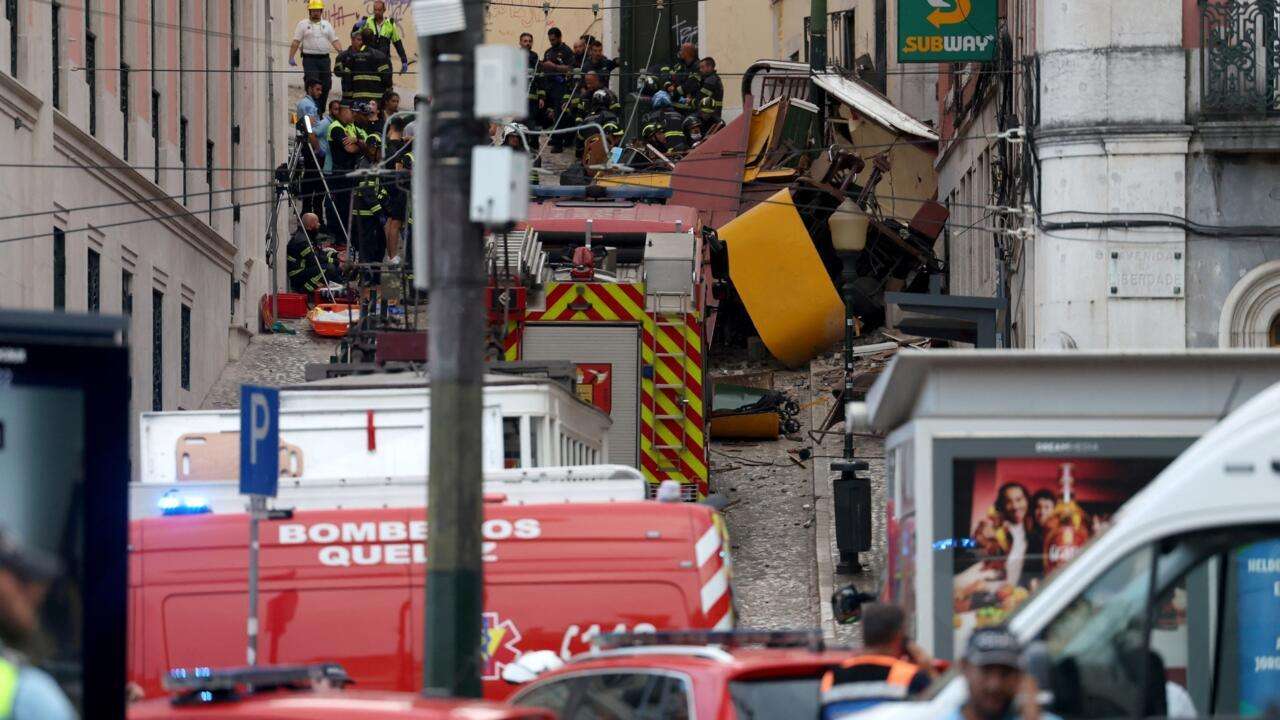
A popular funicular rail carriage which operates in the centre of the Portuguese capital of Lisbon, has crashed from a “great height” killing at least 15 people and injuring a further 20.
It is unclear how many passengers were aboard the famous Glória cable railway when it derailed at around 6pm on Wednesday 3 September and fell into a hotel below, but is thought to have been at its capacity of 43 for the short journey.
Footage shared widely on social media, showed the bright yellow tourist attraction overturned and almost entirely destroyed, with emergency personnel at the scene in huge numbers.
Authorities have indicated that of the injured, five were in a “serious” condition, with the others believed to have sustained more minor injuries.
Simple functionality
A funicular railway is a type of system designed to transport people up and down steep slopes and can be found in many towns and cities around the world. The Glória funicular has two cars which are powered by electric motors.
These are attached to opposite ends of a haulage cable, meaning that as one travels downhill its weight lifts the other, allowing them to ascend and descend simultaneously.
Foreigners among dead
Footage emerging from the scene showed panic and confusion, with a great deal of smoke clearing to reveal a twisted wreckage of metal. It appears that the structure came off the rail after a cable became loose causing a devastating loss of control.
It is being reported at this early stage that foreigners “are among the dead” although so far no names have been released.
Witnesses accounts of tragedy
A witness explained how the lower lift was descending slowly, but as it approached the bottom it seemed to go out of control and hit the pavement very hard. He said he then quickly realised that the second lift was heading towards them from above at great speed, and “we only had time to turn around and start running, because we didn’t know if it was going to hit the lift below.” He added that his biggest concern was that it would end up on the road leading to Rossio Square.
A second witness described the horror of the crashed carriage as it seemed to “break up like a cardboard box” and the awful sight of a large bag being removed some time later, which he presumed contained one of the bodies.
City in mourning
Lisbon’s mayor, Carlos Moedas, declared 3 days of municipal mourning for the city; calling it a “tragic moment for Lisbon”. Portugal’s President Marcelo Rebelo de Sousa also issued a statement expressing his “sympathy and solidarity with the families affected by this tragedy.” He added that he hoped the causes would be “swiftly clarified by the competent authorities”.
European Commission President Ursula von der Leyen also sent her condolences to the families of the victims.
Huge tourist attraction
The tram which derailed runs a 275-metre (900ft) climb from Lisbon’s central Restauradores Square up to the cobbled lanes of Bairro Alto, the so-called “high neighbourhood” leading then to the Sao Pedro de Alcantara viewpoint.
Although the journey takes only three minutes, it has established itself as of one the city’s biggest tourist attractions, with some 3 million people using it every year.
Broken cable to blame?
It is being reported that this funicular was “submitted to a general repair” in 2022, and an intermediate one in 2024, all within “defined protocols for periodic maintenance”.
A specialist in engineering and a former member of Lisbon City Council, suggested that what may have happened is that a traction cable snapped, which would have the effect of causing the funicular to lose control. “From what we can see in the images, it is most likely that a traction cable broke, and when it broke, the brakes that should normally work in a situation like this did not work,” he said.
Maintenance issues called into question
However, Manuel Leal – a syndicate leader for FECTRANS (the transports federation) and STRUP (passenger bus operators) – said that workers of Carris (the Lisbon public transports company) have “presented successive complaints” on the need for maintenance of the city’s funiculars, including the Glória funicular.
“The syndicate is calling for a rigorous inquiry into the causes of this accident, and defends that maintenance should be returned to Carris workers, instead of (given, as it has been) to outside companies,” he said; before adding that workers have been reporting “differences in terms of maintenance that was carried out by Carris workers a few years ago, and the maintenance that is carried out today.”

About the author
Mick Burrows is an independent freelance author based in the UK, boasting over 20 years of experience in the online writing landscape. His extensive background has enabled him to develop a diverse range of material, marked by a unique and distinct style. Recognized as a platinum-level expert author by leading e-zine publications, Mick excels in optimizing content for Search Engine Optimization (SEO) through effective keyword density and distribution. He has served as the lead reviewer for a travel enterprise and the senior previewer at a sports prediction company, melding his passions for sport—particularly football and cricket—with his love for travel, having explored more than 50 countries worldwide.
Read our editorial standards and corrections policy. Spotted an error? Contact the newsroom.
More from World
View section
Antigua and Barbuda, Octopus Energy to Explore Cheaper, Cleaner Power
By Shermain Bique-Charles

Afreximbank issues a $29 million guarantee to scale EAC Customs Bond, easing movement of goods across East Africa
By Editorial Staff
Browne Pushes Small-State Priorities at UN General Assembly
By Shermain Bique-Charles

Afreximbank and ATDC sign US$500 million facility to expand African trade and distribution
By Editorial Staff
Comments
Be the first to comment.
Comments are temporarily unavailable.