
















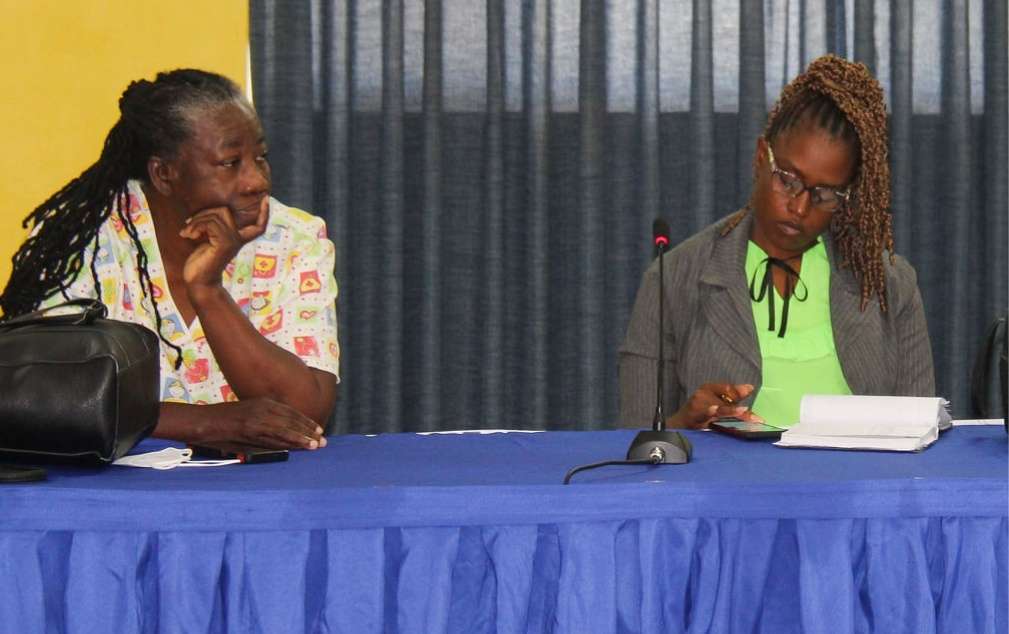
(L-R)Joan Peters – President ABPSA and Janela Evanson, General Secretary ABPSA (photo by ABWU)
The Antigua and Barbuda Public Service Association has officially signed a collective bargaining agreement covering 2018 to 2023, but union leaders are calling on government to stop negotiating contracts after the fact.
ABPSA President Joan Peters told Observer Media the signing marks a critical milestone, making the negotiated benefits legally binding rather than subject to verbal promises that can be challenged.
The agreement delivers concrete gains for public servants: shift allowances have doubled from $100 to $200, while uniform allowances increased from $1,000 to $1,350. Peters emphasized the benefits extend beyond monetary compensation to include improved working conditions.
However, General Secretary Janela Evanson expressed frustration with the timing, noting union members are signing a deal in 2025 that should have been finalized years ago.
“I am calling to the government to begin negotiating in the present so that workers can realize the full benefits of the agreements immediately,” Evanson stated.

The agreement provides 5% increases for 2018 and 2019, 4% for 2020, and 0% for 2021-2023. Evanson explained the union accepted no increases for those latter years due to COVID-19’s revenue impact, in exchange for role reclassification scheduled for 2024—which government is now attempting to delay until 2025.
The association has already prepared its next proposal covering 2024-2026 and plans to submit it before week’s end.
Evanson expressed hope it can be signed by the first quarter of 2026 “to show workers that the government cares about them.”





This should not become the new normal. Retroactive bargaining turns negotiations into history lessons instead of future planning
How can workers plan their lives when contracts are signed two years after they expire? This is not just delay it’s dysfunction
The union has every right to demand real-time negotiations. Back-dated contracts undermine trust and leave workers playing catch-up instead of moving forward.
This highlights a wider issue across the public sector agreements are only effective when implemented on time, not treated as paperwork to tidy up years later.
Comment *Doubling shift allowances and increasing uniform support are meaningful wins now the challenge is ensuring future benefits aren’t delivered retroactivel
Government deserves credit for finalizing the CBA, but workers deserve better than after-the-fact recognition. Stability comes from predictability, not retroactive fixes