











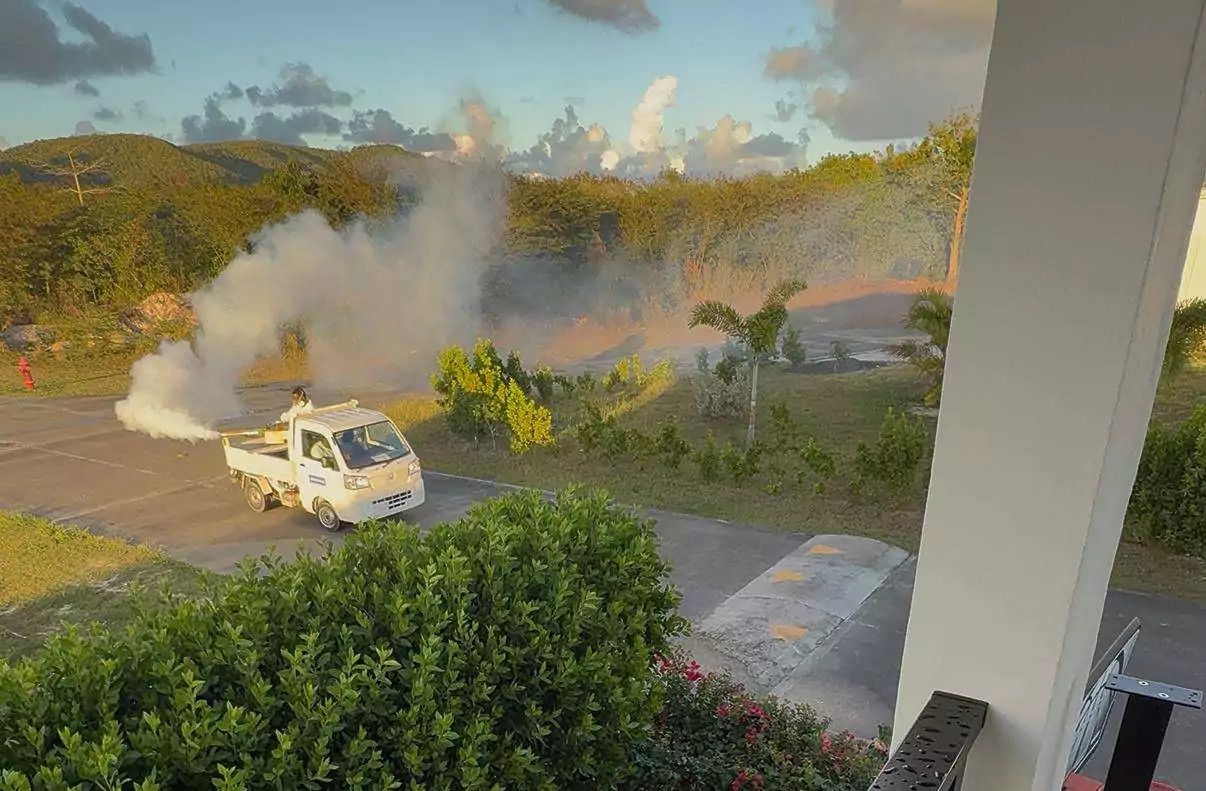
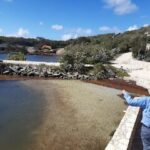
Mosquito fogging in Jolly Harbour
A dispute between a Jolly Harbour property owner and Caribbean Developments (Antigua) Limited (CDAL) is raising serious questions about the meaning of freehold ownership, environmental safety, and the extent of a developer’s authority over independently owned land.
Cyprian Kowalczyk, a freehold property owner in Jolly Harbour, has challenged what he describes as extra-contractual payment demands imposed by CDAL for services he says he never agreed to receive. The dispute has since expanded into a broader conflict involving environmental management practices, particularly a mosquito control programme carried out within the community.
Jolly Harbour operates under a structure where CDAL is the master parcel owner that sold individual plots to buyers, each of whom received an independent freehold title. According to Kowalczyk, the development is not governed by condominium by-laws or homeowner association agreements that would legally bind residents to a developer-controlled system. Despite this, he alleges that CDAL continues to collect maintenance charges and dictate services as though residents are part of a managed complex.
He further claims that when residents have requested formal service agreements for utilities such as water, electricity, and pest control, no contracts have been provided.
The dispute intensified when Kowalczyk objected to CDAL’s ongoing chemical fogging programme. He said he requested that the developer cease spraying near his home due to concerns about its impact on his family’s health, but alleges that the same pattern of unilateral decision-making persisted.
The programme involves the use of Zenivex E20, a synthetic pyrethroid diluted with mineral oil. According to Kowalczyk, the spraying typically takes place around 5:30 p.m., when many residents are outdoors and homes are ventilated. He claims that easterly trade winds averaging 20 km/h carry a visible oily mist into homes, across patios and onto private property.
Kowalczyk reports that the spraying has resulted in an oily residue coating solar panels and air conditioning units, while also triggering health concerns within his household, including his 11-year-old daughter’s diagnosed atopic dermatitis, his own severe dry eye syndrome, and ongoing irritation linked to exposure.
He cited peer-reviewed research outlining potential health risks associated with the chemical mixture used in the programme:
Chronic pulmonary damage is a key concern, as the fogging equipment produces droplets smaller than 60 microns, which can be inhaled deep into the lungs. Mineral oil, which the body cannot metabolize, may accumulate in lung tissue, potentially leading to Exogenous Lipoid Pneumonia (ELP), particularly among children and the elderly.
Cancer risks have also been highlighted, with the International Agency for Research on Cancer (IARC) classifying untreated and mildly treated mineral oils as Group 1 human carcinogens. Kowalczyk argues that the frequency of spraying—estimated at 104 applications per year—far exceeds occupational safety standards.
Additionally, it is said to contain nearly 80 percent isopropyl myristate, a compound used in pharmaceuticals to enhance skin absorption. Kowalczyk claims this disrupts the skin’s protective barrier, increasing pesticide absorption and worsening conditions such as eczema and dermatitis.
Despite raising these concerns, Kowalczyk said CDAL has not altered its approach. Instead, he claims the company advised residents to close windows and doors or temporarily vacate their homes during spraying periods—effectively requiring him to leave his residence for more than 200 hours per year.
CDAL has reportedly defended its position by warning that halting spraying in certain areas could create a “mosquito sanctuary” and pose a risk to the wider community. However, Kowalczyk disputes this assertion, citing official data indicating no arboviral disease transmission in Antigua and Barbuda in early 2026 and only 11 dengue cases recorded in 2025.
He also referenced guidance from international health agencies, including the World Health Organization (WHO), the Pan American Health Organization (PAHO), and the U.S. Centers for Disease Control and Prevention (CDC), which classify ultra-low-volume adulticiding as an emergency response measure rather than a routine preventative practice.

The matter has also prompted regulatory concerns. Kowalczyk has submitted a formal request to the Pesticides and Toxic Chemicals Control Board (PTCCB), supported by more than a dozen residents and additional overseas property owners, seeking confirmation as to whether CDAL holds a valid pest control operator licence. Under the Pesticides and Toxic Chemicals Act 2008, conducting extermination for reward without such a licence constitutes a criminal offence.
Further concerns relate to compliance with the manufacturer’s guidelines for Zenivex E20. According to Kowalczyk, the product label limits application to no more than 25 times per site annually, yet the programme in Jolly Harbour is conducted approximately 104 times per year. The label also cautions against use in wind speeds exceeding 10 mph—conditions that may frequently be surpassed by Antigua’s trade winds, increasing the likelihood of chemical drift onto non-target properties.
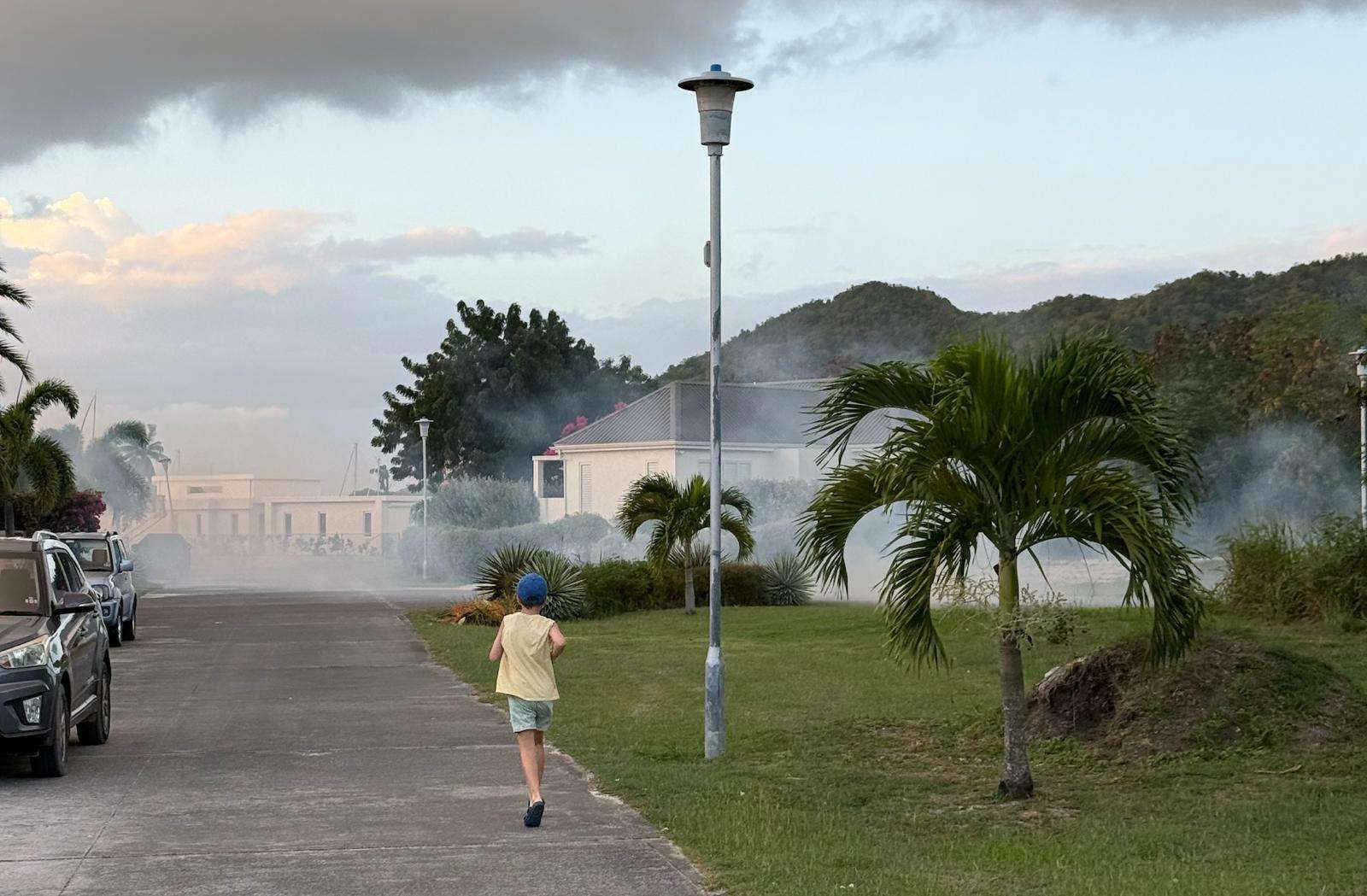
Mosquito fogging in Jolly Harbour
He also cited research questioning the effectiveness of the programme. A 2023 study published in the Journal of Medical Entomology reportedly found the product ineffective at reducing mosquito populations, while a 2021 meta-analysis in Ecology Letters suggested that such chemical interventions can lead to “pest resurgence” by eliminating natural predators.
Kowalczyk noted that once diluted with mineral oil, the fogging mixture is approximately 98 percent oil carrier by volume. He claims this leaves a hydrophobic film on solar panels, reducing energy output, and coats air conditioning systems, trapping dust and reducing efficiency.
While he has made clear that he is not seeking to halt mosquito control efforts entirely, Kowalczyk is calling for alternative approaches, including Bti larviciding, source reduction, and the establishment of buffer zones around private homes.
The dispute has brought into focus broader questions about governance in Jolly Harbour, particularly whether developers can impose environmental practices and service charges on independent freeholders without consent, contracts, or adherence to established safety standards.
The matter remains under review by the relevant authorities.



Wow. Based on what I read i completely understand what the man is saying
Both sides have valid concerns, but the developer need to be more transparent. Contracts, licences, everything should be clear from the start
This poisen gives me a bad chest
This is really sad to read. How can one man go through all that
Antigua is a beautiful place; there are even decent laws. It’s just a difficult place to live given that the authorities won’t intervene when big money is involved.
There are two sides to a story so let me hear the developer side next
To understand the scientific basis for the Defendant’s fogging programme and its effects, I obtained and reviewed peer-reviewed scientific studies and published research from authoritative international health agencies. The following findings are drawn from those sources:
(a) **The fogging is ineffective:** Lopez et al. (2023), published in the *Journal of Medical Entomology*, evaluated five sequential weekly truck-mounted applications of Zenivex E20 and found that “adulticide treatment did not result in consistent short-term or long-term reductions in target WNV vector Culex abundance”.
(b) **No outbreak justifies emergency spraying:** Antigua and Barbuda’s Minister of Health reported to Cabinet in January 2026 that arboviral activity remains “low and controlled” with “no indication of sustained transmission or outbreak conditions”. The Pan American Health Organization (PAHO) confirmed zero arboviral disease transmission in Antigua and Barbuda in early 2026. The World Health Organisation Dengue Guidelines (2009) classify space spraying as an emergency measure, not a routine intervention, and the CDC defines ULV adulticiding as “the last resort”.
(c) **The fogging is counterproductive:** A 2017 study from *PLoS Neglected Tropical Diseases* (Agramonte et al.) documents that pyrethroid resistance alters the blood-feeding behavior in mosquitoes, increasing their agitation and biting activity rather than killing them. A 2015 study from *PLOS Neglected Tropical Diseases* (Wagman et al.) confirms airborne pyrethroids induce this agitated state via neurotoxic pathways. Furthermore, a meta-analysis by Janssen and van Rijn (2021) in *Ecology Letters* establishes that pesticide applications increase average pest densities by killing predators faster than pests.
(d) **Closed houses create mosquito refugia:** Chadee (1988) in *Medical and Veterinary Entomology* establishes that when residents close their houses, mosquito populations survive and thrive inside untreated properties. The Defendant’s instruction that residents should “close all windows and doors” directly facilitates these refugia.
(e) **Exogenous Lipoid Pneumonia:** Chronic inhalation of mineral oil mist carries a documented risk of Exogenous Lipoid Pneumonia (ELP), an insidious and irreversible inflammatory lung condition. I exhibit a 2007 study from *Pediatric Radiology* (Zanetti et al.) documenting ELP in children, and a 2016 study (Han et al.) documenting occupational lipoid pneumonia from paraffin aerosol.
(f) **Penetration Enhancement:** Isopropyl Myristate, which constitutes 79% of the Zenivex E20 concentrate, is a potent chemical penetration enhancer. Suh and Jun (1996) in the *Journal of Pharmacy and Pharmacology* demonstrates it increases dermal absorption by up to 50-fold. When aerosolised, the carrier causes the pesticide mixture to deposit on and adhere to both interior and exterior property surfaces, amplifying the rate of chemical absorption for anyone in contact with those surfaces.
(g) **Solar panel thermal degradation:** Oil films cause significant power loss and “hot spots” leading to permanent thermal degradation of photovoltaic cells. I exhibit the 2022 IEA-PVPS Task 13 Report on soiling losses, marked.
(h) **Residue as a Proxy for Inhalation:** The presence of oily residue on property surfaces serves as a scientifically established proxy for the simultaneous inhalation of the chemical aerosol. Schleier III & Peterson (2011) in the *International Journal of Environmental Research and Public Health* empirically demonstrated that ground deposition of ULV insecticides functions as a reliable surrogate for estimating human bystander exposure — surface accumulation and respiratory risk scale in direct proportion. The United States Environmental Protection Agency (EPA) *Standard Operating Procedures for Residential Pesticide Exposure Assessment* (2012) further establishes the “Transfer Coefficient” (TC) which links measurable surface residues to the inhalation dose inhaled by bystanders. The full 582-page EPA document is available at https://www.epa.gov/pesticide-science-and-assessing-pesticide-risks/standard-operating-procedures-residential-pesticide and directly at https://www.epa.gov/sites/default/files/2015-08/documents/usepa-opp-hed_residential_sops_oct2012.pdf. I can provide a copy by email to the Court or the Defendant upon request.