











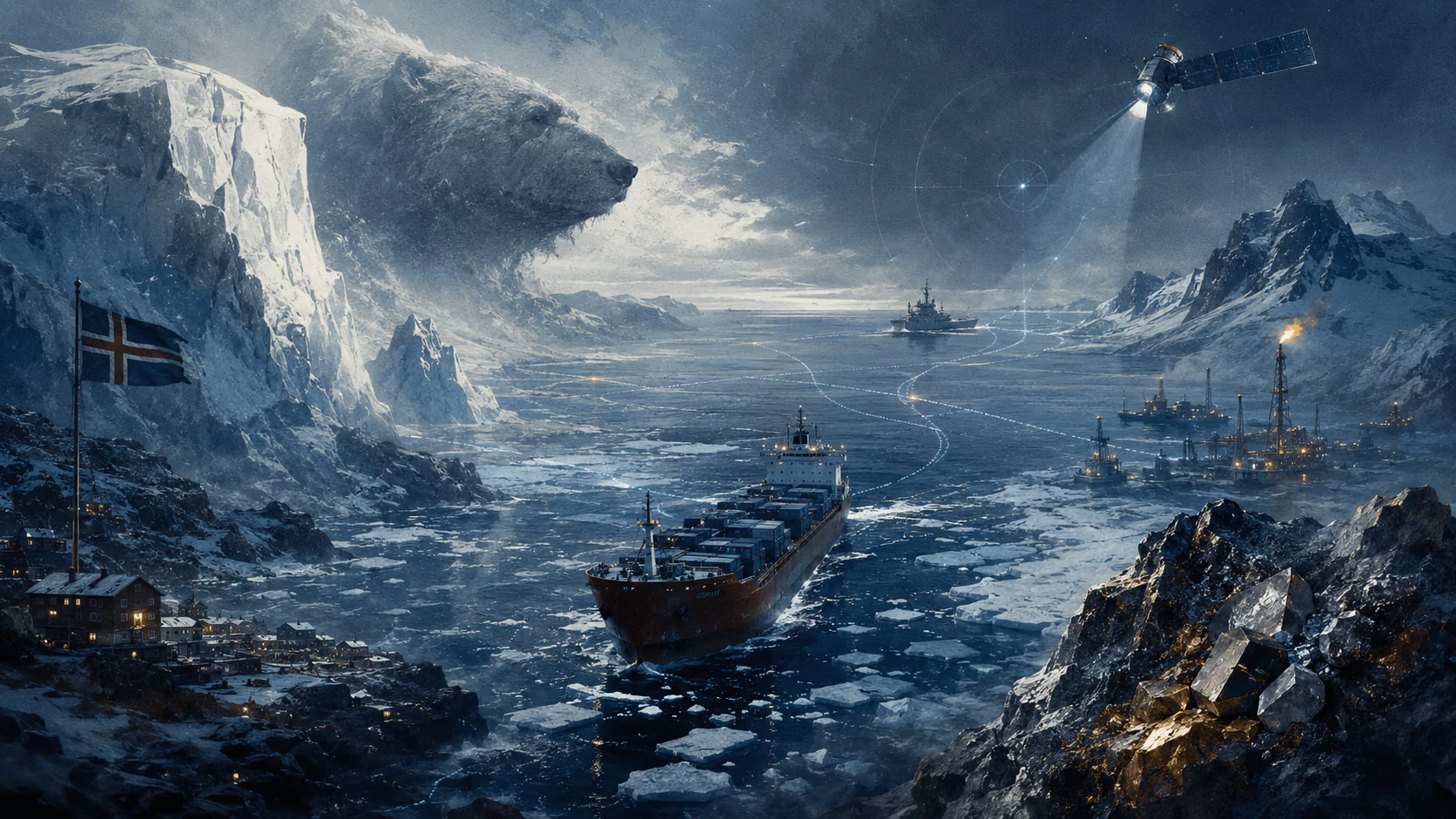
The High North has moved from the margins of strategy to the centre of a contest over energy security, mineral supply chains, maritime access and military deterrence.
1. A climate shock becomes a strategic fact
In the Arctic, climate change is no longer merely an environmental story. It is an infrastructure story, a shipping story, an energy story and, increasingly, a military one. In March 2026, NASA and the National Snow and Ice Data Center reported that Arctic winter sea ice had tied the lowest maximum extent in the satellite record. Copernicus separately reported the lowest March Arctic sea-ice extent in 48 years of satellite data. The trend is changing the operating assumptions of governments, insurers, shipping companies and defence planners.
For northern Europe, the Arctic is no longer a distant frozen hinterland. It is the region where Nordic security, Russian energy ambitions, Chinese supply-chain strategy, US defence planning and Europe’s green-industrial policy increasingly collide. The old shorthand – the Arctic as a zone of peace – now feels inadequate. The new vocabulary is harder-edged: deterrence, domain awareness, ice-class tankers, critical raw materials, dual-use ports, subsea cables and maritime chokepoints.
That does not mean the Arctic has become another South China Sea. Its legal order remains comparatively robust, the environment remains punishing and most commercial cargo still travels elsewhere. But the strategic direction is unmistakable: a once peripheral region is becoming one of the stress tests of the international order.
2. Northern Europe becomes Nato’s new hinge
The Arctic has eight territorial states: Russia, the United States, Canada, Norway, Denmark through Greenland, Iceland, Sweden and Finland. Since Finland joined Nato in 2023 and Sweden in 2024, seven of the eight are now Nato allies. Nato says the accessions have greatly strengthened its High North posture and, in February 2026, launched Arctic Sentry to consolidate allied activity across the region.
Russia remains the indispensable Arctic power. It has the longest Arctic coastline, extensive icebreaker capacity, the most developed Arctic military infrastructure and a strategic dependence on the region that far exceeds that of most rivals. The Kola Peninsula is central to Russia’s nuclear deterrent; the Northern Sea Route is integral to Moscow’s export strategy; and Arctic LNG and oil projects remain important to Russian state revenue and political prestige.
Norway is the European hinge. It is a Nato member bordering Russia, a maritime state facing the Barents Sea and a critical energy supplier to Europe. The Council of the EU lists Norway as the EU’s top gas supplier in 2025, providing almost one-third of EU gas imports. The Norwegian Offshore Directorate describes the Barents Sea as Norway’s largest offshore area and the sea area with the greatest oil and gas potential.
Iceland retains its strategic value as a North Atlantic aviation and maritime node. Denmark’s role is amplified by Greenland, whose territory is both a security asset and a mineral frontier. Finland and Sweden add depth to Nato’s northern flank, tying Arctic security more closely to the Baltic Sea and the defence of the Nordic-Baltic region.
3. Resources: old hydrocarbons, new minerals
The Arctic’s economic appeal begins with hydrocarbons. A widely cited US Geological Survey assessment estimated that the region may hold about 13 per cent of the world’s undiscovered oil and 30 per cent of its undiscovered natural gas, much of it offshore. That estimate does not make every barrel or cubic metre commercially viable; Arctic extraction remains expensive, technically complex and environmentally hazardous. But it explains why Russia, Norway and energy companies continue to treat the region as strategically consequential.
The newer story is minerals. The green transition has turned rare earths, graphite, nickel, copper and cobalt into instruments of industrial power. Greenland is the clearest case. The European Commission and Greenland signed a strategic partnership in 2023 to develop sustainable raw-materials value chains. In December 2025, Reuters reported that Greenland had granted a 30-year permit for the EU-backed Amitsoq graphite project. In May 2026, Critical Metals announced a 15-year offtake agreement for rare earth concentrate from the Tanbreez project.
The logic is geopolitical as much as geological. Europe and the United States want to reduce dependence on Chinese processing and supply chains for materials used in batteries, wind turbines, electronics, missiles and advanced manufacturing. For Greenland, the opportunity is to attract investment while retaining control over environmental and social standards. For Denmark and Nato, it is a reminder that mineral security and territorial security are converging.
The environmental risks are severe. Oil spills are harder to contain in ice-covered waters, clean-up capacity is limited, and infrastructure damage from thawing permafrost can raise operating costs. Indigenous communities face disruption to food systems, travel routes and cultural landscapes. The Arctic resource story is therefore not simply a race for wealth. It is a test of whether industrial policy can coexist with environmental restraint.
4. Shipping routes: promise, friction and chokepoints
The most visible symbol of the changing Arctic is the map of shipping. The Northern Sea Route runs along Russia’s Arctic coast from the Atlantic to the Pacific. The Northwest Passage runs through the Canadian Arctic Archipelago. In theory, Arctic corridors can shorten the distance between northern Europe and East Asia: PolarRES describes the Northern Sea Route as offering a roughly 30-40 per cent distance advantage over the Suez Canal route on Europe-Asia lanes.
Yet distance is not the same as reliability. The Northern Sea Route is seasonal, ice-prone and politically exposed. Russia regulates it, charges fees and often requires icebreaker support. Insurance is expensive, communications are sparse and sanctions complicate Russian logistics. Reuters reported in May 2026 that Russia’s shift of LNG exports towards Asia had sharply raised delivery costs, reflecting the operational constraints of Arctic and alternative routes.
The Northwest Passage is even more legally sensitive. Canada treats the waters as internal; the United States and others have long viewed the route as an international strait. As ice retreats, that dispute may move from academic and diplomatic argument to commercial relevance. Still, the route remains less predictable than the Russian passage and lacks the port, repair, search-and-rescue and refuelling infrastructure required for mainstream liner shipping.
The Suez and Panama canals are not about to become obsolete. Container networks depend on schedule integrity, port calls and logistics density, not just nautical miles. But Arctic routes can still matter at the margin: for energy cargoes, bulk commodities, strategic shipping, emergency rerouting and state-backed commerce. Even a niche corridor can become geopolitically important if it alters bargaining power.

5. Security: from zone of peace to theatre of deterrence
The military dimension is no longer secondary. Russia has reopened and modernised Soviet-era facilities along its Arctic coast, reinforced air defence and radar coverage, and maintained the Northern Fleet as a central instrument of deterrence. For Moscow, the Arctic is a buffer, an energy corridor and a bastion for strategic submarines.
Nato’s response is to improve presence without turning every Arctic incident into a crisis. Allied exercises in Norway, Iceland, Finland and Sweden are increasing in scale and complexity. In February 2026 the UK government announced that British troops deployed to Norway would double over three years and that the UK would play a role in Nato’s Arctic Sentry mission. Canada is also investing in northern defence infrastructure; its NORAD modernisation plan includes upgrades to forward operating locations at Inuvik, Yellowknife, Iqaluit and Goose Bay.
The most likely risks are not deliberate Arctic war but miscalculation: close encounters between aircraft and vessels, cyber disruption of fragile communications networks, interference around subsea cables, or competing interpretations of sovereignty and navigation rights. The geography magnifies danger. Distances are vast, weather changes quickly, and rescue capacity is thin. The Arctic punishes mistakes.
6. Climate, fisheries and governance under strain
The paradox of the Arctic is that the same warming which opens access also undermines the foundations of life and infrastructure. Loss of sea ice reduces albedo, accelerating warming. Thawing permafrost damages roads, pipelines, runways and housing, while coastal erosion threatens settlements. NOAA’s 2025 Arctic Vision and Strategy points to coastal erosion, thawing permafrost and changing wildlife and fish migration patterns as immediate challenges for Arctic communities.
Fisheries are a test case. As waters warm, species shift northward and new fishing grounds may emerge. The Central Arctic Ocean Fisheries Agreement, which entered into force in 2021, prevents commercial fishing in the high seas portion of the central Arctic Ocean for 16 years. It is a rare example of precautionary governance before industrial exploitation takes hold.
Governance more broadly is under pressure. The Arctic Council was long the main forum for cooperation among Arctic states and Indigenous peoples. After Russia’s full-scale invasion of Ukraine, cooperation fractured. A 2026 Belfer Center analysis describes how decades of cooperation were disrupted in 2022 and how efforts to preserve technical work remain constrained by war and sanctions. The Arctic cannot be managed effectively without Russia; the west cannot return to prewar normality with Russia. That contradiction defines the region in 2026.
7. What this means for policymakers and investors
For governments, the priority is resilience rather than spectacle. That means domain awareness, search-and-rescue capacity, satellite communications, icebreaking, port infrastructure and environmental response. It also means Indigenous consultation not as an afterthought but as a condition of legitimate policy.
For investors, the Arctic offers assets with strategic scarcity and operational complexity. Gas, LNG, graphite, rare earths and maritime infrastructure may attract public support because they fit energy security and supply-chain narratives. But the risks are unusually dense: sanctions, permitting, environmental liability, social licence, technology cost, weather downtime and stranded-asset exposure.
For shipping companies and insurers, the Arctic should be treated as an option, not a base case. Route savings are real under favourable conditions. But reliable commercial adoption depends on predictable ice, adequate rescue capacity, transparent regulation, stable geopolitics and an insurance market willing to price the risk. None can be assumed.
8. Conclusion: the High North is now a main board issue
In 2026, the Arctic has become a geopolitical frontier where climate change, resource competition and great-power rivalry converge. The retreat of sea ice is opening the region to commerce, extraction and military activity. Russia sees the Arctic as a strategic asset. Nato sees it as a security priority. Europe sees minerals and gas through the lens of industrial sovereignty. China sees optionality: new routes, resources and influence over emerging rules.
The region’s future will not be decided by a single shipping lane, mine or military base. It will be shaped by cumulative changes: lower ice cover, higher insurance premiums, more sensors, more drills, more mineral deals, more contested infrastructure and more pressure on fragile ecosystems. The winners will not necessarily be those who arrive first. They will be those who can operate safely, finance credibly, insure affordably and govern responsibly in one of the world’s harshest environments.
For northern Europe, the security map now stretches from the Baltic Sea to the Barents Sea, from Greenland’s minerals to Norway’s gas platforms, from Finnish land forces to Icelandic airfields and North Atlantic sea lanes. The Arctic is no longer a peripheral file for polar specialists. It is a main board issue for energy ministers, defence planners, port operators, miners, insurers and central banks.
Ignoring the Arctic in 2026 is no longer an option. The High North is where the future of energy, trade, security and climate policy will be partly decided.




0 Comments