
Prime Minister Browne Calls for Strategic OECS Partnership with Panama to Reduce Costs and Expand Trade Opportunities

PRESS STATEMENT
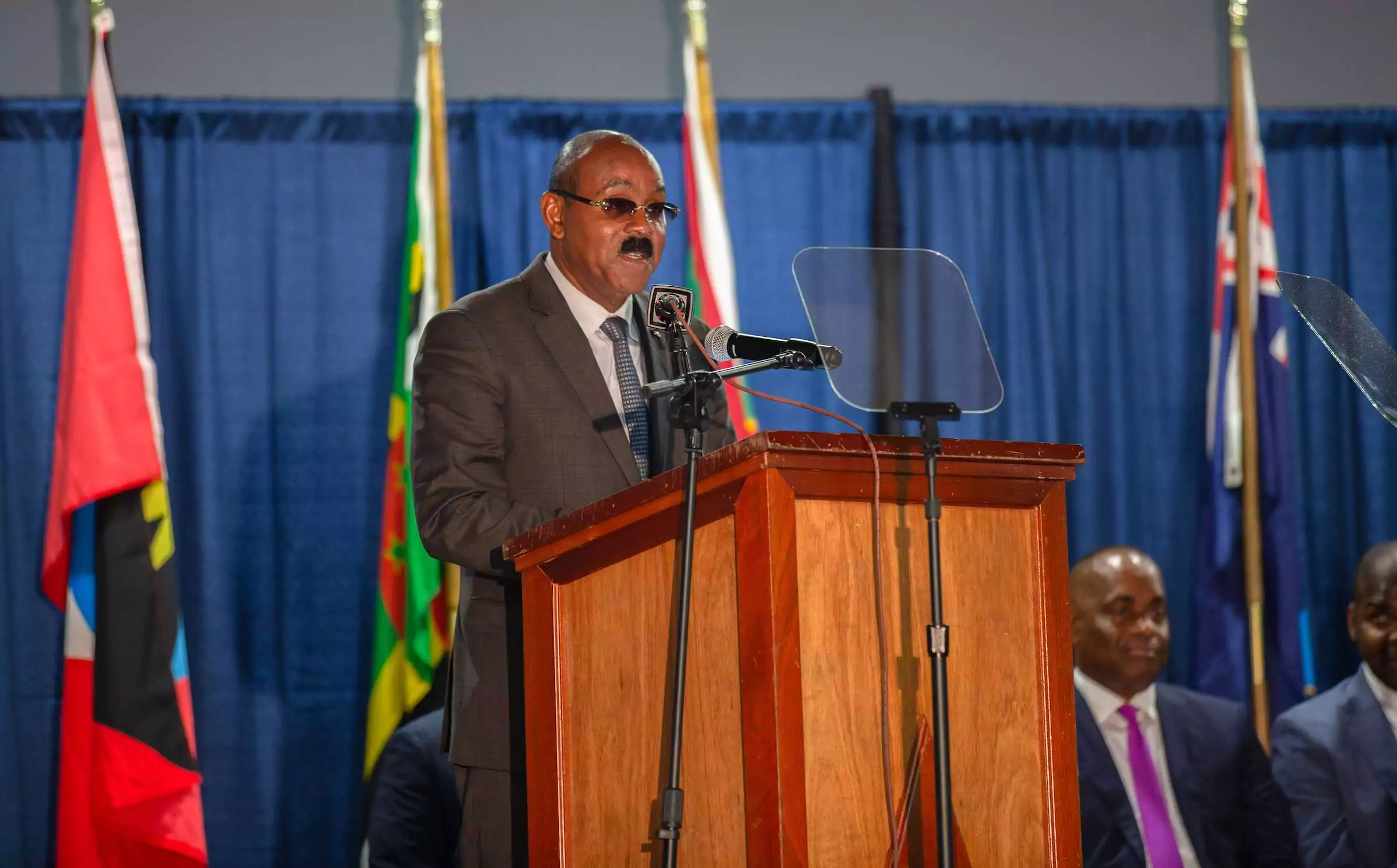
Prime Minister Gaston Browne has called on Member States of the Organisation of Eastern Caribbean States (OECS) to pursue a bold and proactive partnership with Panama, describing the Central American nation as a natural gateway for expanding trade, enhancing food security, and reducing the cost of living across the sub-region.
Addressing the 78th Meeting of the OECS Authority after assuming the Chairmanship of the regional body, Prime Minister Browne argued that the OECS must look beyond its traditional markets and strengthen economic and commercial relations with its Spanish-speaking neighbours, particularly Panama.
“Stretching to our south and west lies a hemisphere of over 447 million Spanish-speaking neighbours with whom our commercial ties remain frustratingly thin,” Prime Minister Browne stated. “We must develop a far more proactive strategy toward our Latin American neighbourhood, and Panama demands our particular attention.”
The Prime Minister pointed to Panama’s unique position as one of the world’s most important logistics and trading hubs. He noted that the Panama Canal remains a critical artery of global commerce, connecting markets across the Atlantic and Pacific Oceans and facilitating billions of dollars in trade annually.
Recent figures show that the Canal continues to experience strong growth in vessel transits and revenues, underscoring its enduring importance to international trade.
Prime Minister Browne also highlighted the strategic value of the Colón Free Zone, located at the Atlantic entrance of the Panama Canal. Established in 1948, the Colón Free Zone is widely regarded as the largest free-trade zone in the Western Hemisphere and one of the largest in the world, serving as a major centre for warehousing, manufacturing, and the re-export of goods to Latin America and the Caribbean.
The Prime Minister emphasized that deeper engagement with Panama could help the OECS diversify its supply chains and reduce its heavy dependence on traditional import markets.
“On food alone, the Caribbean imports between 80 and 90 percent of what it consumes. Central America offers proximity, agricultural complementarity, and established food production chains. An OECS strategy that builds sourcing partnerships with Central American producers, uses Panama as a transshipment point, and develops shared regional emergency stockpiles could fundamentally reduce our cost of living and transform our resilience,” he said.
Prime Minister Browne warned that the rapidly changing global environment—including geopolitical tensions, supply chain disruptions, and climate-related shocks—requires small states to rethink their economic strategies and build stronger regional alliances.
“If we are serious about reducing our over-dependence on a single dominant import market, then Panama is the natural gateway for alternative sourcing across Central America, South America and the Asia-Pacific,” he stated.
The Prime Minister’s vision forms part of his broader call for what he described as an “OECS Renaissance”—an era of bold, transformative leadership, deeper integration, and greater economic self-reliance. He urged OECS leaders to seize emerging opportunities in trade, transportation, energy, and food security, arguing that collective action remains the region’s greatest strength.
“Together, we are a market. Apart, we are vulnerable. The future prosperity of the OECS will depend on our willingness to forge new partnerships, embrace innovation, and position ourselves strategically within the global economy,” Prime Minister Browne concluded.
The Prime Minister’s remarks come at a time when Panama is expanding its role as a global logistics and energy hub, with new investments in infrastructure and shipping capacity aimed at enhancing the competitiveness of the Panama Canal and its associated trade zones.
The Prime Minister’s remarks on Panama were delivered as part of his address upon assuming the Chairmanship of the OECS Authority, where he outlined a vision of an “OECS Renaissance” built on deeper regional integration, economic diversification, and strategic partnerships with Latin America.

About the author
The Editorial Staff refers to all reporters employed by Antigua.news. When an article is not an original creation of Antigua.news—such as when it is based on a press release, other media articles, letters to the editor, or court decisions—one of our staff members is responsible for overseeing its publication.
Read our editorial standards and corrections policy. Spotted an error? Contact the newsroom.
More from Antigua and Barbuda
View section
Two Held After Dennis Francis Wounded in Villa Shooting
Police have detained two suspects within 24 hours of the early-morning attack that left 47-year-old Dennis Francis with gunshot wounds to his lower back and abdomen.
By Cory Wayland

Antigua EMS Staff Head to Orlando for International Emergency Care Conference
Supervisor Akelia Carr and paramedic Mauli George will join emergency medical professionals from around the world at EMS World 2026, with new training and international practices expected to strengthen services at home.
By Cory Wayland

"We Are Because They Were”: Senator O’Donoghue Delivers Stirring Message at AT&LU Conference
At the AT&LU’s 87th Annual Delegates’ Conference, Senator Angelica O’Donoghue called for stronger worker development, renewed solidarity and a new generation of leaders grounded in the movement’s history.
By Editorial Staff

Government Releases U.S. Proposal and Antigua and Barbuda Counter-Proposal on Third-Country Nationals
The government says no agreement has been reached and that its counter-proposal would require written approval for every person transferred from the United States.
By Shermain Bique-Charles
Comments (1)
Apex Jones June 23, 2026, 1:51 PM