











Airport Authority to Remove Three Mahogany Trees as Runway Project Nears Completion
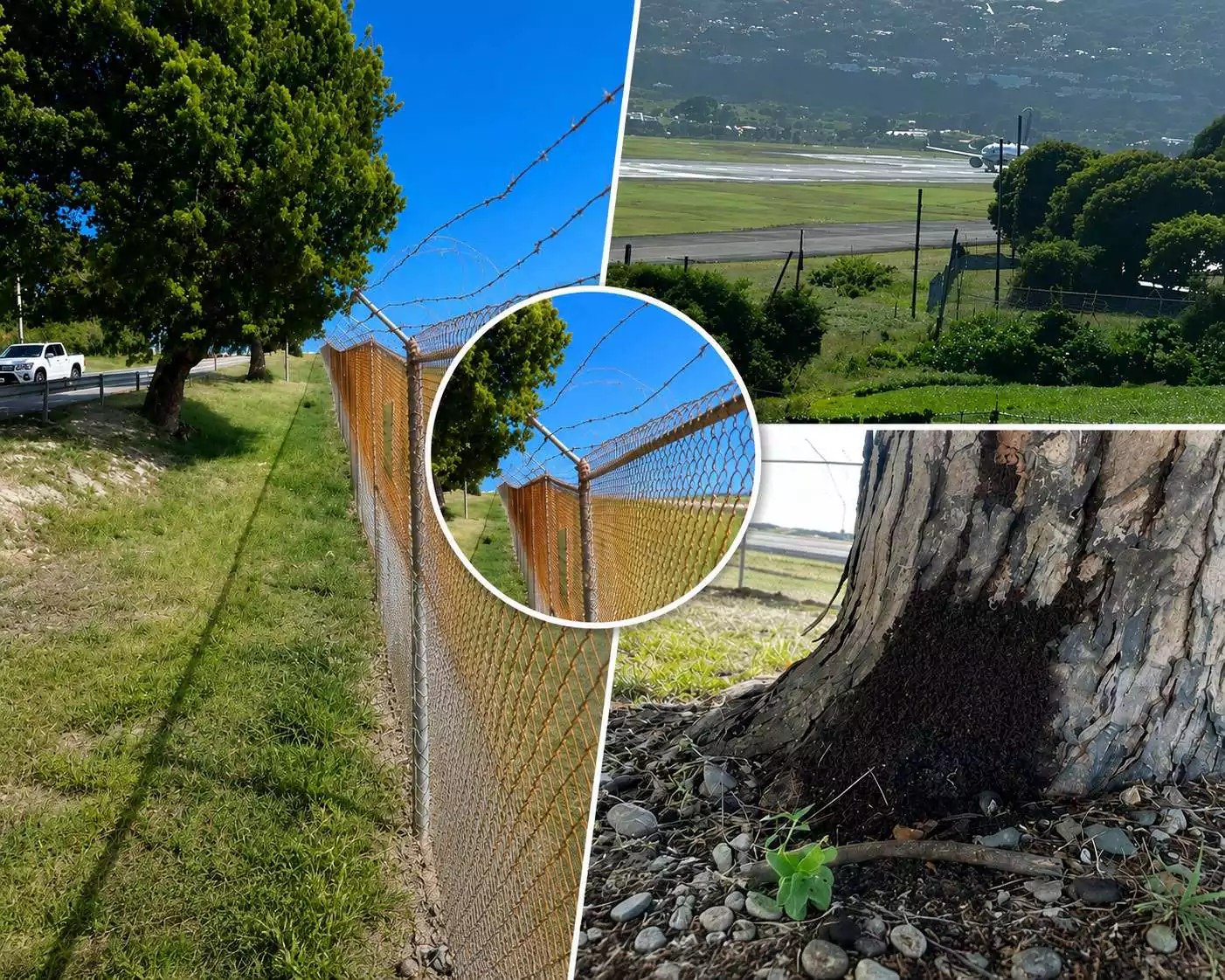
The Antigua and Barbuda Airport Authority (ABAA) will remove three mahogany trees along the Sir George Walter Highway on Sunday morning as part of efforts to improve safety at VC Bird International Airport, where a US$50 million airfield rehabilitation project is entering its final phase.
The exercise, scheduled to begin at 6:30 a.m., will be carried out in collaboration with several government agencies, including the Police Traffic Department, which will manage traffic to ensure the smooth flow of vehicles along the busy roadway.
According to the Airport Authority, the trees have become a significant obstruction to the line of sight between the Air Traffic Control Tower and the western end of the runway. As the upgraded airfield prepares to accommodate aircraft using the full length of the runway, officials say maintaining an unobstructed view is critical to safe air traffic operations.
Airport officials said the decision was made only after years of attempts to address the issue through regular pruning and maintenance.
Director of Operations Joseph Samuel said those measures were no longer sufficient.
“Unobstructed visibility is essential for the safe and efficient management of aircraft operations on and around the runway,” Samuel said.
He explained that the trees prevent air traffic controllers from maintaining complete visual surveillance of aircraft movements, creating an operational risk that could not be ignored.
Acting Chief of Air Traffic Services Eugene Silcott said air traffic controllers rely on a clear view of the entire manoeuvring area to safely direct aircraft and prevent accidents.
“One of the primary responsibilities of an air traffic controller is to prevent collisions between aircraft and other aircraft, vehicles, personnel, or obstacles on the maneuvering area,” Silcott said.

He noted that controllers must also monitor for wildlife and animals that may enter the airfield before issuing take-off or landing clearances.
“Safety remains, and must always remain, our highest priority,” he added.
The Airport Authority acknowledged that the mahogany trees hold sentimental value for many Antiguans and Barbudans and stressed that the decision to remove them was reached only after extensive consultation with the Forestry Unit of the Ministry of Agriculture and the Environment Division.
A detailed assessment by the Forestry Unit, later confirmed by Senior Forestry Officer Adriel Thibou, found evidence of termite infestation and structural deterioration that had significantly weakened the trees.
The report concluded that the trees’ size, location and canopy spread encroach on protected aviation safety surfaces while also posing a threat to motorists, airport personnel and the travelling public, particularly during periods of severe weather when the risk of tree failure increases.
Officials said the removal aligns with international aviation safety standards established by the International Civil Aviation Organization (ICAO) and follows local forestry best practices aimed at protecting public safety.
To mitigate the environmental impact, the Airport Authority said it is partnering with the Forestry Unit and the Environment Division to plant several replacement trees in approved locations.
In addition, the wood from the felled trees will be repurposed into functional and commemorative features, preserving part of the site’s natural heritage.
Samuel said the initiative reflects the Authority’s commitment to balancing aviation safety with environmental responsibility.
“This underscores the ABAA’s unwavering commitment to environmental stewardship. While aviation safety is foremost, we also must ensure that our operations are guided by sustainable and proper environmental practices,” he said.


Couldn’t just trim it? The whole tree?
Removing thise teees can never be a great idea.
It’s not about how nice it makes the place look but rather for runway safety
Now vehicle going to tear down fence and end up on the airstrip. Those trees are there for close to a hundred years so how come all of a sudden they are obscuring view of runaway meaning tower design wasn’t planned based on the surrounding environment.