
OPINION | The Caribbean Under Digital Attack: Protecting Citizens In The Age Of Cyber Fraud

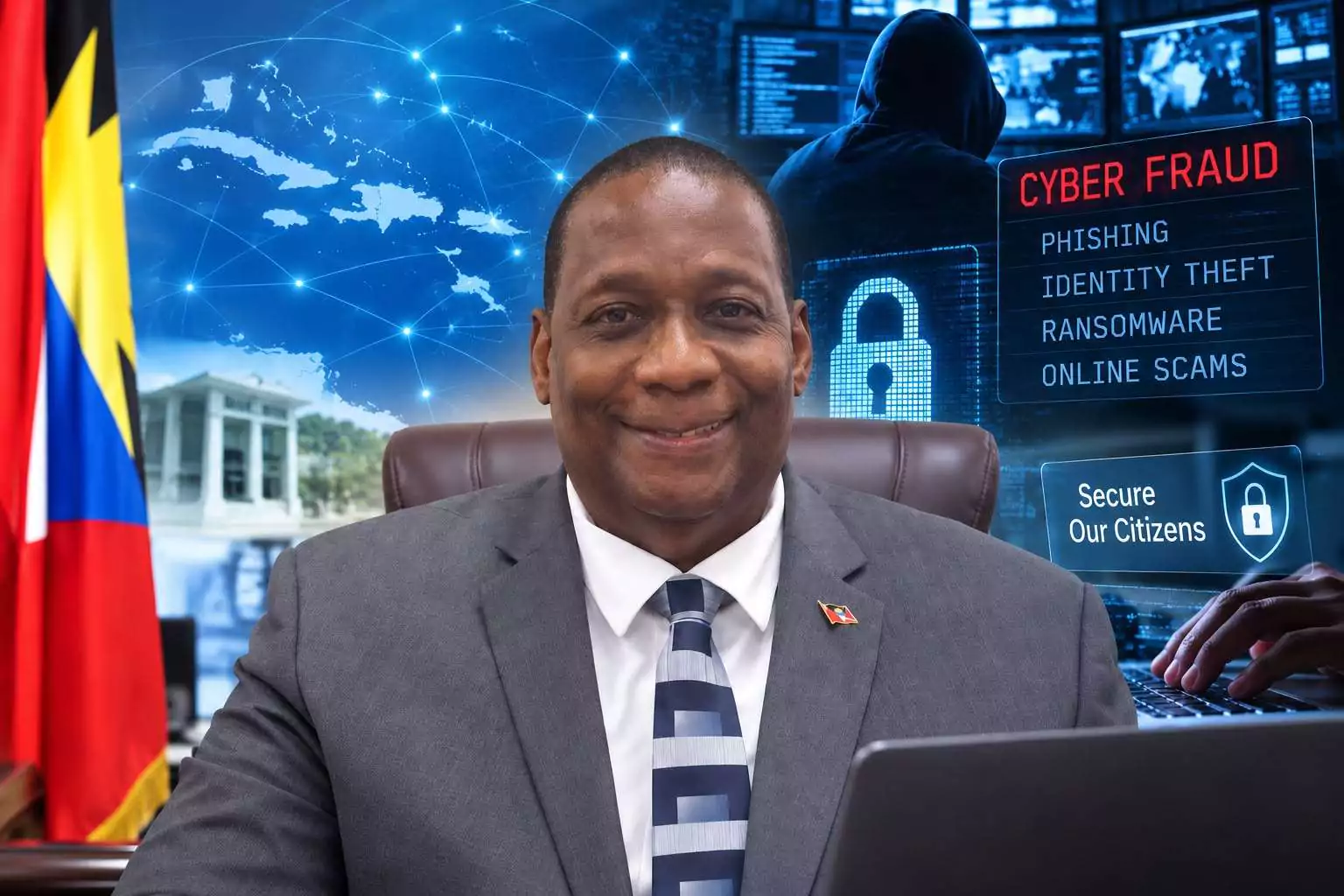
By Ambassador Dr. Clarence E Pilgrim
Across the Caribbean, the digital revolution that allows salaries, remittances and business payments to move across a screen in seconds has opened a dangerous door. Criminals can now reach households, businesses and public institutions from almost anywhere. Cyber fraud is no longer merely a technology problem. It is a matter of citizen security.
The Trump Administration deserves credit for recognising this reality. On March 6, 2026, President Donald Trump signed Executive Order 14390, “Combating Cybercrime, Fraud, and Predatory Schemes Against American Citizens.” The Order addresses phishing, financial fraud, ransomware, impersonation, sextortion and other cyber-enabled crimes while strengthening coordination, enforcement and victim-restoration mechanisms where permitted by law.
For the Association of Caribbean States (ACS), and in particular its significant sub-group, the Caribbean Community (CARICOM), the lesson is timely: as finance becomes borderless, citizen protection must become more coordinated across borders. The ACS and CARICOM need not replicate American capabilities. They should adapt the principle to Caribbean realities. When cybercrime threatens a family’s savings, a child’s safety, a business’s survival or confidence in financial institutions, it has moved beyond cyber risk.
The CARICOM Cyber Security and Cybercrime Action Plan 2025 already provides a framework for resilience, legislation, capacity building, cooperation and incident response. The next step is a stronger citizen-protection mechanism built upon existing regional and national institutions, particularly CARICOM IMPACS.
The Charter of Civil Society for the Caribbean Community, adopted in St John’s, Antigua and Barbuda, in 1997, also provides a Caribbean foundation. It affirms principles of personal security, property, dignity, information access, child protection, responsible governance and care for vulnerable groups. Technology has changed; the obligation to protect dignity, property and the vulnerable has not.
A pensioner deceived into transferring retirement savings, a child subjected to sextortion, or a business losing operating capital through fraudulent payment instructions has suffered real harm. An AI-generated impersonation can turn technological sophistication into personal loss. The measure of progress should be how effectively technology protects human welfare.
Caribbean central-bank data show how rapidly the financial environment is changing. In The Bahamas, retail clearing transactions reached approximately B$10.4 billion in 2024. In Barbados, direct electronic transfers increased by more than 700 per cent between 2013 and 2024. Belize recorded a 75.3 per cent increase in instant transfers in 2025, while Guyana recorded approximately G$881.7 billion in electronic funds transfers.
These figures are not evidence of fraud. They demonstrate the scale of the digital financial space now requiring protection. Digitalisation itself is not the danger; the concern is that expanding infrastructure also creates opportunities for sophisticated fraud.
The Bank of Jamaica received 443 consumer complaints in 2025, with 87 recorded in the fraud-related category.
The Central Bank of Trinidad and Tobago reported that cybersecurity incidents more than doubled between 2023 and 2024, driven largely by phishing and business-email-compromise attacks. The Eastern Caribbean Central Bank reported phishing attacks against customers of two commercial banks between January 2023 and March 2024, with estimated losses of EC$765,000 or more.
Suriname’s 2025 Financial Stability Report identified fraud, phishing and card-skimming incidents. In Haiti, the Banque de la République d’Haïti linked digital payments with stronger consumer protection against fraud, cybercrime, identity theft and misuse of personal data.
The evidence points in one direction: Caribbean money is increasingly digital, and consumer protection must evolve alongside it.
CARICOM should establish a common Fraud Loss and Recovery Reporting Framework using agreed definitions for attempted fraud, successful fraud, funds intercepted, money recovered, victim reimbursements and major scam types. The region cannot effectively measure success until it can consistently measure loss.
A lean CARICOM Cyber Fraud and Citizen Protection Network, linked to CARICOM IMPACS, could connect national focal points, financial institutions, financial-intelligence authorities and law enforcement without creating another large bureaucracy.
CARICOM could begin with a six-month technical working group to agree definitions, identify national focal points and design rapid-response protocols before phased implementation.
Speed must be central. Cyber fraud has its own “golden hours.” The longer stolen money moves through accounts, platforms and jurisdictions, the harder recovery becomes. CARICOM should develop rapid-response protocols connecting citizens, financial institutions, law enforcement and financial-intelligence authorities, while respecting domestic law, privacy and due process. The objective is simple: move legitimate information at least as quickly as criminals move money.
The Trump Administration’s emphasis on victim restoration merits consideration. Where cybercrime proceeds are lawfully recovered, seized or forfeited, Caribbean jurisdictions should examine whether existing mechanisms can facilitate restitution to identifiable victims.
Public education must also be part of the defence. Awareness campaigns should be continuous, practical and targeted especially at elderly citizens, young people, small businesses and digital-payment users. A bank employee, teacher, journalist or family member may be the first to prevent a cybercrime or assist a victim.
Success should be measured by tangible human outcomes: faster intervention, more stolen funds intercepted or recovered, more victims assisted, quicker warnings and fewer repeat attacks.
President Trump’s Executive Order reinforces a fundamental principle: the object of cybersecurity is not the protection of machines, but the protection of people. CARICOM can advance that principle through regional cooperation, respect for rights and institutions, protection of the vulnerable and prudent use of limited resources.
The region does not need to wait for a major crisis before building the systems required to protect its citizens. Technology should widen opportunity without widening vulnerability. Development and protection should advance together, and public policy should direct innovation, security and shared resources toward the greatest good for all.
Disclaimer:
The views expressed are those of the writer.
This story was first published by Antigua News on : antigua.news/2026/09/14/opinion-the-caribbean-under-digital-attack-protecting-citizens-in-the-age-of-cyber-fraud. © 2026 Antigua News. Republication without permission is not allowed.

About the author
The Editorial Staff refers to all reporters employed by Antigua.news. When an article is not an original creation of Antigua.news—such as when it is based on a press release, other media articles, letters to the editor, or court decisions—one of our staff members is responsible for overseeing its publication.
Read our editorial standards and corrections policy. Spotted an error? Contact the newsroom.
More from Antigua and Barbuda
View section
Antigua and Barbuda’s Garth Simon Shares COP31 Negotiation Insights with Youth Fellows
The Department of Environment representative discussed climate finance and how small island states can make their priorities heard in global climate talks.
By Shermain Bique-Charles

Education Minister Daryll Matthew Pushes Back Against Teachers’ Union Over Proposed School Hours
The Education Minister insists no decision has been made to change secondary school operating hours and criticises the union’s response, maintaining that consultations will begin in January 2027.
By Cory Wayland

PM Browne Says Government Has Commitments for Beach Parks in Antigua and Barbuda
Browne named Jolly Beach and Pearns Point in Antigua and said commitments had also come from Murbee and PLH in Barbuda.
By Shermain Bique-Charles

Accident Investigation reports critical safety risks not understood by crew on striken yacht that claimed life of Antiguan citizen
UK investigators found that the Bayesian’s crew were unaware of the yacht’s vulnerability to extreme winds before it capsized off Sicily, killing seven people, including Antiguan chef Recaldo Thomas.
By Mick the Ram
Comments (2)
John September 14, 2026, 4:29 PM
Informed citizen September 15, 2026, 11:14 AM