
Novo Banco’s €2bn bond dispute exposes Portugal’s trust problem
Fresh rulings defend a decision that pushed selected creditors back into a failed bank. Foreign investors have good reason to question the reliability of Portugal’s legal protections.

By Dario Item

The Novo Banco bond dispute is a damaging advertisement for Portugal’s treatment of investors. Creditors saw roughly €2bn of senior bonds moved from an operating bank back to the failed lender it had replaced. They then waited close to a decade for a first ruling on the legality of that decision.
Now, September and October rulings by Portugal’s Supreme Administrative Court have reaffirmed the operation’s legality and declined a further referral to the Court of Justice of the European Union. Their reasoning gives foreign investors good grounds to question how much protection Portuguese law offers when their interests collide with a domestic banking rescue.
What happened to the Novo Banco bonds
When Banco Espírito Santo collapsed in August 2014, Banco de Portugal created Novo Banco to preserve its functioning business. Assets and selected liabilities, including the bonds at issue, moved to this new institution, known as a bridge bank.
A senior bond is a loan to a bank with priority over lower-ranking debt if the bank fails. That priority does not guarantee repayment. The identity of the bank owing the money still matters enormously.
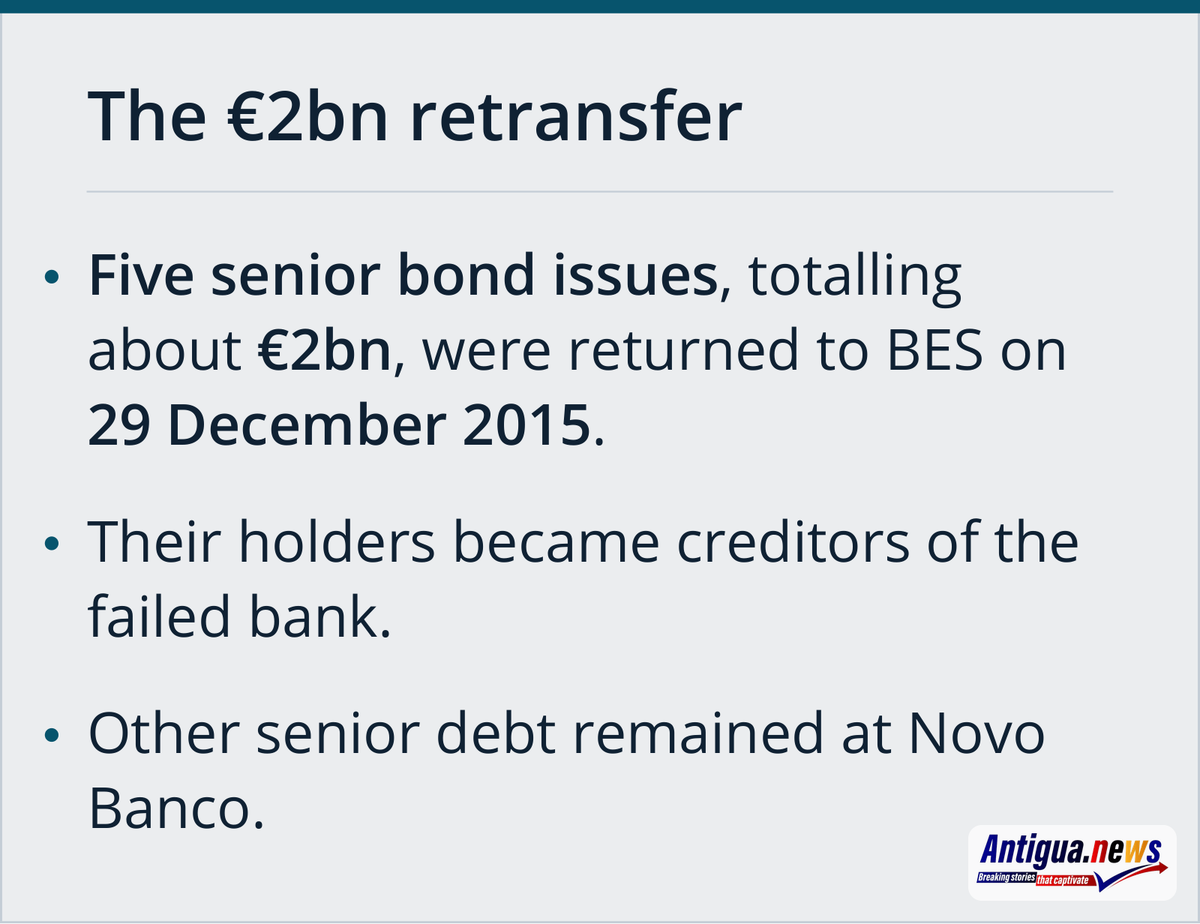
On 29 December 2015, the central bank sent five bond issues back to BES. Their holders were left with claims against the failed lender instead of Novo Banco. The authority said the measure allocated previously unrecognised BES losses to creditors and strengthened the bridge bank’s capital.
The selected issues had €100,000 denominations and had originally been placed with qualified investors. Other senior debt remained at Novo Banco. The dispute concerns both the power to make that change and the justification for choosing those creditors to bear it.
Old rules for a later decision
Between the initial rescue and the bond retransfer, Portugal enacted Law 23-A/2015, implementing the EU’s Bank Recovery and Resolution Directive. Article 40(7) of the directive sets conditions for moving liabilities back out of a bridge bank, referring to what was specified in the original transfer.
The Portuguese judges nevertheless consider the December 2015 decision part of the rescue begun in August 2014. They therefore apply the earlier framework, under which the central bank had reserved broad powers to move assets and liabilities between the two institutions.
That approach has European support. In a related case, Advocate General Juliane Kokott’s 2020 opinion treated a later retransfer as inseparable from the original rescue. She reasoned that applying the directive would impose new requirements on the earlier decision. Her opinion was advisory, but its reasoning has informed the Portuguese judgments.
The difficulty for investors is the breadth of the power that survives. Seventeen months after the rescue, the authority could select particular creditors for a change with severe financial consequences, under rules predating the new safeguards. Calling the exercise part of the original operation does little to make that exposure easier to assess.
The courts’ approach requires an investor to look beyond the law in force when a later decision is taken and back to the legal framework of the rescue. That is a consequential limitation on what newer protections can deliver.

What Luxembourg has actually decided
The European Court’s September 2024 judgment also supports the Portuguese position. Paragraph 91 states that the bank resolution directive did not apply to the disputes then before it.
The scope of that statement matters. It was made in cases about recognition in Spain, without a detailed examination of Article 40(7). The Portuguese judgments give it substantial weight in rejecting the challenge to the later exercise of the retransfer power. The specific conditions governing that exercise warranted a clearer European answer.
The same European judgment preserved a proportionality review for a creditor who acquired a bond while Novo Banco was the debtor. It directed the national court to consider the original reservation of retransfer powers and the creditor’s professional status. Neither factor removes the need to assess whether the burden imposed was justified.
A further European reference could have clarified the limits of those earlier decisions. Such references allow national judges to obtain an authoritative interpretation of EU law. The 2026 Remling judgment permits a final court to decline one when an established exception applies, but requires specific reasons. Here, the weakness is how confidently the Portuguese judgments treat the earlier cases as sufficient to dispose of the investors’ more detailed objections.
Who should bear the losses
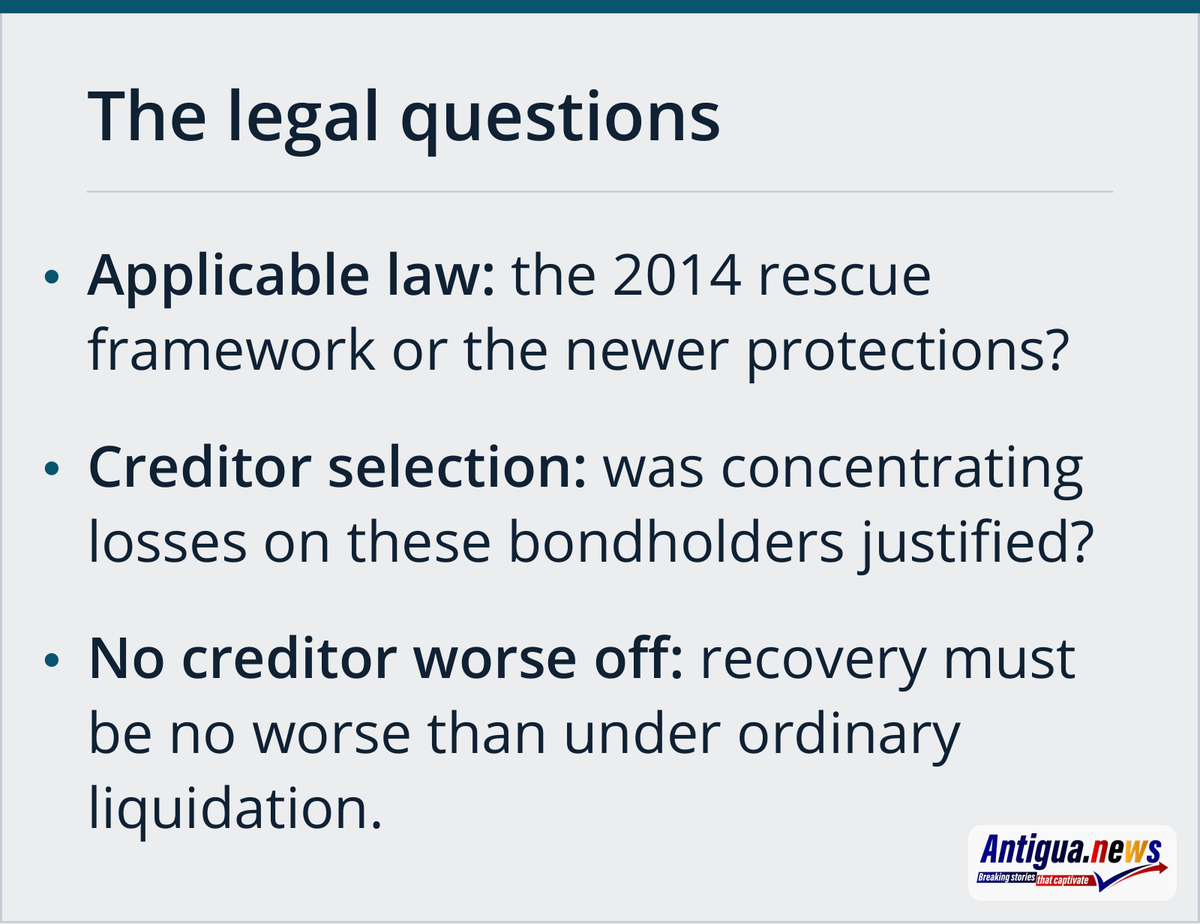
The courts also accept that creditors of the same rank can receive different treatment where public interests justify it. They discuss alternatives to concentrating losses on the five issues and endorse the central bank’s concern that a wider allocation could damage the bank and financial stability.
Protecting depositors and keeping a bank functioning are legitimate objectives. Yet a convincing defence of the selected allocation must explain why those objectives required this particular group to suffer so heavily. In these judgments, the general dangers of spreading losses more widely carry too much of the explanatory burden.
The distinction matters to foreign investors. A fund operating from abroad needs confidence that its claims will receive rigorous protection even when protecting them complicates a domestic rescue. The judgments reject nationality discrimination. That does not settle the broader question of whether the process offers outsiders a dependable safeguard against an unjustified selection to absorb losses.
Nor does professional status dispose of the issue. Understanding financial risk does not amount to consenting to every later decision by a regulator. The scope of the power, the reasons for choosing particular creditors and the scrutiny of those reasons all affect whether an investment can be assessed sensibly.
The safeguard known as ‘no creditor worse off’ compares recovery with what a creditor would have received in an ordinary liquidation. It does not by itself establish that a selective allocation of losses was fair. The courts recognise that distinction.

The cost of trusting Portugal
The delay compounds the problem. As I argued in July 2025, the credibility of investor protection depends heavily on the courts delivering it. The first merits judgment in the pilot proceedings arrived only in January 2026, following actions brought in 2016.
Our May report examined the 23-day interval between admission of a crucial appeal and judgment. The court has since explained that the draft was circulated to all three judges and that its procedure permitted dispensing with formal preliminary review. Speed alone proves no failure of scrutiny. It also does nothing to repair the preceding years of uncertainty.
For an investor, the time required to enforce a right affects its practical value. Litigation absorbs resources and leaves the value of investors’ claims uncertain for years. A legal system that takes close to a decade to deliver a first merits decision in a dispute of this importance has failed a basic test of reliability.
Portugal should take that failure seriously. Foreign investors are entitled to weigh the Novo Banco experience when assessing Portuguese bank debt and the institutions responsible for protecting their claims. A successful legal defence of the retransfer does not erase the reasons for distrust created by the operation and its aftermath.
Investors can respond to legal uncertainty by demanding higher returns, imposing tougher terms or choosing another jurisdiction. That is the commercial risk Portugal invites when a bank rescue leaves such doubts about the protections available to creditors.
The authorities have secured repeated judicial endorsement of their decision. The next foreign investor must decide whether to trust the legal system that produced that result. On the Novo Banco record, Portugal has given that investor strong reasons to hesitate.
This story was first published by Antigua News on : antigua.news/2026/11/25/novo-banco-bond-dispute-portugal-investor-trust. © 2026 Antigua News. Republication without permission is not allowed.

About the author
Dr. Dario Item is the Head of Mission of the Embassy of Antigua and Barbuda in Madrid. He is an experienced financial crimes lawyer with nearly 30 years of practice. He holds degrees in law and political science, a Ph.D. in criminal law and an LL.M. in transnational financial crime.
Read our editorial standards and corrections policy. Spotted an error? Contact the newsroom.
More from Business and Finance
View section
Nasdaq plunges 5.3% as AI fears deepen stock market sell-off
Doubts over artificial intelligence spending and the prospect of higher interest rates send technology shares tumbling, extending a bruising decline.
By Dario Item

Monaco exits FATF grey list in boost to €190bn wealth hub
The decision ends 28 months of FATF monitoring, but Monaco remains on the EU’s separate list of high-risk third countries.
By Dario Item

Liechtenstein register hack exposes the privacy risks of financial transparency
Data concerning 31,000 legal entities were stolen from the principality’s beneficial ownership register. As access moves to an identity-checked service in Vaduz, the unresolved question is whether stronger entry controls can protect the people behind the records.
By Dario Item

How much is Hormuz really adding to Caribbean fuel prices?
The disruption is raising the cost of gasoline and diesel far beyond the Gulf. But refinery shortages, shipping costs and changes to subsidies must be separated to establish what motorists are paying for.
By Dario Item
Comments
Be the first to comment.