
Myanmar Says It Will Defy Parts of the Rohingya Genocide Ruling
The Gambia won an order for the safe return of Rohingya refugees. Myanmar’s president says he will choose which measures to accept, and an armed group controls most of the land they fled.

By Dario Item

Nemat Hussen brought his son to hear the verdict. Nine years earlier, he had lost his mother and his eldest son in Myanmar. Now, in a refugee camp in Bangladesh, a television carried the voice of a judge in The Hague. At 5:13 p.m., a community leader told the crowd in Rohingya what the judge had said in English. Myanmar had committed genocide.
Human Rights Watch recorded the scene at Jamtoli camp on November 19. On Wednesday, at a cabinet meeting in Myanmar’s capital, President Min Aung Hlaing gave his first public response to the judgment. His government would reject measures it considered inappropriate, the state newspaper reported on Thursday. He did not say which ones. Myanmar has long described the 2017 campaign as a counterterrorism operation. More than 730,000 members of the predominantly Muslim Rohingya minority fled to Bangladesh.
Among the orders he left in doubt is the one that would allow families like Hussen’s to go home. The International Court of Justice ruled that Myanmar must make it possible for displaced Rohingya to return safely and voluntarily to the places where they lived. It was the first time the United Nations court had found a state responsible for committing genocide. It took a small country on the other side of the world to bring the case.
How The Gambia brought Myanmar to court
Abubacarr Tambadou, then The Gambia’s justice minister, visited the refugee camps in Bangladesh in 2018. He had spent years prosecuting cases arising from the genocide in Rwanda. What he heard from the Rohingya reminded him of the accounts he had heard from Rwandan survivors. In November 2019, with the backing of the Organisation of Islamic Cooperation, The Gambia filed suit.
Myanmar challenged its right to do so. None of the killings had taken place on Gambian soil. But the promise at the heart of the Genocide Convention, the judges held in 2022, was one each signatory had made to all the others. The Gambia was entitled to ask the court to enforce it. By nine votes to six, the judges ultimately found that Myanmar’s forces had acted with the intent to destroy a substantial part of the Rohingya population in northern Rakhine State.
The case was already on the table in Antigua this month. At the summit where Gaston Browne took the Commonwealth chair, leaders welcomed the court’s role and called for conditions that would allow the Rohingya to return. They also asked other countries to help Bangladesh, which has given shelter to more than 1.2 million displaced Rohingya.
What a right to return means in Rakhine
Hussen came from Maung Nu, a village where soldiers massacred Rohingya residents in August 2017. It was one of three villages The Gambia asked the judges to examine for evidence of intent. In court, its name was part of an argument about what the military meant to do. For Hussen, it was the place where his family had lived.

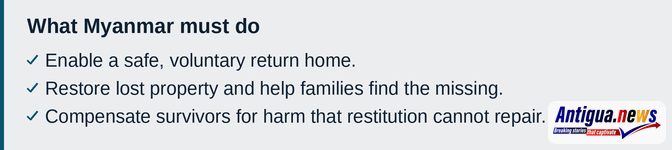
Read closely, the judgment anticipates what a family might find on returning. Where property can be restored, Myanmar must restore it. Where it has been destroyed, it must be replaced or compensation provided for what cannot be made good. The judges also ordered Myanmar to help locate missing relatives, identify those who died and allow families to bury them with dignity.
A harder question is who can get a family safely back to its village. Since fighting resumed in late 2023, the Arakan Army, an armed group fighting Myanmar’s military, has taken control of nearly all of Rakhine State. It holds the areas where most refugees would return. Even if the president were to accept every order tomorrow, the government that owes the Rohingya safe passage would still have to deal with the armed group that controls the ground.
Who can enforce the genocide judgment?
Antigua and Barbuda has experience of what a small country can gain in The Hague. Last year it welcomed the court’s advisory opinion on climate change. The Gambia has secured something legally different: a final judgment binding on Myanmar. If Myanmar fails to comply, Article 94 of the UN Charter allows The Gambia to take the matter to the Security Council. The council decides whether to act.
Individual governments can act sooner. On Monday, Britain announced sanctions on five senior Myanmar military officers and a further £5 million in humanitarian assistance for communities in Rakhine. It also asked for talks with other members of the Security Council.
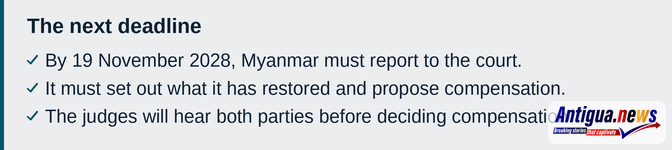
The judges kept one part of the case in their own hands. Within two years Myanmar must tell them what it has done to restore what was lost and how much it proposes to pay for the harm that remains. The Gambia will have a chance to respond before the court settles the terms. Any compensation is for the Rohingya themselves. November 2028 is a date for a report. The court has set no date on which a refugee can expect to cross the border.
In Cox’s Bazar, Sayed Ullah, a Rohingya community leader who listened to the verdict, told Reuters what the decision had changed for him that day.

This story was first published by Antigua News on : antigua.news/2026/11/26/myanmar-rohingya-genocide-ruling-gambia-right-to-return. © 2026 Antigua News. Republication without permission is not allowed.

About the author
Dr. Dario Item is the Head of Mission of the Embassy of Antigua and Barbuda in Madrid. He is an experienced financial crimes lawyer with nearly 30 years of practice. He holds degrees in law and political science, a Ph.D. in criminal law and an LL.M. in transnational financial crime.
Read our editorial standards and corrections policy. Spotted an error? Contact the newsroom.
More from World
View section
Spain Votes After an Eviction Shook Its Government
An elderly tenant’s eviction helped trigger the November 29 snap election. Pedro Sánchez is recovering in some polls, but the right still has the clearer route to a governing majority.
By Dario Item

Dozens of KFC Restaurants Closing Across 10 U.S. States as Major Franchise Operator Files for Bankruptcy
Financial troubles, falling sales and millions in unpaid franchise fees have forced a major KFC operator into bankruptcy, with 72 restaurant locations affected and more closures possible.
By Cory Wayland

Robert Pattinson is the new James Bond
The Twilight and The Batman star succeeds Daniel Craig as 007 in the next James Bond film, directed by Denis Villeneuve and written by Steven Knight.
By Mick the Ram

Microsoft Outage cripples millions globally
Outlook, Teams and Copilot users reported disruptions across 74 countries as Microsoft cited increased load on its infrastructure.
By Mick the Ram
Comments
Be the first to comment.