
Global temperatures stay more than 2°C above pre-industrial levels for a record week
The world was 2.25°C warmer on 23 November than the pre-industrial average for that date, the largest daily difference in the Copernicus record.


The world’s average surface air temperature has been more than 2°C above pre-industrial levels for seven days in a row for the first time on record, Europe’s Copernicus Climate Change Service has confirmed.
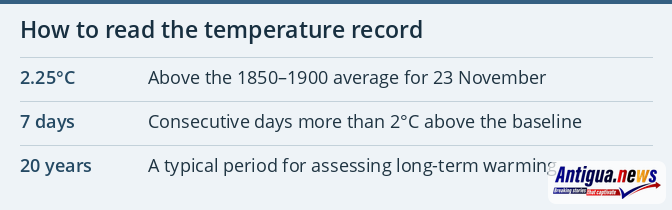
The biggest gap came on Monday, 23 November, when the planet was 2.25°C warmer than the estimated average for that date between 1850 and 1900. Ten days this month have already reached or exceeded the 2°C mark, Copernicus said on Thursday.
The first individual day above 2°C was recorded in November 2023. Samantha Burgess, head of strategic climate research at the European Centre for Medium-Range Weather Forecasts, described this month’s run of warm days as “a stark preview of where our climate is heading”, the Financial Times reported.
What does a week above 2°C mean?
July is usually the warmest month for the planet. But a day in November can set a record for the gap between the temperature measured and the temperature expected for that date. It is this gap that Copernicus tracks against a pre-industrial baseline.
Under the Paris Agreement, countries agreed to hold global warming to well below 2°C and pursue efforts to limit it to 1.5°C. Scientists typically use 20-year averages to assess when a warming level has been reached. Temperatures can cross either mark on individual days or even for a whole year before the long-term average reaches it.
This year a strong El Niño, the periodic warming of surface waters in the tropical Pacific, has added to the heat trapped by greenhouse gases from human activities. Earlier this month, Copernicus said 2026 was virtually certain to become the second calendar year above 1.5°C, after 2024. It also expected the average for the four years from 2023 to 2026 to exceed that mark.
What is at stake for Antigua and Barbuda?
The figures come days after countries failed to adopt the proposed Antalya Pact at COP31. Antigua and Barbuda’s environment minister, Michael Joseph, had called for simpler access to grants to help small islands prepare for a warmer climate.
One example is the cost of keeping farms supplied with water. In Antigua and Barbuda, the Adaptation Fund approved US$250,000 in 2020 to test whether renewable energy could help farmers secure a more reliable supply for their crops.
This story was first published by Antigua News on : antigua.news/2026/11/27/global-temperatures-2c-pre-industrial-seven-days-copernicus. © 2026 Antigua News. Republication without permission is not allowed.

About the author
Michael Williams is a journalist with over a decade of experience in news reporting. At Antigua.news, he covers international affairs, with a particular focus on major global news events, geopolitical developments and the evolving dynamics of international relations.
Read our editorial standards and corrections policy. Spotted an error? Contact the newsroom.
More from World
View section
North Korea orders Swiss office to close over sanctions on children’s camp
Switzerland says it will keep talking to Pyongyang from Beijing after a dispute over a camp accused of receiving children from occupied Ukraine.
By Michael Williams

Erin Patterson seeks High Court appeal over Australia’s mushroom murders
Jurors stayed at the same motel as a police investigator and prosecution lawyers. Patterson says the arrangements undermined her trial.
By Michael Williams

Myanmar Says It Will Defy Parts of the Rohingya Genocide Ruling
The Gambia won an order for the safe return of Rohingya refugees. Myanmar’s president says he will choose which measures to accept, and an armed group controls most of the land they fled.
By Dario Item

Spain Votes After an Eviction Shook Its Government
An elderly tenant’s eviction helped trigger the November 29 snap election. Pedro Sánchez is recovering in some polls, but the right still has the clearer route to a governing majority.
By Dario Item
Comments
Be the first to comment.