
Argentina Loses Bid to Block New Oil Drilling off the Falklands
Britain gave March 2027 as the earliest date for drilling at Sea Lion. Argentina’s case cited a declaration backed by Antigua and Barbuda.

By Dario Item

The International Tribunal for the Law of the Sea on Saturday rejected Argentina’s request to order Britain to prevent new drilling and the installation of production equipment at Sea Lion, an oil field about 220 kilometres north of the Falkland Islands. The judges voted 18 to 3 against a temporary halt while the dispute goes to arbitration.
Argentina, which calls the islands the Malvinas, argued that the oil could stay in the seabed while sovereignty remained in dispute. The majority found that deciding who held rights to the seabed would first require the arbitrators to settle who owned the islands. The provisions of the law of the sea that Argentina invoked gave the arbitrators no apparent authority to settle that question.
Britain’s foreign secretary, Ed Miliband, and its attorney general, Ellie Reeves, welcomed the decision on Saturday and urged Argentina to end its economic pressure on the islands. Argentina’s foreign minister, Pablo Quirno, had said on Friday that his government would continue to pursue sanctions against suppliers. “Our strategy neither begins nor ends in Hamburg,” he told the Argentine broadcaster A24.
Antigua and Barbuda appears in a footnote to Argentina’s filing. To show the judges that its claim to the seabed had international support, Buenos Aires cited a declaration adopted in Bogotá in March by the Community of Latin American and Caribbean States. The declaration backed Argentina’s rights in the sovereignty dispute and called for fresh talks with Britain.
What can happen before drilling begins
The order records three assurances Britain gave in court. Development drilling would begin no earlier than March 21, 2027. Oil would not be extracted before March 2028. No new licences would be issued while the licensing regime remained suspended.
At the hearings, Argentina’s lawyers drew a distinction between the wells that had established the presence of oil and the ones the companies now wanted to drill. The new wells would feed a vessel that could process and store the oil. By the time an arbitral panel ruled, counsel for Argentina argued, the seabed would already have been altered.

The majority found no preliminary basis in the provisions Argentina cited for the arbitrators to hear its claims. The judges therefore did not examine urgency. Two dissenters, Hidehisa Horinouchi and Raúl Vinuesa, objected that this left the risk of environmental harm unexamined.
One point of contention was how to contain a spill far from shore. Argentina’s lawyers pointed to the difficulty of deploying cleanup equipment in rough seas. In a separate dissent, Judge Bimal Patel considered a major accident unlikely on the British evidence. The damage could still reach waters beyond the field, he wrote. He would have required both countries to exchange environmental assessments and coordinate their spill response before drilling began. They could do both, he reasoned, while reserving their claims to the islands.
There may be time for the arbitrators to act before the first well is drilled. Britain told the judges it expected the arbitration panel to be in place by the end of December or, at the latest, in January. Argentina said it was ready to move quickly. Once constituted, the panel could consider a request for interim protection from either country. It will decide for itself whether it has jurisdiction.
In a separate case in September, an association of environmental lawyers and a group of Argentine veterans of the 1982 war obtained an injunction from a federal judge in Río Grande. Judge Mariel Borruto ordered the operator, Navitas Petroleum, and its partner, Rockhopper Exploration, to suspend work pending an Argentine environmental review. In Hamburg, the Argentine government sought an order against Britain itself.
Who gets the royalties?
For the government in Stanley, Sea Lion promises a 9 per cent royalty on oil production. Its approval of the first two phases of the field’s northern development took effect in December 2025. Navitas and Rockhopper committed to the first. Rockhopper put the funding needed to bring the first oil to market at US$1.8 billion. Under the islands’ legislation, new oil and gas licences require a British minister’s consent.
In court, Argentina pointed to politicians’ statements suggesting that Britain might share in the proceeds. The British delegation told the tribunal there was no revenue-sharing agreement with London and that the islands had kept the money collected so far.
Buenos Aires has leverage over companies that work on either side of the South Atlantic. Quirno told A24 that Argentina was pursuing sanctions against more than 60 businesses, including suppliers. Contractors, he said, had to weigh the value of a job at Sea Lion against access to the much larger Argentine energy market. Two contractors told Navitas that the threat of Argentine sanctions had prompted them to pull out. Rockhopper said on November 20 that Navitas was arranging replacements and expected no significant delay.
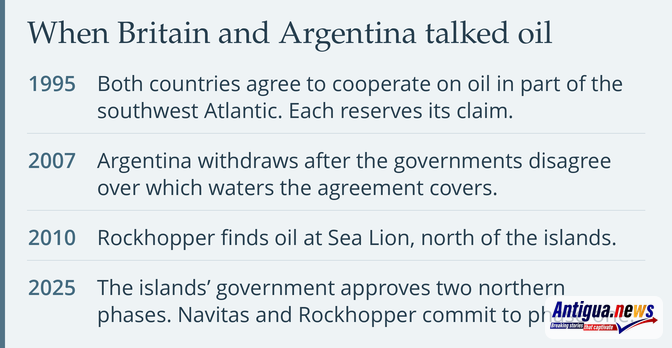
Oil was once a subject on which the two governments could agree. In 1995 they undertook to cooperate on oil in part of the southwest Atlantic while preserving their competing claims. They fell out over which waters the arrangement covered. In 2007, Argentina withdrew. Three years later, Rockhopper found oil at Sea Lion.
Where the Caribbean stands
At a summit in Buenos Aires in 2023, Foreign Minister E. P. Chet Greene backed Argentina’s rights in the sovereignty dispute and urged talks. In June, Antigua and Barbuda’s delegate at the United Nations described the country as a friend of both sides. Fisheries management and scientific research, the delegate suggested, offered the two governments a place to start.
Saturday’s ruling came 36 years to the day after Britain and Argentina agreed to set up the South Atlantic Fisheries Commission. They would share information on catches and assess fish stocks together. The agreement expressly preserved each government’s position on sovereignty.
Antigua’s neighbours heard a different argument this week. The premiers of Montserrat and the British Virgin Islands met in London with British ministers and the chair of the Falklands legislature. In a communiqué released on Friday, Britain and the overseas territories affirmed the right of the territories’ peoples to self-determination. Britain singled out Argentina’s economic pressure on the Falklands as a threat.
The islanders’ vote and Argentina’s claim
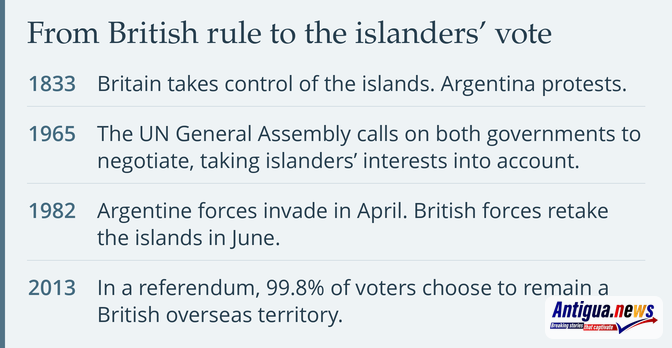
Argentina traces its claim to territory inherited from Spain at independence. Britain dates its claim to 1765. A 1965 UN resolution called for talks that took the islanders’ interests into account. For London, their wishes carry decisive weight. In 2013, 99.8 per cent of votes cast favoured remaining a British overseas territory. Buenos Aires maintains that a local vote cannot settle a question of Argentina’s territorial integrity.
When Dorothy Gould, a Falkland Islands legislator, addressed the UN decolonization committee in June, she invited delegates to visit the islands and meet the people whose future they were discussing. Gould was seven when Argentine troops invaded in 1982.

Paula Vernet, an Argentine petitioner, recalled what her family had taken to the islands in the early nineteenth century. Her ancestor Luis Vernet, appointed a commander there by Buenos Aires in 1829, had gone with his children, a piano and even the houseplants. Her father had come to the UN to tell the family’s story, she said. If the dispute was still open, her children would come too.
This story was first published by Antigua News on : antigua.news/2026/11/28/falklands-oil-drilling-sea-lion-argentina-tribunal-ruling. © 2026 Antigua News. Republication without permission is not allowed.

About the author
Dr. Dario Item is the Head of Mission of the Embassy of Antigua and Barbuda in Madrid. He is an experienced financial crimes lawyer with nearly 30 years of practice. He holds degrees in law and political science, a Ph.D. in criminal law and an LL.M. in transnational financial crime. He is involved in the Credit Suisse AT1 case and represents investors affected by the write-down of the bonds.
Read our editorial standards and corrections policy. Spotted an error? Contact the newsroom.
More from World
View section
WWE Superstar Bronson Reed Dies at 38 Following Medical Complications
World Wrestling Entertainment has confirmed the death of Australian wrestler Bronson Reed, weeks after he reportedly suffered serious injuries during a WWE event in Saudi Arabia.
By Cory Wayland

Uganda opens Bundibugyo Ebola vaccine trial to children as young as one
Researchers aim to enrol 224 children and adults in Africa’s first trial of an mRNA vaccine against the virus behind the outbreak in DR Congo.
By Michael Williams

North Korea orders Swiss office to close over sanctions on children’s camp
Switzerland says it will keep talking to Pyongyang from Beijing after a dispute over a camp accused of receiving children from occupied Ukraine.
By Michael Williams

Global temperatures stay more than 2°C above pre-industrial levels for a record week
The world was 2.25°C warmer on 23 November than the pre-industrial average for that date, the largest daily difference in the Copernicus record.
By Michael Williams
Comments
Be the first to comment.