
Who had the power to wipe out AT1 bonds at Yes Bank and Credit Suisse?
Yes Bank’s bondholders won in India’s Supreme Court. Collecting six years of coupons is a separate fight. For Credit Suisse investors, even the question of reinstatement remains open.

By Dario Item

The first city in the Indian Supreme Court’s judgment on Yes Bank is Basel. Justice Dipankar Datta takes the reader to the Rhine and the Bank for International Settlements before turning to a Saturday in Mumbai in March 2020. By then Yes Bank had almost exhausted its best-quality capital. Its administrator signed away ₹84.15bn of bank bonds. The bank’s creditors owed much of their eventual victory to the date on his order.
Three years later, on the Sunday UBS agreed to buy Credit Suisse, the Swiss bank was trying to prevent much the same thing happening to its bondholders. At 4.24pm it emailed its regulator to object. The rescue under discussion would supply liquidity, it said. Wiping out its bonds would do little to get cash out to customers who wanted their money back. At 10.01pm the regulator sent its order. Some SFr16.5bn of bonds were to go.
On October 15 India’s Supreme Court dismissed appeals by Yes Bank, the central bank and the government, upholding the Bombay High Court’s January 2023 decision to set the write-down aside. All three have since asked the Supreme Court to reconsider. The Swiss appeals are still outstanding. Investors who bought additional tier one bonds in either country accepted that they could lose their principal to keep a bank in business. What they agreed about who could impose that loss, and when, varied considerably. Those differences also determine what a court victory puts back in an investor’s account.
The Yes Bank clause that disappeared
Yes Bank’s common equity tier one ratio, a measure of its core capital against risk-weighted assets, had fallen to 0.6 per cent by the end of 2019. The threshold in the bond documents was 6.125 per cent. The bank could have acted on that breach. It chose to try to raise capital instead. By March 5 the government had imposed a moratorium and the Reserve Bank of India had put Prashant Kumar in charge in place of the board.
On March 6, the central bank published a draft rescue plan that would extinguish the affected bonds outright. Holders representing roughly three-quarters of the debt were prepared to take shares. The central bank incorporated that proposal into a revised draft. Yet the plan published in the Gazette of India on March 13 contained neither provision. The following day Kumar ordered the two bond issues written down to zero.
The Supreme Court accepted that the decision to reconstruct Yes Bank had triggered what the bond documents called the point of non-viability. At that stage the power to decide on a write-down belonged to the central bank. Kumar could exercise the powers of Yes Bank’s directors. His appointment by the regulator did not entitle him to decide for it. There was also the matter of one word in the rules. A write-down had to take place before reconstruction. The plan had already come into force when Kumar signed.

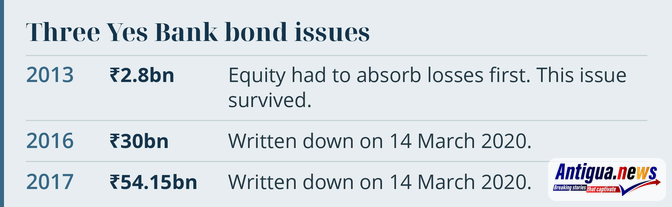
A third Yes Bank bond survived the rescue. The paperwork put before the Indian cabinet identifies a ₹2.8bn issue from 2013 whose terms required ordinary equity to absorb losses first. The authorities excluded it from the write-down. Buyers of the 2016 and 2017 issues had no such protection. The old shareholders kept diluted stakes, generally subject to a three-year lock-up on 75 per cent of their shares. The bondholders who won in court did so on other terms of their contracts.
What Switzerland added on the Sunday
In New Delhi the government dropped the write-down clause before it approved the rescue. In Bern the Federal Council added one. Article 5a of its emergency ordinance gave FINMA, the Swiss financial regulator, express authority to order a write-down of additional tier one capital. The amendment took effect at 8pm on March 19, 2023, between Credit Suisse’s protest and FINMA’s order. Under the merger terms, UBS offered one of its shares for every 22.48 Credit Suisse shares, worth about SFr3bn in total at the announcement.
FINMA’s explanation was that the bank had received extraordinary public support in the form of liquidity loans backed by a federal guarantee. The bond terms examined by the court also specified what that support had to achieve. It had to improve Credit Suisse’s capital adequacy, or be about to do so. A central bank loan can put cash in the till by Monday morning. The borrowing bank also books a liability. The loan itself adds no equity.

Credit Suisse made a further point in its email to FINMA. The price UBS was offering, the bank wrote, did not reflect the equity that cancelling the debt would create. In the seller’s view, that benefit would accrue to the buyer’s shareholders. It was an objection recorded while the terms of the takeover were still being settled.
Switzerland’s Federal Administrative Court set aside FINMA’s order on October 1, 2025. It found that Credit Suisse still met its capital requirements and that the public assistance provided liquidity. The contractual trigger had therefore not been reached. The court also examined whether the state could extinguish investors’ property independently of the contract. In its partial ruling, it found the statutory provisions insufficient and Article 5a unconstitutional. It left the request to restore the bonds for a later decision.
What Yes Bank bondholders get back
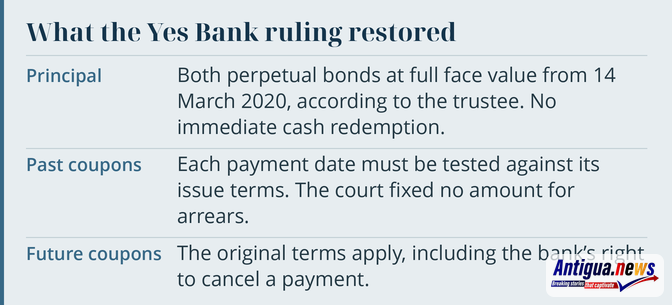
The Indian judgment runs to 35 pages. For the investor looking at an empty securities account, the operative passages are paragraphs 80 and 81. The first dismisses the appeals and lifts the interim order that had kept the Bombay judgment on hold. Axis Trustee, which acts for the holders, says the legal consequence is that both issues stand restored at their full original face value with effect from March 14, 2020, on the terms in force immediately before the write-down.
It still takes an instruction from Yes Bank to reactivate the securities identifiers and credit the accounts of the holders who owned the bonds at the time, or their successors. Axis filed a contempt petition on November 6 to obtain those steps. Yes Bank denies wilful disobedience. By November 28 the trustee had reported no recredit, and there was no public order granting the stay sought by the central bank. Even after recredit, a holder who wants cash can sell at the market price once trading resumes. The bonds are perpetual. Holders cannot demand their face value on the strength of the judgment. The bank may call the bonds with the regulator’s prior approval.
Paragraph 81 deals with income. Yes Bank must pay whatever falls due under the respective issue documents. Both sets of terms allow the bank to cancel a coupon in whole or in part. The coupons are non-cumulative: a validly cancelled payment drops out for good. That leaves a live question about the years when the bank treated the two issues as extinct. An empty account statement proves that the holder received nothing. It does not establish that the bank validly cancelled that year’s coupon.
For the 9.5 per cent issue, the trustee identifies six December payment dates from 2020 through 2025. For the 9 per cent issue there are seven October dates from 2020 through 2026. Each calls for its own examination of the applicable terms, distributable funds and any cancellation. The court fixed no sum for arrears or interest on late payment. The same terms govern future income. The 2026 October coupon fell on Sunday the 18th, with payment scheduled for Monday the 19th, four days after the judgment. On October 24 the bank said it was still considering its options. It announced no cancellation in that filing. The next scheduled coupon on the 9.5 per cent issue is December 23.
The Reserve Bank of India’s review petition, seen by Reuters, argues that reversing the write-down could weaken future rescues. Yes Bank has put a figure on the effect. Using its June 30 balance sheet, it estimated that reinstating the principal would cut its common equity tier one ratio by about 2.5 percentage points. Its total tier one ratio, which includes AT1, would stay at 14 per cent.
If the Swiss Federal Supreme Court upholds the ruling
The investors in the Swiss lead case made two requests in a single sentence. They asked the Federal Administrative Court to annul FINMA’s decree and to require the regulator to instruct the issuer to undo the write-down of their 4.5 per cent notes and put them in the position they would have occupied without it. The operative order expressly grants the first half of that sentence. The Federal Supreme Court gave both appeals suspensive effect in December 2025. It had published no decision on the merits as of November 28, 2026.
What would change if the Federal Supreme Court upheld that decision? FINMA’s order of March 19, 2023 would be definitively annulled. Credit Suisse, however, had already carried it out. The lower court addressed this very point in paragraph 3.9.3: setting aside the regulator’s order would not, by itself, reverse the write-down the bank had made. The judges left the investors’ request to undo it for a further decision.
The relief those investors seek is to have their notes treated as outstanding from March 2023. If they obtain it on those terms, they would recover a perpetual security at its original face value. That face value is the principal of the bond. It would become payable in cash only as provided in the issue terms. For past coupons, the question at each payment date would be what the issuer owed on the assumption that the notes were still outstanding. Future coupons would likewise fall due subject to the terms of the restored issue. The partial ruling awards no sum under any of these headings.
That is where the two cases stand apart. In India, the trustee’s position is that the bonds already stand restored in law. It is pressing Yes Bank to put them back in investors’ accounts. In Switzerland, even after a successful defence of the partial ruling on appeal, the holders would still be waiting for a decision on restoration itself.
This story was first published by Antigua News on : antigua.news/2026/11/28/yes-bank-credit-suisse-at1-bond-write-offs. © 2026 Antigua News. Republication without permission is not allowed.

About the author
Dr. Dario Item is the Head of Mission of the Embassy of Antigua and Barbuda in Madrid. He is an experienced financial crimes lawyer with nearly 30 years of practice. He holds degrees in law and political science, a Ph.D. in criminal law and an LL.M. in transnational financial crime. He is involved in the Credit Suisse AT1 case and represents investors affected by the write-down of the bonds.
Read our editorial standards and corrections policy. Spotted an error? Contact the newsroom.
More from Credit Suisse AT1 Case
View section
Credit Suisse AT1 wipeout: the price of UBS’s ‘yes’
UBS demanded protection. Bern resisted an unlimited guarantee. The cancellation of SFr16.5bn in bonds was part of the agreement that followed — despite Credit Suisse’s warning that the contractual conditions had not been met.
By Dario Item

Was Credit Suisse worthless? What UBS knew before the deal
Swiss rescue records challenge the claim that any price above zero was fair. Misleading statements before the collapse could also expose UBS to new investor claims in Switzerland.
By Dario Item
Comments
Be the first to comment.